Welcome to the final lesson of our first module. Over the past few lessons, you've built a solid foundation for looking at art. You started by learning the language of visual elements and composition—the "what"—and then explored the various materials and techniques artists use—the "how." You now have the skills to describe an artwork's appearance and construction with confidence.
In this lesson, we add the third and most transformative layer to our analysis: context. No work of art exists in a vacuum. Each is a product of a specific time, place, and culture, created by an individual with their own beliefs and motivations. To truly understand an artwork, we must look beyond the canvas or stone and investigate the world that produced it. Our goal is to explain how historical and cultural context can radically change the interpretation of a work of art. This will complete your foundational toolkit, enabling you to move beyond simply seeing art to truly understanding it.
The Power of Context
Every artwork tells a story, but that story can change dramatically depending on who is telling it and why. A piece of art is not just an object; it's a historical document, a cultural artifact, and a personal statement all at once. To begin, let's watch a short video that uses a fascinating example to illustrate just how crucial context is.
Why We Study Art: Crash Course Art History #1
This introductory video from the Crash Course Art History series, "Why We Study Art," immediately dives into the importance of perspective and context in interpreting art.
Watch the first two minutes. Pay close attention to the example of the Mexican biombo screen at the beginning, which shows how the same historical event can be depicted in vastly different ways. Then, continue through the explanation of what art history is—not just memorization, but a critical tool for understanding people, places, and ideas.
As the video argues, art history is about thinking critically and observing closely. The "context" of a work of art refers to all the circumstances surrounding its creation—the historical events, social structures, political climate, religious beliefs, and personal life of the artist. Understanding these factors is the key to unlocking the deeper meanings embedded in the work.
Let's get a more formal definition and framework for this idea.
5. Meaning in Art | Introduction to Art: Design, Context, and Meaning | OpenALG
This chapter from the textbook Introduction to Art: Design, Context, and Meaning provides a clear definition of context and its role in interpretation.
Read the introduction to the chapter. It lays out the fundamental idea that interpreting art is a mental process that combines visual evidence with contextual information.
Now that we have a definition, how do we apply it? Art historians break down contextual analysis into several categories. The video below gives a practical overview of how to approach this.
How to Analyze Art | Visual and Contextual Analysis
This video, "How to Analyze Art" by Art History with Alder, offers a clear guide to performing both visual and contextual analysis. We will focus on the contextual part.
Watch the section on contextual analysis. The presenter breaks it down into two key questions: Function: What was the purpose of the piece? This segment explores the "why" behind the art—was it for worship, political propaganda, personal expression, or something else? Context: What was the historical environment? This part explains how to use clues like the date, the artist, and the culture to understand the world in which the art was made.
Case Studies: How Context Changes Everything
Let's put this into practice with two famous but very different paintings. We'll look at each one first without context, and then see how adding context transforms its meaning.
Case Study 1: Political Context and Civic Virtue
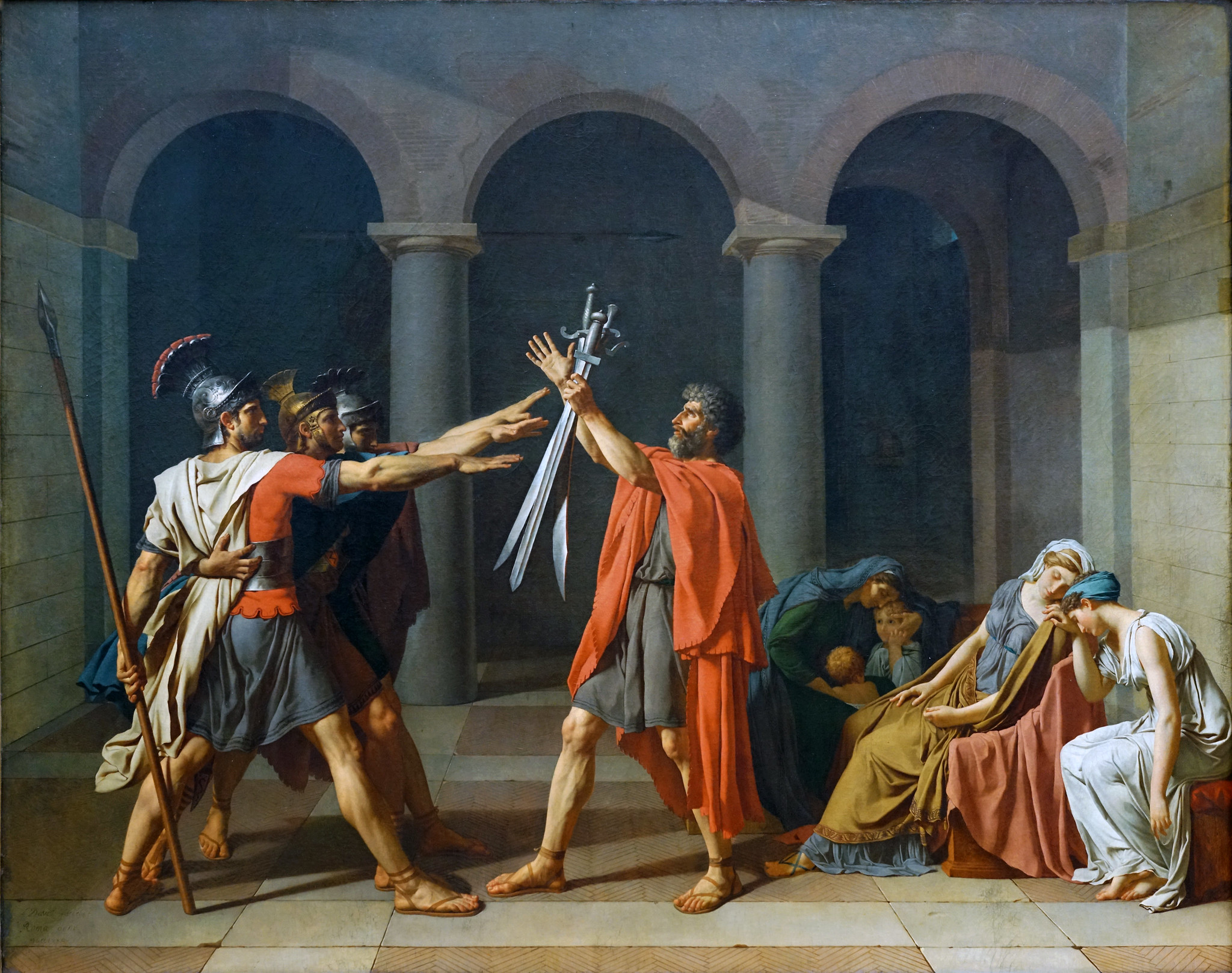
At first glance, this is a dramatic, stage-like scene. Using the formal analysis skills you've developed, you can see the stark, rigid lines of the male figures on the left contrasted with the soft, curving forms of the grieving women on the right. The composition is severe and balanced, with the three arches in the background framing each group. The central figure, the father, holds three swords aloft as his sons pledge an oath with muscular, outstretched arms. The lighting is harsh, highlighting the tension of the moment.
So, what's going on? Without context, it's a powerful but mysterious scene from ancient history.
Now, let's add the context:
- The Story: The painting depicts a Roman legend about a war between Rome and the rival city of Alba Longa. To settle the conflict without a full-scale war, each side chose three brothers to fight to the death. The painting shows the Roman Horatii brothers swearing an oath to their father to fight for their city, even though their wives and sisters (one of whom is engaged to an enemy champion) will suffer regardless of the outcome.
- The Time: The artist, Jacques-Louis David, painted this in 1784, just five years before the outbreak of the French Revolution. Paris was a hotbed of Enlightenment ideas, which promoted reason, order, and civic virtue. There was a growing sense that loyalty to the state and its principles should outweigh personal or family loyalties.
- The Message: When exhibited in Paris, the painting was a sensation. It wasn't just a scene from Roman history; it was seen as a powerful political statement. The Horatii brothers became symbols of republican virtue and self-sacrifice for the greater good. The painting's clear, rational composition and its message of patriotic duty resonated deeply with the revolutionary spirit of the time.
With context, the Oath of the Horatii transforms from a historical illustration into a revolutionary call to action.
Case Study 2: Cultural Context and Inner Worlds

This painting is immediately striking for its stylistic strangeness. The ground is a brilliant, flat red. A thick tree trunk slices diagonally across the canvas, separating the viewer from the action. In the foreground, a group of women in traditional Breton bonnets pray. In the background, on the red field, two figures—one with wings—are wrestling. This scene clearly isn't a realistic depiction of the world. Why would an artist paint this way?
Now, let's add the context:
- The Artist: Paul Gauguin was a French artist who grew tired of the industrialization and materialism of Paris. He sought out places he considered more "primitive" and spiritual. In 1888, he was living in the rural, deeply Catholic region of Brittany in northwestern France.
- The Influence: Gauguin was heavily influenced by Japanese woodblock prints, which were newly popular in Paris. From them, he adopted the use of flat areas of color, strong outlines, and unusual compositional angles (like the diagonal tree trunk).
- The Subject: The painting doesn't depict a physical event. It depicts a vision. The women, having just heard a sermon about Jacob wrestling with the angel, are collectively imagining the biblical scene unfolding before them. Gauguin is not trying to paint the world as it looks, but as it is experienced through faith and imagination. The unnatural red ground signifies that this is a mental, not a physical, space.
With context, the painting is no longer just a "weird" picture. It becomes a pioneering attempt to represent an internal, psychological reality—a key goal that would drive much of modern art in the decades to follow.
The Ever-Changing Meaning of Symbols
Context is especially critical for understanding symbols. A simple shape can have vastly different—even opposite—meanings depending on the culture and historical moment. The following reading provides a powerful example of this.
5. Meaning in Art | Introduction to Art: Design, Context, and Meaning | OpenALG
This section of the textbook explores how the meaning of symbols is not fixed, but changes across time and culture.
Read the section titled Changes in Meaning. Pay special attention to the discussion of the cross and, most importantly, the swastika. Note how a symbol with a long history of positive associations in many cultures was radically redefined in the 20th century.
This example powerfully demonstrates that meaning is not inherent in an image itself, but is assigned to it by people within a specific context. This is perhaps the single most important lesson in art history.
Conclusion
This lesson marks the end of our introductory module. You have now assembled a complete three-part toolkit for analyzing art, one that addresses your goal of understanding the "why" behind what you see. You can now approach any artwork by asking:
- Formal Analysis: What does it look like? (Elements, composition)
- Medium Analysis: How was it made? (Materials, techniques)
- Contextual Analysis: Why was it made and what does it mean? (History, culture, purpose)
Here are the key takeaways from today's lesson:
- Art is never created in a vacuum; it is always a product of its context.
- To interpret a work, we must investigate the historical, social, political, and cultural forces that shaped it.
- Context can completely transform an artwork's meaning, turning a historical scene into a political manifesto, or an unrealistic landscape into a map of the mind.
- Symbols are not universal. Their meaning is determined by culture and can change drastically over time.
You are now fully equipped to begin our chronological journey through the history of art. With this analytical framework in hand, you'll be able to do more than just recognize famous works; you'll be able to understand them on a much deeper level.
In our next module, we travel back in time to the dawn of civilization. We'll begin in the river valleys of Mesopotamia and Egypt, applying your new skills to understand how the world's first great empires used art to express power, order their universe, and prepare for eternity.