Hello! Following our exploration of data ingestion pipelines, we now turn to the critical question of where to store and manage this data for analysis and machine learning. How we architect our central data repository has profound implications for cost, performance, governance, and—most importantly for us—the efficiency of our ML workflows.
In this lesson, we will compare the three dominant data platform architectures: the traditional data warehouse, the flexible data lake, and the modern data lakehouse. Understanding the evolution from one to the next and the specific trade-offs of each is essential for designing robust ML systems and a common topic in design interviews. You will learn not just what they are, but why they exist and which is best suited for various ML use cases.
The Two Poles: Data Warehouse and Data Lake
To understand the modern data platform, we must first look at the two foundational architectures that preceded it. They represent two different philosophies for handling data, each with distinct strengths and weaknesses.
A great way to build intuition is to see these concepts explained with a practical example. The following video walks through the entire process, from raw business transactions to analytics-ready data, clarifying key terms along the way.
Data Warehouse vs Data Lake vs Data Lakehouse | ETL, OLAP vs OLTP
This video from the codebasics channel provides an excellent, easy-to-understand explanation of the core concepts that differentiate data warehouses and the systems they draw from.
Please watch the first part of the video, from the beginning up to the end of the OLAP/OLTP discussion. Focus on: The distinction between OLTP (Online Transaction Processing) systems—the live databases that run the business—and OLAP (Online Analytical Processing) systems, which are built for analysis. The ETL (Extract, Transform, Load) process, which takes raw transactional data and prepares it for analytics. The reason for separating analytical workloads from transactional databases to avoid performance degradation and outages.
With that foundational context, let's formally define and compare the data warehouse and the data lake.
The Data Warehouse: A Citadel of Structured Data
The Data Warehouse (DW) is the classic solution for business intelligence (BI). Its primary purpose is to power analytics and reporting by providing high-performance query capabilities on highly structured and curated data.
- Data Type: Exclusively structured data.
- Schema: It employs a "schema-on-write" model. This means the data must be cleaned, transformed, and fitted into a predefined, rigid schema before it is loaded into the warehouse. This is the "T" (Transform) in the ETL process.
- Primary Use Case: Business Intelligence (BI), enterprise reporting, and OLAP.
- Strengths:
- High Performance: Optimized for fast SQL queries and BI dashboards.
- Data Quality & Consistency: The strict schema-on-write process ensures data is clean and reliable.
- ACID Compliance: Guarantees atomicity, consistency, isolation, and durability of transactions, which is crucial for financial and business reporting.
- Weaknesses for ML:
- Inflexibility: Cannot handle unstructured (text, images) or semi-structured (JSON, logs) data, which are vital for many modern ML models.
- Cost: Storage and compute are tightly coupled and often proprietary, making it expensive to store vast amounts of historical data.
- Data Silos: ML practitioners often need access to raw, untransformed data for feature engineering. The warehouse only contains the clean, transformed subset, forcing data science teams to build separate data pipelines, leading to data duplication and silos.
The Data Lake: A Reservoir of Raw Potential
The Data Lake (DL) emerged as a response to the limitations of the data warehouse, driven by the rise of "big data" and the need to store massive volumes of diverse data types cheaply.
- Data Type: All types—structured, semi-structured, and unstructured.
- Schema: It uses a "schema-on-read" model. You can load data in its raw, native format without preprocessing. The structure is defined only when the data is read for a specific analysis. This corresponds to an ELT (Extract, Load, Transform) process.
- Primary Use Case: Storing large volumes of raw data for data science, exploratory analysis, and ML model training.
- Strengths:
- Flexibility: Accommodates any data type.
- Cost-Effectiveness: Built on cheap object storage (like Amazon S3, Google Cloud Storage), decoupling storage from compute. You can store petabytes of data affordably.
- ML-Ready: Provides data scientists with access to the raw, granular data needed for advanced feature engineering.
- Weaknesses:
- The "Data Swamp": Without strong governance, a data lake can become a disorganized, undocumented, and untrustworthy repository of low-quality data.
- Poor Performance for BI: Querying raw files directly is much slower than querying a structured warehouse.
- Lack of Reliability: Lacks ACID transactions, making it difficult to handle concurrent data updates and leading to potential data corruption or inconsistency.
To solidify your understanding, the next video offers a concise, point-by-point comparison of these two architectures and introduces the third concept, the data lakehouse.
Data Lake vs. Data Warehouse vs. Data Lakehouse: Which One to Choose?
This video from IBM Technology clearly breaks down the six key differences between these architectures.
Watch the segments covering the first three differences (Purpose, Structure, Cost) and the final three differences (Performance, Flexibility, Scalability). This will give you a clear framework for comparison.
The Synthesis: The Data Lakehouse
The challenges of maintaining two separate systems—a data lake for ML and a data warehouse for BI—led to significant complexity, data duplication, and governance issues. The Data Lakehouse is a modern architecture designed to eliminate this dichotomy by combining the benefits of both.
The core idea is to implement data warehouse features (like ACID transactions, data versioning, and schema enforcement) directly on top of the low-cost, open storage of a data lake.
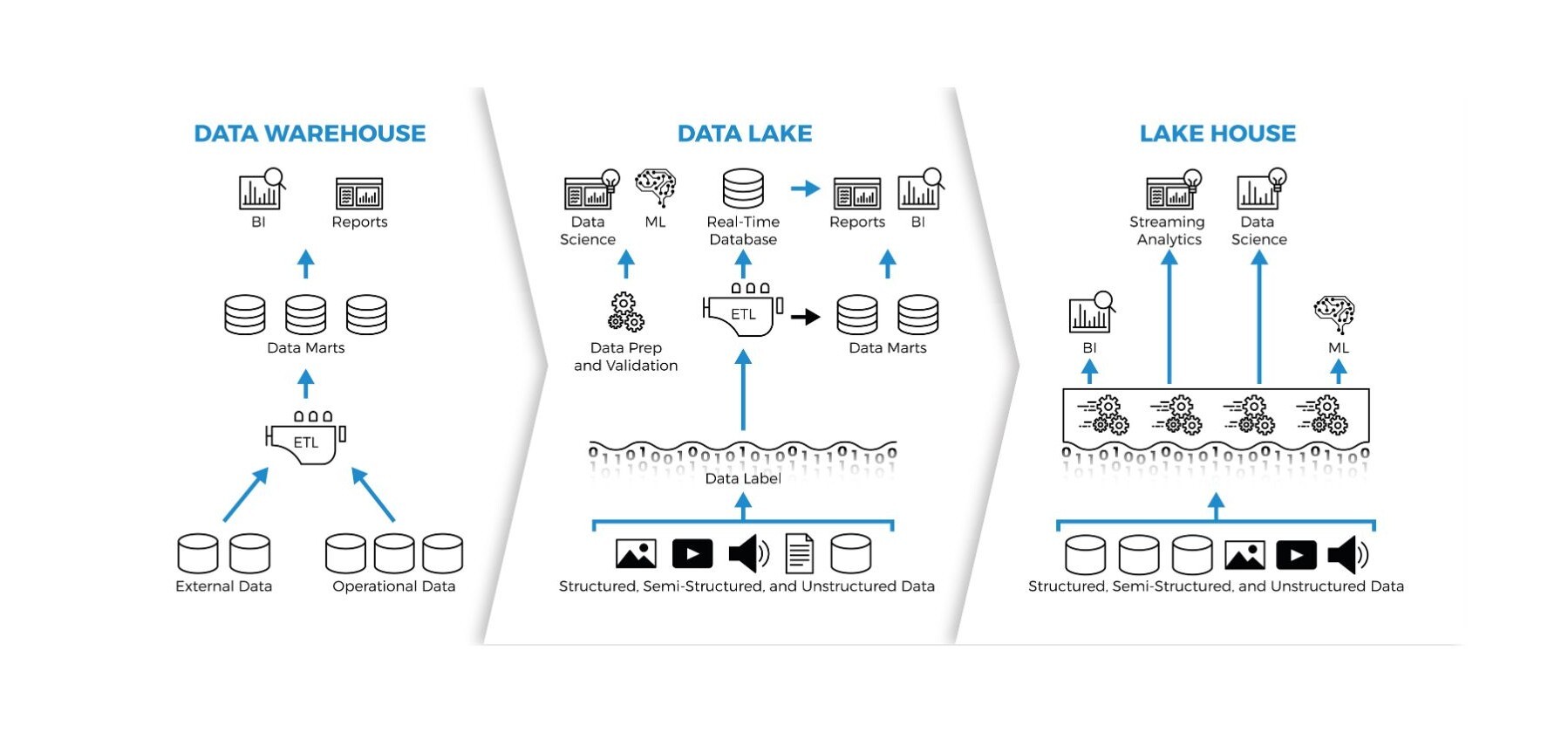
The key technology enabling the lakehouse is a new generation of open table formats, such as Apache Iceberg, Apache Hudi, and Delta Lake. These formats act as a metadata and transaction layer over files in your data lake (e.g., Parquet files on S3), making them behave like structured, reliable database tables.
The following article offers a superb analysis of why traditional architectures fall short for ML and how the lakehouse addresses these specific pain points.
Data Lakehouse for Machine Learning: Powering Scalable AI
This article from Athena Solutions is tailored to our focus on machine learning. It directly connects architectural features to ML workflow needs.
Please read the following sections: Start with Why Traditional Architectures Hinder Machine Learning Progress to understand the specific problems ML teams face with separate lakes and warehouses. Next, read How the Data Lakehouse for Machine Learning Changes the Game, which lists the core benefits. Finally, read Key Lakehouse Features Enabling Modern ML for a deeper dive into the specific capabilities like data versioning and ACID transactions that are so valuable.
Why the Lakehouse Excels for ML
As the article highlights, the lakehouse architecture provides a unified platform that is purpose-built for the entire data lifecycle, from BI to AI.

Here are the critical advantages for ML system design:
- Unified Data Source: Data scientists, analysts, and engineers all work from a single source of truth. This dramatically reduces data movement, eliminates silos, and simplifies governance.
- Reduced Training-Serving Skew: By using the same data platform for both batch training (feature engineering) and real-time serving (feature lookups), you minimize inconsistencies between the data your model was trained on and the data it sees in production.
- Reproducibility via Data Versioning: Table formats like Delta Lake and Iceberg support "time travel," allowing you to query the exact state of a table at a previous point in time. This is invaluable for reproducing experiments, debugging models, and auditing data lineage.
- Reliability for Feature Engineering: ACID transactions ensure that feature tables are always in a consistent state, even with concurrent batch and streaming updates. This is crucial for building reliable production feature pipelines.
- Scalability and Openness: It retains the core benefits of the data lake: cheap, infinitely scalable object storage and the flexibility to use various open-source compute engines (like Spark, Flink, and Trino).
A Framework for Comparison
To bring this all together for an interview setting, it's helpful to have a concise comparison table. The following reading provides an excellent summary chart and discusses the major vendor platforms in this space.
Building a modern data platform: Architecture and strategy
This article from Xenoss provides a detailed, multi-dimensional comparison that is perfect for structuring your thoughts in a system design discussion.
First, carefully study the main comparison table at the beginning of the article. This table contrasts the three architectures across 15 different dimensions, from primary purpose to common failure modes. Then, skim the section "Technology stack selection", focusing on the summary table comparing Databricks, Snowflake, and BigQuery. This gives you context on the major commercial players and their architectural philosophies.
Conclusion
In this lesson, we have charted the evolution of large-scale data storage architectures and evaluated them through the lens of machine learning system design. You are now equipped to articulate the strengths and weaknesses of each approach.
Key Takeaways:
- Data Warehouse: Optimized for BI on structured data. It's performant and reliable but inflexible and costly for raw, diverse data, making it a poor choice as the primary store for modern ML.
- Data Lake: Provides cheap, flexible, and scalable storage for all data types, which is essential for data science. However, it suffers from reliability issues and can devolve into a "data swamp."
- Data Lakehouse: The modern synthesis. It brings the reliability, performance, and governance of a data warehouse to the open, low-cost data lake. It is the preferred architecture for new systems that need to serve both BI and advanced ML/AI workloads from a single, unified source of truth.
- Enabling Technology: The magic of the lakehouse is enabled by open table formats (Delta Lake, Iceberg, Hudi) that provide a transactional metadata layer over raw files in object storage.
In our next lesson, we will address a problem that persists regardless of your chosen architecture: ensuring data quality. We will move on to designing data validation and quality monitoring strategies, a critical step in building trustworthy and robust ML pipelines.