Welcome to the final lesson in our module on the YouTube ecosystem. In our previous sessions, we've explored how YouTube recommends videos and delved deep into watch time and audience retention—the crucial signals that tell the algorithm a viewer is satisfied after they click. We established that holding a viewer's attention is paramount.
Now, we'll address the other half of that equation: getting the click in the first place. This lesson focuses on Click-Through Rate (CTR), the metric that measures the power of your video's first impression. By the end of our 60 minutes, you will be able to describe precisely how CTR combines with the metrics we've already discussed to influence whether YouTube's algorithm buries your video or promotes it to millions.
What is Click-Through Rate (CTR)?
At its core, Click-Through Rate is a simple but powerful metric. It answers the question: "Of all the people who saw my video's thumbnail on YouTube, what percentage clicked to watch it?"
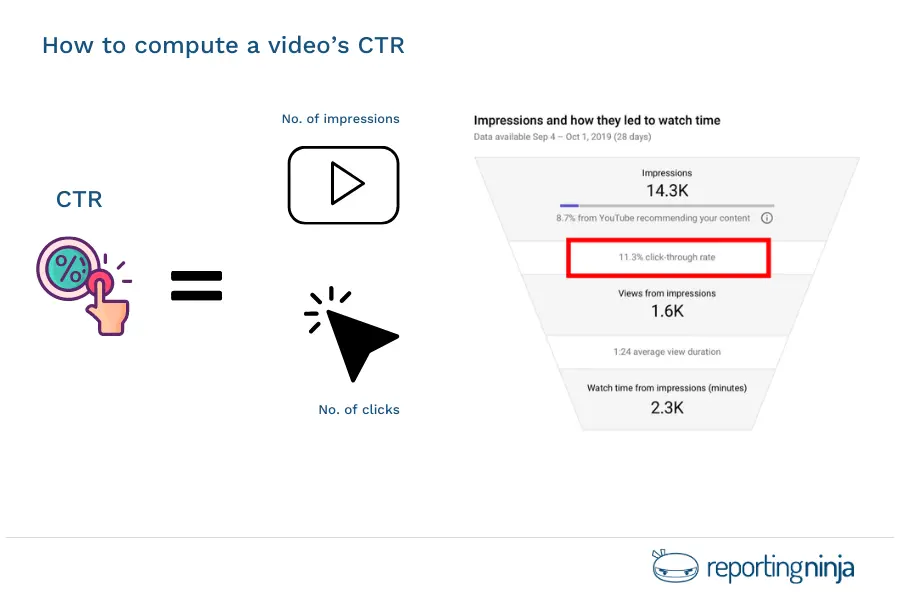
The calculation is straightforward:
An "impression" is counted when your video's thumbnail is shown to a user on YouTube (for example, on the homepage, in search results, or in the "Up Next" feed).
To get a feel for what these numbers mean in practice, it's helpful to have some general benchmarks.
What’s a Good CTR on YouTube? And How to Double Yours! - Mediacube
This article from Mediacube provides clear, industry-accepted benchmarks for CTR. As you read, focus on internalizing the different performance tiers.
Read the section titled "What is a Good Click-Through Rate on YouTube?" Pay attention to the numerical ranges provided for low, average, and high CTR.
As you just read, a CTR between 2% and 10% is a very wide but common range. A rate above 10% is generally considered excellent. However, as we'll soon see, this number is never the whole story.
CTR's Role: Earning the "Trial Click"
To understand CTR's influence, it's useful to think of YouTube's ranking system not as a simple checklist, but as a series of tests. Your job is to pass each test. The Taja.AI blog provides an excellent framework for this, dividing ranking factors into two groups:
- Input Factors: Your title, thumbnail, description, and tags. These are the elements you control to package your video and tell the algorithm what it's about.
- Performance Factors: How viewers react to your video. This is the feedback that tells the algorithm if your packaging was accurate and the content was satisfying.
CTR is the very first performance factor. It's the bridge between your inputs and the deeper performance metrics like retention.
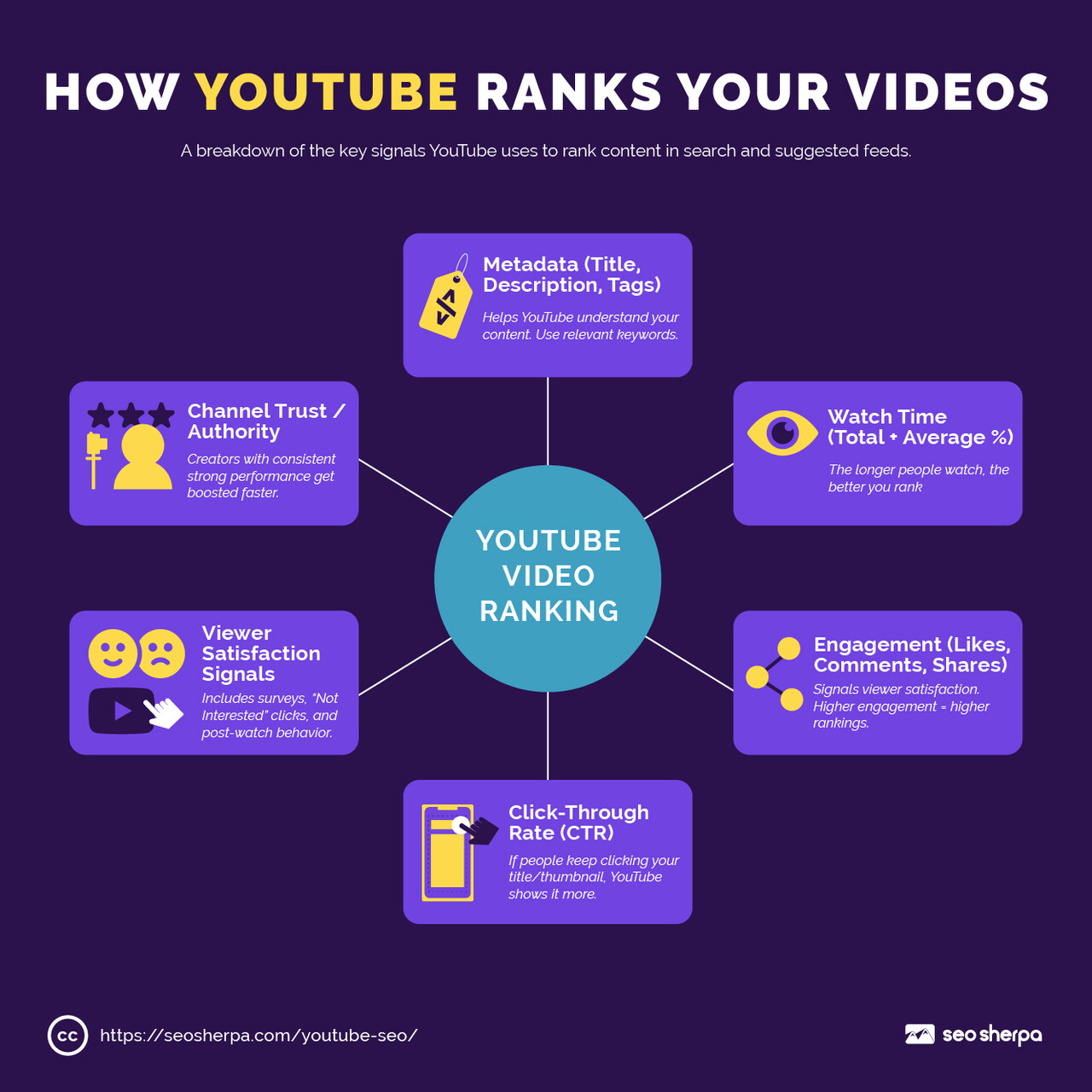
Let's explore this idea of CTR as the initial test.
Master YouTube Ranking Factors 2026 - Taja.AI
This article clearly explains the dynamic between your video's packaging and the audience's response.
Please read the section under the heading "Performance Factors Delivering on Your Promise". Focus on how the author describes CTR's specific job: to earn a "trial click."
The key takeaway is that your title and thumbnail (your inputs) have one job: to earn that click. A high CTR tells the algorithm that your packaging is effective at grabbing attention for a given topic. But this is only the first half of the test.
The Critical Partnership: CTR and Audience Retention
A high CTR can get your foot in the door, but it's what happens next that determines if you're invited to stay. The algorithm's primary goal is viewer satisfaction, which it measures through watch time. Therefore, CTR is always evaluated in partnership with audience retention.
Nick Nimmin, a respected YouTube educator, explains this relationship based on YouTube's own guidance.
YouTube Click Through Rate Explained
In this video, Nick Nimmin breaks down the official word from YouTube on how CTR is interpreted by the algorithm.
Watch the section from the beginning of his point on avoiding clickbait. He explains exactly how YouTube uses average view duration to validate a high CTR. Pay close attention to his explanation of how a mismatch between the thumbnail and the content creates a negative signal.
This leads us to the most important diagnostic pattern for any creator:
High CTR + Low Audience Retention = Clickbait
When viewers click in large numbers but leave almost immediately, it sends a powerful negative signal to YouTube. It indicates a broken promise—the content did not deliver on the expectation set by the title and thumbnail. The algorithm interprets this as a dissatisfying experience and will stop promoting the video.
The Mediacube article you reviewed earlier also emphasizes this point.
What’s a Good CTR on YouTube? And How to Double Yours! - Mediacube
Let's revisit the Mediacube article to reinforce this crucial concept.
Read the short section titled "Why a High CTR Isn’t Always Good." This summarizes the relationship between clicks and engagement.
Conversely, High CTR + High Audience Retention is the ultimate positive signal. It tells YouTube: "Not only was this video's packaging compelling, but the content also delivered on its promise and satisfied the viewer." This is the combination that triggers the algorithm to push your video to a much wider audience.
The Feedback Loop: How CTR Drives Promotion
So, what does this "wider promotion" look like, and how does it affect your CTR? It might seem counterintuitive, but a video that is performing exceptionally well will often see its CTR decrease over time.
This happens because of how YouTube tests your video with new audiences.
Exposing YouTube’s BIGGEST lie: Click Through Rate
This video from Dexxter Clark provides a fantastic visual explanation of the promotion feedback loop.
Watch from his explanation of the audience groups. He illustrates how YouTube first shows your video to your core audience. If it performs well (high CTR and retention), the algorithm "tests" it with a broader, less-targeted group of people.
Here is the process:
- Initial Test: YouTube shows your video to a small, highly relevant audience (like your subscribers and people who have watched similar content). With this group, you should expect a high CTR.
- Positive Signal: If this core audience clicks and watches (High CTR + High Retention), the algorithm gains confidence in your video.
- Expansion: It then promotes the video to a much larger, broader audience. These viewers may be less familiar with you or only casually interested in the topic.
- CTR Normalization: Because this new, broader audience is less targeted, they are naturally less likely to click. As a result, your video's overall CTR will begin to fall.
This decrease in CTR is not a sign of failure; it is a sign of success. It means your video passed the initial test and has been "graduated" to a wider audience, leading to a massive increase in impressions and, ultimately, more views. Your 15% CTR on 1,000 impressions might become a 5% CTR on 500,000 impressions. You've traded a higher rate for a much larger volume.
Conclusion
We have now completed our tour of the core mechanics of the YouTube algorithm. You understand that your video's success hinges on a two-part test: earning the click and holding the attention.
Key Takeaways:
- CTR is the First Test: Click-Through Rate measures the effectiveness of your title and thumbnail, determining if your video's "packaging" is compelling enough to earn a "trial click."
- CTR Works with Retention: A high CTR is only valuable when paired with strong audience retention. This combination signals high viewer satisfaction to the algorithm.
- High CTR + Low Retention is a Penalty: This pattern signals "clickbait" or a broken promise, causing the algorithm to stop promoting your video.
- Successful Promotion Lowers CTR: As YouTube promotes your video to a broader audience, your CTR will naturally decrease. This is a sign that you are reaching more people, not a sign of failure.
We have spent this first module understanding how the algorithm evaluates content. Now, we'll shift our focus to what content to create in the first place. A deep understanding of audience is the foundation for crafting videos that naturally excel on these metrics.
In the next lesson, we will begin Module 2, "Content Strategy and Niche Analysis," by defining a target audience persona for your tech and AI edutainment channel. This will be the first step in building a content strategy that is designed for success from the ground up.