A year-round calendar can give every student the same number of required school days while giving them different experiences of those days. In this module, the focus shifts from whether a calendar works on average to whether its benefits and burdens are shared fairly. This lesson examines two decisions in particular: who gets each track and who can actually use instruction offered during breaks. The next lesson will bring those findings into a district-level recommendation.
A calendar can be equal on paper and unequal in practice
On a multi-track calendar, different groups attend school and take breaks at different times. The calendar below makes that scheduling feature visible. It does not show whether one track has more experienced teachers, better services, or easier access to activities during breaks. Those require separate evidence.
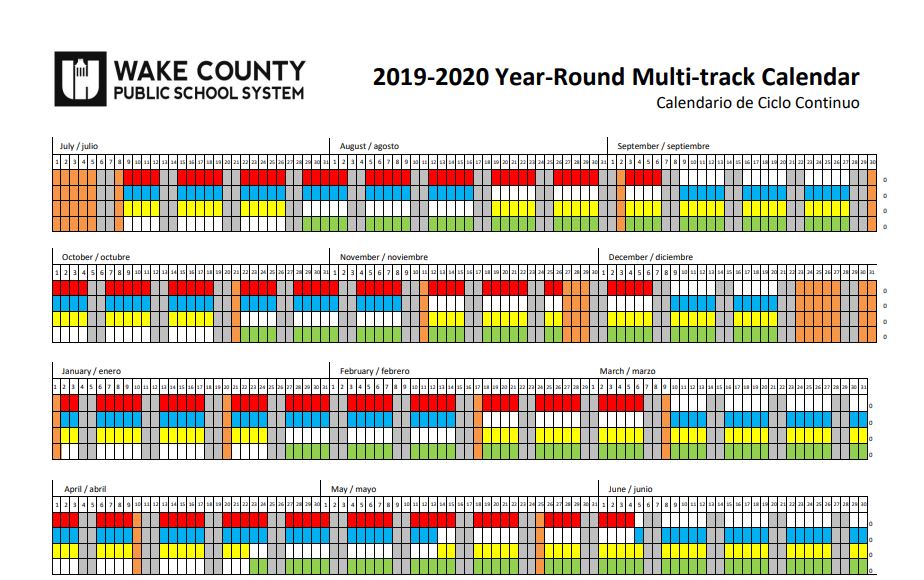
Suppose two students each receive 180 required instructional days. One is placed on a track that fits their household’s work and childcare arrangements; the other is placed on a track whose breaks repeatedly require new care arrangements. Equal day counts have not produced equal burdens. Similarly, equal track sizes do not guarantee equal instruction if qualified teachers or specialized services are concentrated on some tracks.
It helps to separate three tests of fairness:
- Assignment: Are track places allocated by clear, consistently applied rules that account for family needs without concentrating disadvantages?
- Provision: Does every track receive comparably strong required instruction and support?
- Usable access: When extra instruction is optional, can eligible students realistically attend it, not merely enroll in theory?
These tests can conflict. Keeping siblings on the same schedule may be essential for a family, while a track already in high demand has limited places. A fair policy must explain how it handles that constraint rather than promising everyone their first choice.
Fair track assignment requires more than a lottery
Read the California Department of Education’s Year-Round Education Program Guide as an example of an implementation guide, not a rule that automatically governs every district. Its track-assignment guidance combines family scheduling priorities with an aim to prevent segregation across tracks.
Year-Round Education Program Guide - School Facilities (CA Dept of Education)
Read the California Department of Education's guidance to see how track preferences, appeals, and specialized services complicate a seemingly simple assignment decision.
Under "Track Assignment Considerations" and its "General Axioms" subsection, read the assignment guidance. Follow the priorities for family schedules, the call for balanced tracks, the appeals process, and the practices the guide warns against. Then, under "Operational Strategies for Special Services," read the "Special Day Classes" and beginning of the "Resource Specialists" subsections, from service coverage. Notice the tension between concentrating a service for staffing reasons and making that service available across tracks.
A lottery can be fair among people with the same priority, but it does not decide what the priorities should be. A district might first try to keep siblings together, account for documented scheduling needs, and accommodate access to required services. It can then allocate remaining places using a published procedure. Families also need timely notice: an assignment announced too late can be difficult to accommodate even if the selection procedure itself was impartial.
The guide’s concern about balanced tracks addresses a different problem. If requests, exceptions, or assignment practices repeatedly place students with greater educational needs on one track, that track may become harder to staff and serve well. Conversely, moving students solely to make demographic totals look balanced can disregard genuine family constraints. Fairness is not achieved by one rule in isolation. A defensible policy states its priorities, explains how capacity limits are resolved, checks the resulting distribution of students and resources, and allows a timely appeal.
Track averages alone may conceal problems. A district should examine, by track, indicators such as access to experienced teachers, appropriate language and disability-related services, class sizes, and whether families received a requested schedule. It should also examine combinations: students who need a particular service may have nominal access to every track but, in practice, be offered only one workable assignment. An appeal process matters most when families can understand it and receive a decision early enough to act on it.
Optional instruction is an additional opportunity, not an automatic benefit
Break-time instruction—often called intersession—can offer tutoring, enrichment, or other support. If attendance is optional and adds days beyond the required calendar, it is not simply a redistribution of the same instructional time. That distinction matters when assessing fairness: students may share the same required calendar but receive different amounts of actual instruction.
Read the following review for two linked cautions. First, studies have identified disparities among tracks. Second, when intersession is part of a program, it can be difficult to tell whether any learning benefit came from the calendar, the extra instruction, or both.
Read this Community Guide systematic review to connect track-level equity concerns with the uncertainty about what calendar studies actually measure.
In "Effects on Inequities," begin in the paragraph opening "Two studies" and read the multi-track findings. Focus on the reported differences within and between schools, without treating those findings as a prediction for every calendar. In "Discussion," under "Summary of findings," read the latter part of "Single-track YRSCs," from intersession uncertainty. Then read "Multi-track YRSCs" from the evidence caution.
The review reports that some studies found students from lower-income households and some racial or language groups disproportionately assigned to tracks with less experienced teachers. That is a reason to inspect assignments and resources, not proof that every multi-track school produces the same outcome. The review also finds the evidence insufficient to determine whether multi-track calendars improve achievement overall; implementation details and results vary. An equity assessment should therefore avoid both easy claims: that the calendar necessarily harms students, or that a benefit from optional classes proves the schedule itself improves learning.
For optional instruction, the meaningful question is not just whether a program exists. Consider the successive hurdles between an offer and a useful experience:
- Eligibility and places: Who qualifies, who is notified, and are there enough seats for those who need them?
- Timing: Does the program run while each eligible student is on break, rather than while some are in regular classes?
- Practical attendance: Are transportation, meals where needed, accessibility, and family schedules addressed?
- Instructional quality: Are appropriately qualified staff and relevant supports available on each offered date?
A program can be free yet difficult to use if reaching it requires transport a household cannot arrange. It can be offered “to all tracks” yet have too few seats during one track’s break. And a student’s required educational services must not be treated as an optional intersession benefit that the family must secure independently.
Assessing a proposed plan
Consider a proposed school with three tracks of 100 students each. All three tracks have the same 180 required school days. Sixty students qualify for optional break-time tutoring, but 36 of them are assigned to Track C; 12 are on Track A and 12 on Track B. The initial plan runs tutoring only during Track A’s break, when the other tracks are in regular session. It charges no fee but offers no transportation.
The plan has two distinct equity problems. Assignment is uneven: Track C has 36 qualifying students per 100, compared with 12 per 100 on each other track. That difference warrants investigation of the assignment rules and the services each track receives; it does not, by itself, establish why the difference arose. Access is uneven: the proposed tutoring date fits Track A’s break, not the breaks of the other two tracks. Calling the program “available to eligible students” would obscure that mismatch. Lack of transportation could further reduce participation even among Track A students.
A stronger proposal would publish track priorities and capacity constraints, check resulting assignments and teacher and service coverage, and provide a timely appeal route. It would schedule tutoring during each relevant track’s break—or specify a credible alternative with comparable access—and budget for enough qualified staff, places, and practical attendance support. These changes have costs and staffing implications, so a district should state which it can deliver rather than describe an unfunded option as equal access.
To judge the revised plan, look beyond the number of students offered a place. Compare, by track and by relevant student group, the number eligible, the number offered a place at a usable time, the number attending, and the instruction received. Investigate gaps before attributing them to families’ choices. This approach tests whether the policy works as implemented, while leaving room to revise it when evidence reveals an unintended burden.
Key takeaways
A fair year-round calendar needs fair assignment, comparable required services, and genuinely usable access to optional instruction. Equal instructional-day totals or a uniform lottery cannot establish all three. Published priorities, timely notice and appeals, checks for track-level disparities, and realistic intersession staffing and access make a proposal easier to evaluate and improve.
In the next lesson, these equity findings will be weighed alongside learning evidence, building capacity, operating feasibility, and family needs to justify a district-level calendar choice.