Welcome. This first module establishes how school calendars work before the course turns to evidence about learning and the practical tradeoffs. The starting distinction is easy to miss in debates: a school can operate across more months without giving any student more instruction. In this lesson, you will classify calendar proposals by asking two separate questions: Were existing instructional days moved, and was instructional time added?
Count instruction before looking at the shape of the year
A traditional school calendar places most instruction between late summer and spring, leaving one long summer break. A balanced or year-round calendar spreads breaks more evenly. “Year-round” describes the distribution of school and vacation periods; it does not, by itself, specify how many days students attend.
Read the introduction and comparison table in the following guide. The useful starting point is its observation that a traditional calendar and a year-round calendar can each contain 180 instructional days.
Year-Round Education Program Guide - School Facilities (CA Dept of Education)
Read the California Department of Education's guide to establish what a calendar change does—and does not—necessarily change.
Under “Introduction,” read the opening explanation, paying particular attention to the statement about 180 instructional days. Then find the “Year-Round Calendars” table. Read across the instructional-days row: the listed calendars have the same number of instructional days even though their vacation patterns differ.
For an initial comparison, suppose the traditional calendar gives each student 180 instructional days, with six instructional hours per day. Its scheduled instruction totals:
A balanced calendar with 180 days of the same length also provides 1,080 scheduled hours. A shorter summer might make the school year look longer, but some of the days formerly taught before summer have been placed elsewhere in the year. Time has been redistributed, not added.
The figure below makes that distinction visible. On each side, the labeled “Learn” segments sum to 180 days. The balanced calendar has a shorter summer break and longer breaks at other points, but not more labeled instructional days. Treat the figure as an illustration of the major blocks, rather than a complete accounting of every day of the calendar year.
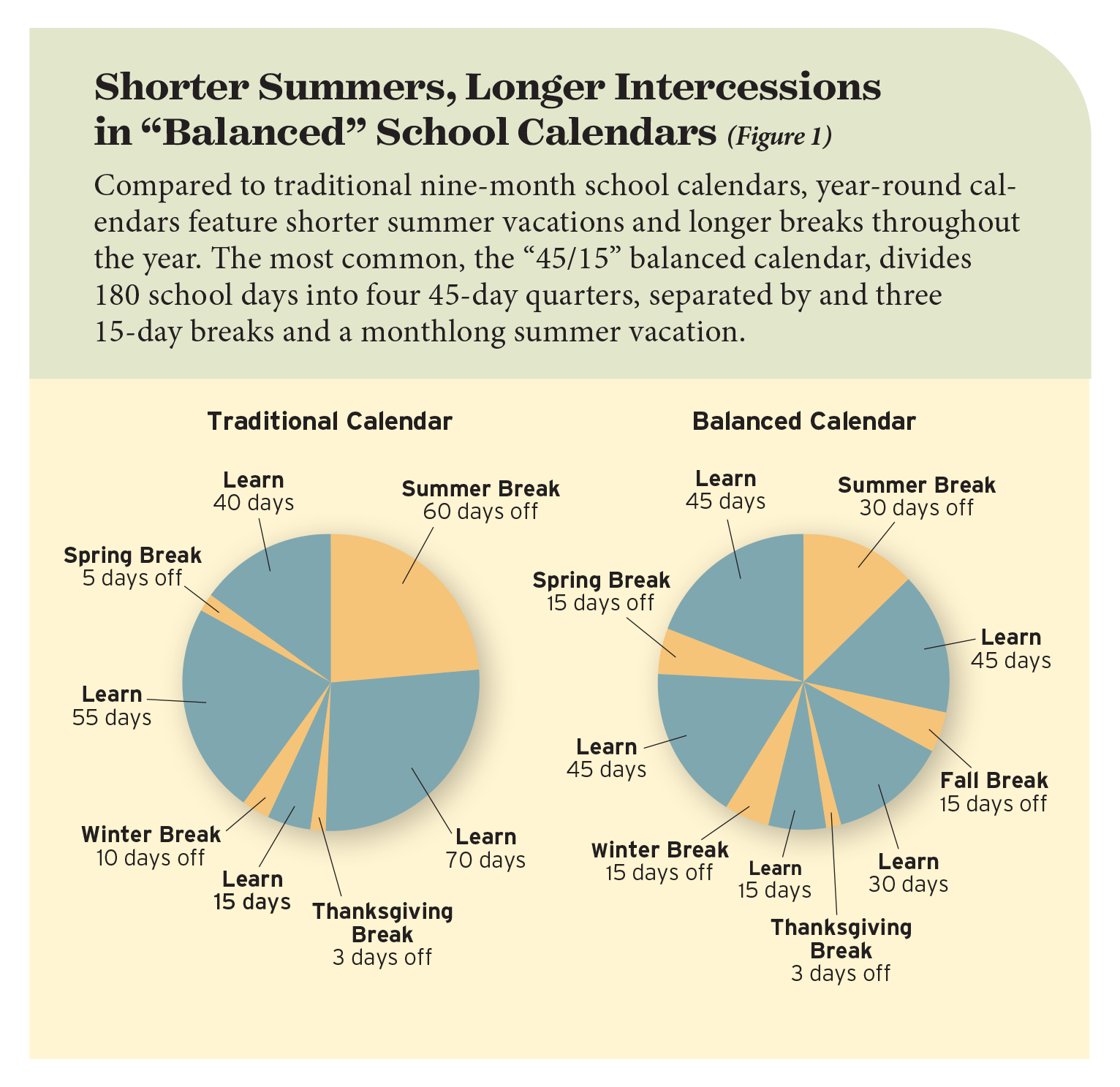
A label such as “45/15” describes a pattern—typically 45 instructional days followed by a 15-day break—not an automatic increase in annual instruction. To know how much instruction a student receives, count that student’s days across the full school year.
Redistribution and extension are different policies
The Congressional Research Service makes a distinction: its report concentrates on year-round schools that reorganize the calendar, while acknowledging that some schools also offer more instructional days. Those are different proposals, even if both are called “year-round schooling.”
Year-Round Schools: In Brief - Every CRS Report
Read the Congressional Research Service's definition of year-round schooling and its qualification about schools that add days. This will give the classification used throughout the lesson.
In “What Are Year-Round Schools?” (pp. 1–2), read from the definition through the discussion of intersessions. Then find footnote 3 in the same section and read its scope clarification. Notice that an intersession is a break from regular instruction that may also be used to offer activities; its existence alone does not tell you whether students have extra instructional days.
Use the original calendar as the baseline. First compare scheduled instructional time per student. Then determine whether any of the existing instructional days were moved to different parts of the year.
- Redistributing existing time: The student receives the same total instruction, but its placement changes. Moving school days out of a long continuous term to create shorter, more frequent breaks is an example.
- Adding instructional time: The student receives more instruction, without a separate rearrangement of previously scheduled days. For example, a school could keep its existing 180 days in place and append ten instructional days, reducing summer break.
- Combining both: The school relocates some existing instructional days and schedules additional instruction. A shorter summer alone does not establish this category: summer may have shortened solely because new days were appended.
The phrase “more days” is useful only when school days are comparable in length. If daily hours change, compare total scheduled instructional hours as well. A plan with 180 six-and-a-half-hour days adds 90 scheduled hours relative to 180 six-hour days, despite having no extra days. Conversely, a proposal with more but much shorter days might not add instructional time overall. Scheduled hours are an accounting measure, not a promise that students will learn more; evaluating learning is a later task.
Classifying calendar proposals
Assume the starting calendar has 180 six-hour instructional days. The examples below separate where the days fall from how much instruction students receive.
| Proposed calendar | What changed relative to the baseline? | Classification |
|---|---|---|
| 180 six-hour days; some existing school days are moved so summer is shorter and breaks during the year are longer | Placement changes; total instruction stays at 1,080 hours | Redistribution |
| 190 six-hour days; the original 180 stay in place and ten new days are appended | Total rises to 1,140 hours; no existing days move | Adding time |
| 190 six-hour days; some of the original 180 move into new positions during the year, and ten additional days are scheduled | Placement changes and total rises to 1,140 hours | Both |
| 180 six-and-a-half-hour days; all dates stay the same | Total rises to 1,170 hours, though the number and placement of days do not change | Adding time |
The second row highlights a common classification error. Its summer break becomes shorter, but that does not mean the school redistributed existing instructional days. Nothing was moved; ten days were added. The third row contains two distinct changes, which is why it belongs in the combined category.
A comparison also needs a clear answer to “instruction for whom?” Imagine a school moves its regular 180 days into a balanced pattern and offers an optional ten-day course during a break. The regular calendar redistributes time for all students. Students who attend that course also receive added instruction; students who do not attend still have 180 days. Calling the school’s calendar “190 days” for everyone would conceal that difference.
Likewise, a break described as an intersession is not automatically a vacation for every student, nor automatically ten days of instruction for every student. Check whether activities are offered, whether attendance is optional or required, and which students participate before counting them. This distinction will matter later when the course examines claims that calendar changes improve achievement: a result associated with a balanced calendar could also reflect instruction offered during breaks.
The classification to carry forward
A school’s operating months, a student’s instructional days, and that student’s instructional hours are related but not interchangeable. To classify a proposal, establish a per-student baseline, compare total scheduled instruction, and identify whether previously scheduled days were relocated. That yields redistribution, added time, or both without relying on the potentially misleading label “year-round.”
The next lesson looks at single-track and multi-track calendars: whether everyone follows one schedule or student groups rotate through different schedules. That arrangement affects who attends at a given time, but it still does not, on its own, tell you whether any individual student receives more instruction.