Earlier lessons established two starting points: God’s kingdom has begun but is not yet complete, and apocalyptic imagery can make a real claim without describing events like a photograph. Those points matter when reading Matthew 24. Jesus begins by predicting the temple’s destruction, yet later speaks of the Son of Man coming in clouds. Do those statements describe one historical crisis, Christ’s future return, or both?
Allow about 50–55 minutes. Read Matthew 24:1–35 first, keeping Mark 13:1–31 and Luke 21:5–33 available for comparison. The selected video segments examine three answers. The goal is not to settle every disputed verse, but to see what each reading explains well and where it faces difficulty.
Start with the question the disciples ask
All three accounts begin at the temple. Jesus predicts that its imposing buildings will be torn down (Matthew 24:1–2; Mark 13:1–2; Luke 21:5–6). The Roman destruction of Jerusalem and its temple in AD 70 therefore belongs in any responsible discussion of the passage. A later painting can help convey the scale of that catastrophe, though it is an artist’s reconstruction, not evidence for the details of the event.
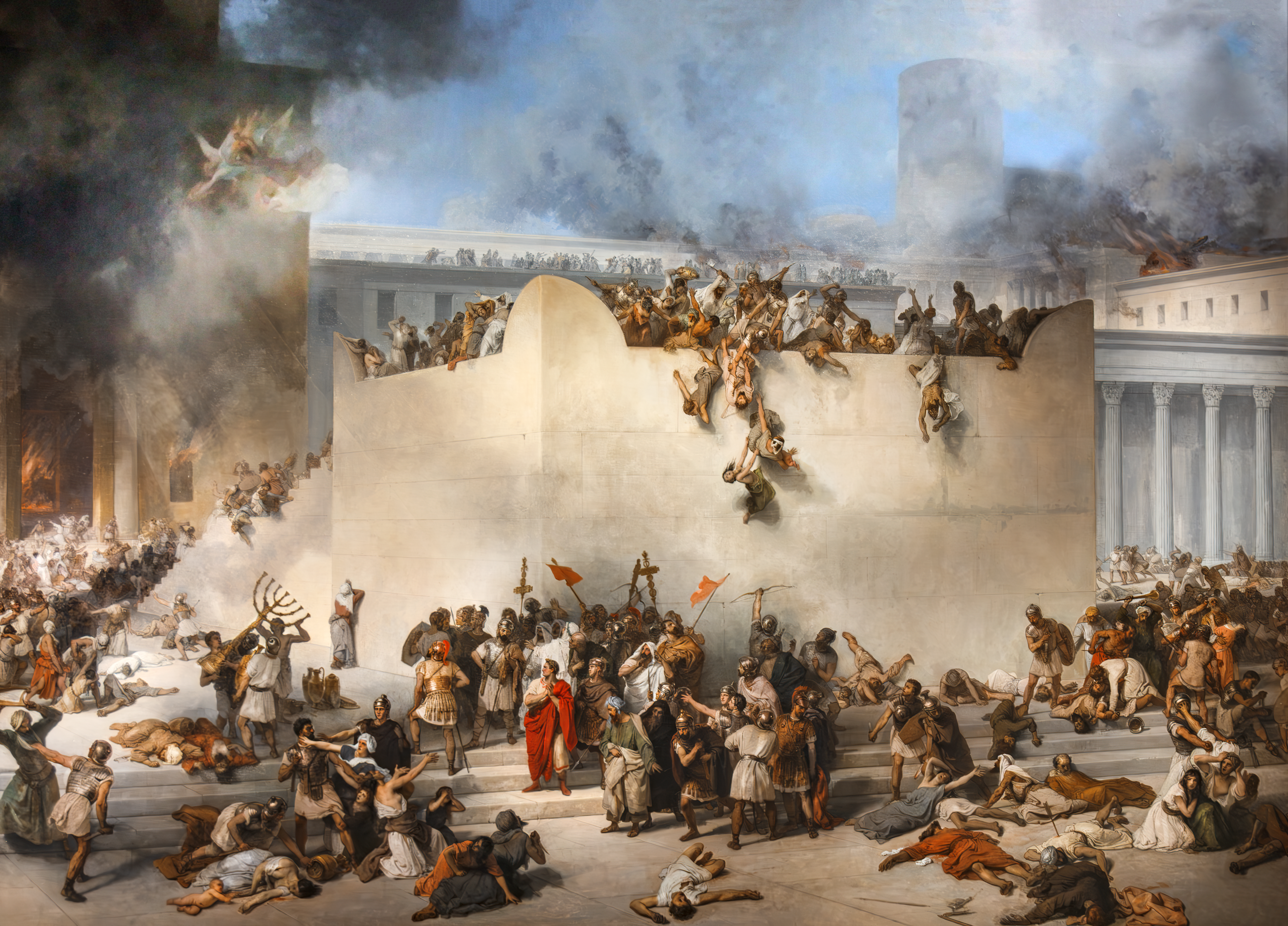
Matthew records the disciples asking when “these things” will happen and what will be the sign of Jesus’ coming and “the end of the age” (24:3). Mark and Luke phrase the question more narrowly around when these things—the predicted destruction—will occur (Mark 13:4; Luke 21:7). Matthew thus makes the larger expectation explicit, while all three keep the temple in view. The interpretive problem is whether the disciples have correctly linked the temple’s fall with the final coming, and how Jesus’ answer treats that link.
As you compare the accounts, notice a second anchor. Matthew 24:15 and Mark 13:14 use Daniel’s language of a “desolating sacrilege” or “abomination of desolation”; Luke 21:20 instead says that Jerusalem will be surrounded by armies. Each account then tells people in Judea to flee (Matthew 24:16; Mark 13:14; Luke 21:21). Their placement suggests a close relationship between the warnings. It does not automatically prove that Luke’s armies exhaust everything Matthew and Mark intend by Daniel’s phrase.
Reading the discourse chiefly as future
A futurist emphasis holds that, although Jesus’ opening prediction concerned the temple known to his disciples, much of Matthew 24:4–35 points beyond AD 70 to an especially severe future crisis culminating in Christ’s return. Readers in this family of interpretations may understand the distress of 24:21, the unmistakable coming of the Son of Man in 24:27–30, and the gathering of the elect in 24:31 as exceeding what happened in first-century Jerusalem. Some expect a future temple; others see earlier events as a pattern that will recur. Those are additional interpretive judgments, not details stated in Matthew 24:1–35.
The challenge is to account for Jesus’ original audience. Why does he give locally actionable instructions—“let those who are in Judea flee” (24:16)—if the main crisis is remote? And what does he mean by “this generation will not pass away until all these things take place” (24:34)? Some futurists take “this generation” to mean the generation that sees the final signs begin. That reading is possible within their proposed sequence, but it needs an argument: elsewhere, “this generation” commonly refers to people living in Jesus’ own time.
What is the Olivet Discourse Predicting? | Mark Strauss on Mark 13, Matthew 24, and Luke 21
In “What is the Olivet Discourse Predicting?”, Mark Strauss, speaking on the Logos Bible Study App channel, lays out the futurist reading and tests it against the disciples’ question and the passage’s time language.
Watch the futurist case. Track which verses are assigned to the future, then listen for the objections concerning the temple setting and “this generation.” Strauss assesses this view rather than simply presenting it as his own.
Reading the discourse chiefly as Jerusalem’s fall
A Jerusalem-centered reading takes the opening prediction and “this generation” as controls on the whole passage through Matthew 24:35. The flight from Judea, severe distress, and Luke’s explicit description of a besieged city fit the first-century crisis particularly well. On this view, the darkened sun and shaken heavens in Matthew 24:29 use prophetic imagery for a world-changing judgment, as similar language does elsewhere in Scripture. The Son of Man “coming” in 24:30 can then be read in light of Daniel 7:13–14: an image of his vindication and authority becoming evident through events, rather than a description of his bodily arrival on earth in AD 70.
This reading takes Jesus’ time statement seriously. Its hardest questions concern the scale and apparent visibility of Matthew’s language. Lightning seen across the sky (24:27), the mourning of “all the tribes” (24:30), and angels gathering the elect from the four winds (24:31) can sound like more than a local judgment. A Jerusalem-centered interpreter must explain those details rather than dismiss them as “just symbols.” Nor does reading this discourse chiefly in relation to AD 70, by itself, deny a future return taught elsewhere in the New Testament.
What is the Olivet Discourse Predicting? | Mark Strauss on Mark 13, Matthew 24, and Luke 21
Strauss next presents the reading that locates the discourse’s fulfillment in the first century and identifies the principal objections to it.
Watch the Jerusalem reading. Focus on how “this generation” and the Son of Man imagery support it, and on why Matthew 24:29–31 remains contested.
Reading both events in the discourse
A both-and reading sees Jerusalem’s destruction as a real subject of Jesus’ warning while also finding his future return in the discourse. One version places a transition near Matthew 24:29–31: the preceding instructions concern the crisis in Judea, while the cosmic language and gathering of the elect concern the final coming. Another sees first-century judgment as a foreshadowing of that coming, so that some language has a nearer reference and a fuller future horizon. These versions agree about two horizons but do not agree on precisely where—or whether—a clean dividing line falls.
This approach can account for both the local force of “flee to the mountains” and the expansive force of the Son of Man’s coming. It has its own textual difficulty: Matthew says “immediately after the tribulation of those days” before describing the cosmic signs (24:29). If the tribulation refers to AD 70 and the coming remains future, how does “immediately” work? Luke 21:24 speaks of Jerusalem being trampled “until the times of the Gentiles are fulfilled” before his account turns to cosmic signs (21:25). Some readers see room there for a longer horizon; others caution against using Luke to erase Matthew’s sharper connection. Neither observation removes the need to read each account on its own terms.
What is the Olivet Discourse Predicting? | Mark Strauss on Mark 13, Matthew 24, and Luke 21
Strauss develops his preferred combined reading, often described as prophetic “telescoping”: events can be presented together without an explicit account of the interval between them.
Watch the combined reading. Notice where Strauss places the shift in subject and how he handles the pressures posed by “immediately” and “this generation.” His proposal is an interpretation to evaluate, not a division marked unambiguously in the text.
What the parallels clarify—and what they do not
The three readings are not divided over whether the temple matters; they differ over how far the answer moves beyond it. These are the main points to keep together when you return to Matthew 24:1–35:
| Textual feature | Jerusalem emphasis | Future emphasis | Both-and emphasis |
|---|---|---|---|
| Temple prediction and flight from Judea | Central to the discourse | Historical starting point; later warnings may point ahead | Refer substantially to the first-century crisis |
| Son of Man and gathering (24:29–31) | Vindication and deliverance expressed in prophetic imagery | Christ’s future coming and gathering | Future coming, or language with near and future horizons |
| “This generation” (24:34) | Jesus’ contemporaries | Often the generation that sees the final signs | Often Jesus’ contemporaries for the nearer events; the scope of “all these things” is debated |
Mark preserves the temple setting and the generation saying (13:1–4, 30), so Matthew’s added wording about the coming cannot make those disappear. Luke makes the Jerusalem crisis especially concrete with armies, captivity, and a trampled city (21:20–24), so its historical reference cannot be treated as incidental. Conversely, the parallels do not supply an agreed answer to whether the Son of Man passage (Matthew 24:29–31; Mark 13:24–27; Luke 21:25–28) describes that same crisis or a final event.
Conclusion
Matthew 24:1–35 begins with a definite prediction about the temple, moves through warnings addressed to Jesus’ hearers, and reaches language whose scope is disputed. A Jerusalem-centered reading has particular strength in the local instructions and “this generation”; a future-centered reading emphasizes the magnitude of the Son of Man’s coming and gathering; a both-and reading attempts to retain both sets of evidence while facing questions about their sequence. Comparing Mark and Luke sharpens these questions without mechanically settling them.
The next module turns from this debated discourse to Paul’s account of bodily resurrection. That will provide another biblical foundation for considering what Christians expect when God’s purposes reach their completion.