Welcome back. Last lesson established an important limit: 2 Thessalonians 2 speaks of believers being gathered to Christ, but does not place that gathering at a measured point within a tribulation period. This lesson compares four proposed placements. In about 40 minutes, you will learn to read their timelines while keeping tribulation—affliction or persecution—distinct from divine wrath, even where an interpretation says the two overlap.
First, establish what the timeline is measuring
In 1 Thessalonians 4:13–18, Paul says that believers who have died will rise and that living believers will be “caught up” with them to meet Christ. Rapture is a later term for that catching up. The disputed question is when it happens relative to a period of end-time distress, not whether Paul describes believers meeting Christ.
Many rapture timelines use a seven-year tribulation as their measuring line. That length comes from a particular reading of Daniel 9:24–27 alongside other prophetic passages; it is not a duration stated in 1 Thessalonians 4. Nor do all Christians expect a distinct future seven-year period. For this lesson, treat it as the shared ruler used by the four diagrams, not as a premise every Christian accepts.
Read the introduction and four-view list in The Rapture Question from The Gospel Coalition. It establishes the common vocabulary before we examine what each placement implies.
The Rapture Question - The Gospel Coalition
Read the essay's introductory explanation and its list of the four timing views. Focus on the difference between the gathering itself and the proposed sequence surrounding it.
Under “Introduction,” begin with the paragraph opening “The concept of a ‘rapture’ refers.” Read the introduction and list, stopping at item 4, “Post-Tribulation.” Notice which descriptions specify a point within the proposed period and which put the gathering at its end.
A second distinction matters just as much as the date of the gathering. Tribulation can refer to suffering, including hostility directed at believers. God’s wrath refers to divine judgment. Christians who hold these four views may agree that believers are not destined for God’s wrath (1 Thessalonians 5:9), yet disagree about when that wrath occurs and how believers are spared. Being spared from judgment does not, by itself, specify whether believers are removed beforehand or protected while events unfold.
Put the four gatherings on one ruler
Watch this short comparison from Pre, Mid or Post Tribulation RAPTURE by LoveIsrael.org. The presenters state the four positions compactly; one speaker then explains why he favors a prewrath reading. Use their presentation as a map of proposals, not as a verdict on which proposal is correct.
Pre, Mid or Post Tribulation RAPTURE | Biblically defined | End Times Discussion
Watch the four-view comparison to hear how each position locates the gathering and describes what believers experience beforehand.
Watch the four positions, from pretribulation through prewrath. Then watch the qualification: the speaker distinguishes his own prewrath interpretation from one more specific claim about when Revelation 6:17 marks the start of wrath.
Here is the schematic. “Midpoint” means the midpoint in the proposed seven-year framework. “Public return” marks the return at the end of that framework; whether the gathering and that return are distinct events is itself disputed.
| View | Before the period | First half | Midpoint | Latter part | End |
|---|---|---|---|---|---|
| Pretribulation | Believers gathered | Public return | |||
| Midtribulation | Believers remain | Believers gathered | Public return | ||
| Prewrath | Believers remain | Believers remain | Believers gathered, at an unspecified later point before divine wrath | Public return | |
| Posttribulation | Believers remain | Believers remain | Believers remain | Believers gathered at Christ’s public return |
The following image presents the same four placements. Read its dark “Wrath of God” bars as claims made by particular versions of the views, not as an agreed schedule of divine judgment.
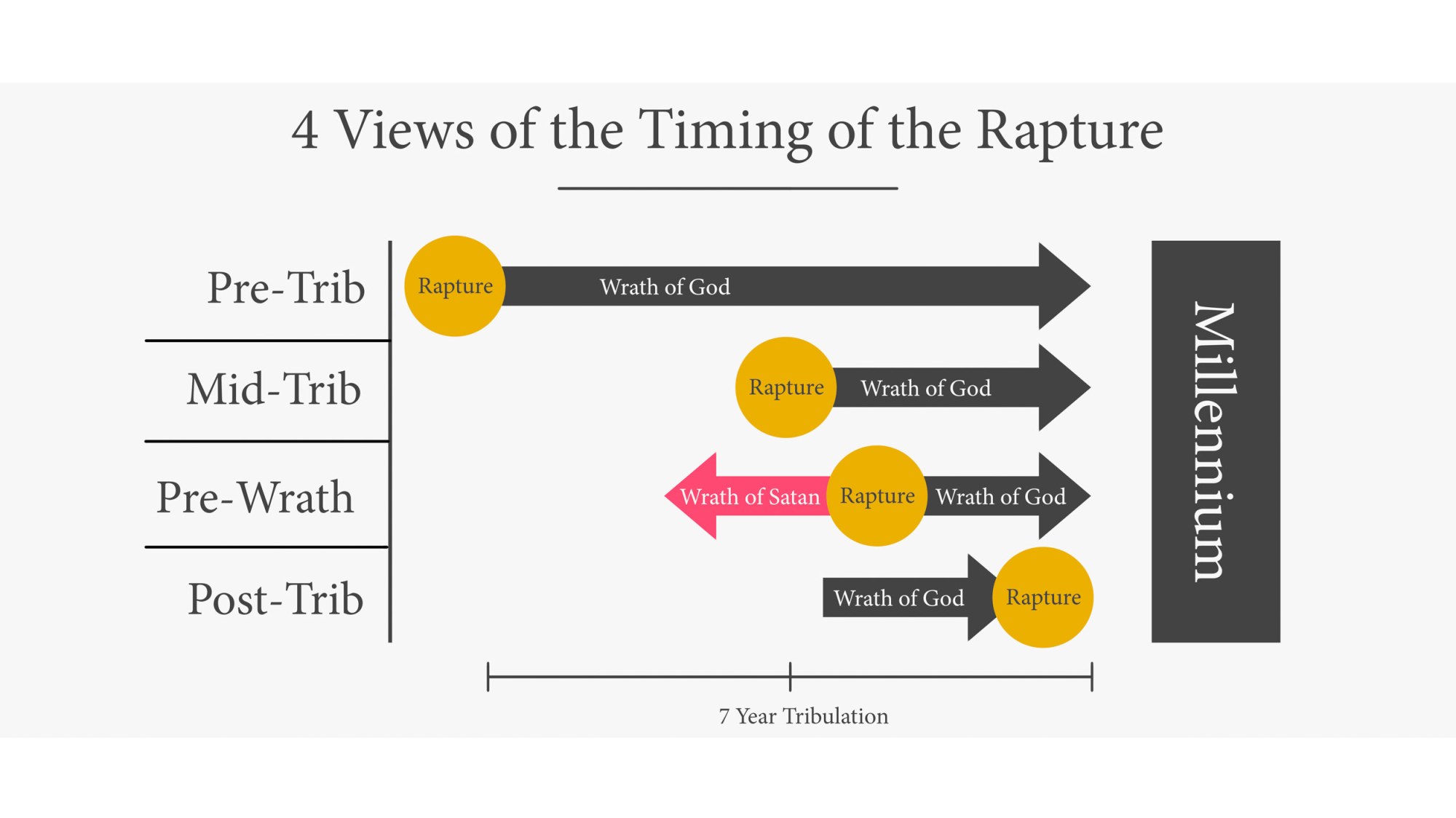
Two features prevent misreading the chart. Midtribulation names a position at the midpoint; prewrath names a position relative to divine wrath, usually later than the midpoint in this kind of diagram. And the posttribulation row does not mean its adherents deny divine wrath. It means the gathering is not placed before the period of tribulation in order to remove believers from it.
Ask what each view calls “wrath”
A pretribulation reading gathers the church before the proposed period begins. In a common dispensational version, Christ gathers believers first and returns publicly after the tribulation. Its advocates commonly argue that divine judgment characterizes the period, so believers must be removed before it. That does not require claiming that God directly causes every violent act or every instance of persecution within those years. The consequential interpretive claim is that the church must be absent from this period of judgment.
Read the pretribulation description in The Rapture Question, including the essay’s response to its argument about wrath. The essay argues against pretribulationism, so distinguish the position it describes from the author’s evaluation of it.
The Rapture Question - The Gospel Coalition
Examine both the proposed two-stage sequence and the argument that believers must be removed to escape divine wrath.
In “View 1: The Rapture and the Return of Christ are Separate and Distinct Eschatological Events,” find the paragraph beginning “The dispensational teaching.” Read the proposed sequence. Later in that same section, find the paragraph beginning “They contend to spare the Church from divine wrath.” Read the wrath argument and response. Focus on where the description ends and the essay’s counterargument begins.
A midtribulation reading places the gathering at the halfway point. Believers therefore experience the first half but are removed before the latter half. Some versions identify the midpoint with the seventh trumpet of Revelation 11 and expect especially severe persecution or judgment afterward. The precise claim that all divine wrath starts only at the midpoint is not necessary to every midtribulation account: some interpreters see judgments earlier as well. Its defining feature on our ruler is the midpoint gathering, not one universally agreed account of every preceding event.
The section “The mid-tribulation view” in The ‘rapture question’ shows how one argument connects the midpoint to passages in Revelation and Daniel. Those connections are interpretive identifications, rather than timestamps supplied by 1 Thessalonians 4.
The ‘rapture question’ - The Gospel Coalition
Read one fuller account of why an interpreter places the gathering halfway through the proposed period.
Under “The mid-tribulation view,” start at the paragraph opening “This view has not had a great deal of literature written on its behalf.” Read the section's argument, ending just before “The post-tribulation view.” Track which part states the proposed timing and which parts argue for identifying events in different biblical passages with one another.
A prewrath reading makes the distinction between tribulation and wrath central. In a common version, believers remain through serious end-time persecution attributed to satanic and human opposition. They are gathered after some tribulation but before an identifiable outpouring of God’s wrath. The gathering is therefore not fixed at the midpoint merely because it happens before wrath. Prewrath interpreters can disagree about exactly where the boundary falls; the video itself cautions against treating one verse as an automatic timestamp.
Finally, a posttribulation reading places the gathering at Christ’s public return after the tribulation. Believers remain present through the period of distress. If divine judgments also occur during that period, posttribulation interpreters can understand believers as spared God’s condemning wrath without being physically absent throughout. Accounts differ on whether wrath is chiefly a final climax or also occurs earlier. What defines the view is that meeting Christ and his public return belong together at the end, rather than being separated by years.
Read the opening of the essay’s posttribulation section for that central placement. We will examine its arguments from Matthew and Thessalonians more closely in the next lesson.
The Rapture Question - The Gospel Coalition
Read the account of a single return and a gathering at the end of the tribulation. Set aside, for now, the section's longer arguments about individual passages.
Under “View 2: The Rapture and Return of Christ Occur Simultaneously at the End of the Tribulation,” read the opening paragraph. Stop at the sentence describing the gathering as a public event. Focus on whether this view separates the gathering from Christ’s return.
What the diagram can—and cannot—settle
The diagram answers a useful question: where does each view put believers’ gathering on its proposed timeline? It cannot establish that the seven-year ruler is correct, that every hardship during it has the same source, or that “not destined for wrath” means one particular method of protection. Even the labels pretribulation and prewrath answer different questions: the first locates the gathering relative to a period; the second locates it relative to divine judgment within a proposed sequence.
The caution from last lesson still applies. Paul’s mention of “our being gathered to him” in 2 Thessalonians 2:1 does not itself supply a midpoint, a late-period boundary, or a seven-year interval. Each view reaches those placements by relating multiple passages and making judgments about which events are the same.
Conclusion
The four positions can now be kept distinct: pretribulation gathers believers before the proposed period; midtribulation at its midpoint; prewrath after some end-time persecution but before a proposed outpouring of divine wrath; and posttribulation at Christ’s public return after the tribulation. Their disagreement concerns both when believers are gathered and whether enduring tribulation entails experiencing God’s wrath.
Next, you will compare Matthew 24:29–31, 1 Thessalonians 4:13–18, and 2 Thessalonians 2:1–4. Those passages will let you test the assumptions that make different sequences possible, rather than accepting any timeline simply because it is easy to draw.