Hello! Welcome to our final lesson in the "Advanced Threading Concepts and Patterns" module.
In the previous lesson, we built a custom reader-writer lock by carefully orchestrating mutexes and condition variables. We were in full control of the logic that determined which thread runs next. Today, we'll explore what happens when our synchronization primitives interact with an external authority: the operating system's thread scheduler.
This lesson directly addresses the learning outcome: Explain the concept of priority inversion and how priority inheritance can solve it. We will dissect a classic, dangerous bug that arises in priority-based multithreaded systems and examine its standard solution. This topic is especially critical in real-time and high-performance computing, where predictable execution is paramount.
A Primer on Thread Priorities
Most modern operating systems employ a priority-based scheduler. The idea is simple: threads are assigned a priority level, and the scheduler prioritizes running higher-priority threads over lower-priority ones. If a high-priority thread becomes ready to run, it will typically preempt any lower-priority thread that is currently running.
The Pthreads standard provides interfaces for setting thread scheduling policies (e.g., SCHED_FIFO, SCHED_RR) and priorities, though using them often requires special permissions and is system-dependent. For this lesson, we don't need to implement them, but we must understand the core principle: higher priority means more important.
The Priority Inversion Problem
Now, let's consider what happens when thread priorities and mutexes interact. This can lead to a paradoxical and dangerous situation called priority inversion.
In short, priority inversion occurs when a high-priority thread is forced to wait for an unnecessarily long time for a lower-priority thread to complete its task.
Let's break down the classic scenario involving three threads:
- T_High: A high-priority thread.
- T_Med: A medium-priority thread.
- T_Low: A low-priority thread.
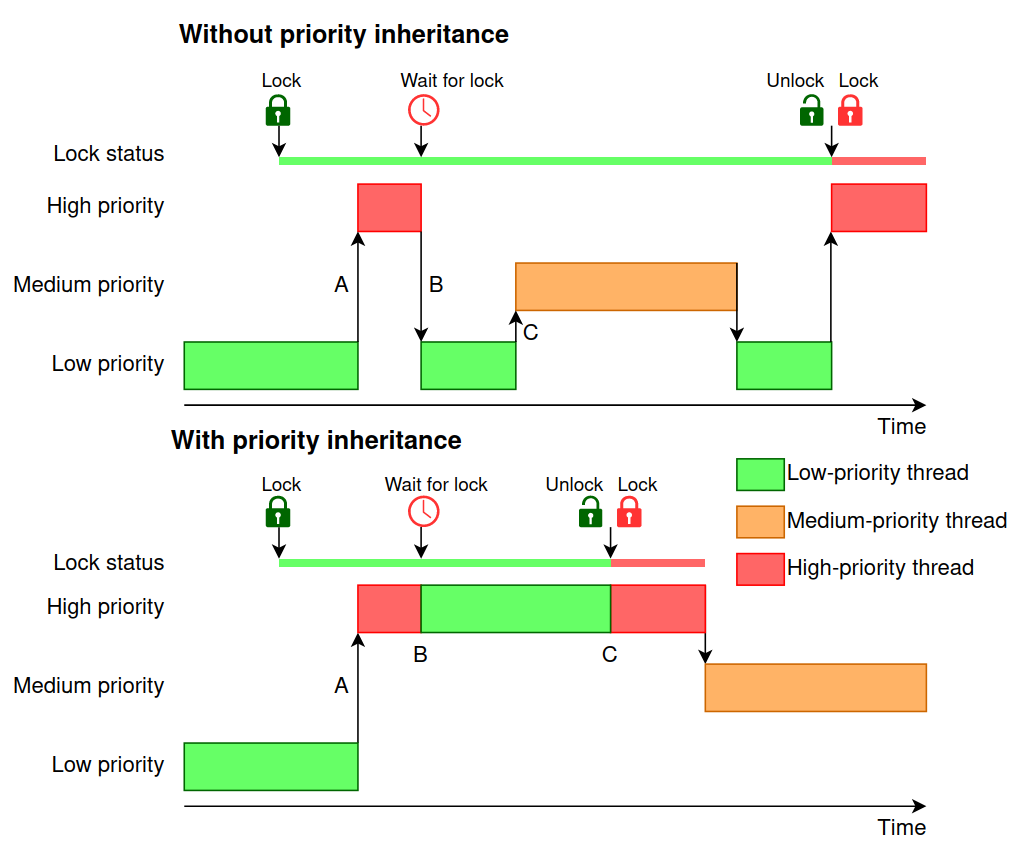
The sequence of events unfolds as follows:
- Lock Acquired:
T_Lowstarts running and acquires a mutexMto enter a critical section. - Preemption:
T_Highbecomes ready to run. Since it has a higher priority, it preemptsT_Low. - Blocking:
T_Highattempts to acquire the same mutexM. SinceT_Lowholds it,T_Highblocks and is put to sleep. - The Inversion: The scheduler now looks for the next-highest-priority thread to run.
T_Highis asleep. The choice is betweenT_MedandT_Low. SinceT_Medhas higher priority thanT_Low, the scheduler runsT_Med. - The Stalemate:
T_Low, which holds the mutex thatT_Highneeds, is starved of CPU time byT_Med.T_Highis therefore indirectly blocked by a thread of a lower priority (T_Med), effectively "inverting" their intended priorities.
The following resource provides an excellent description and visualization of this exact scenario.
Real-Time Programming: Priority Inversion
This article from Picknik.ai on real-time programming lays out the priority inversion problem with a very clear explanation and timeline diagram.
Please read the first section, up to (but not including) the C++ code example. Pay close attention to the definition of priority inversion and study the timeline diagram titled 'Without priority inheritance'. This visual is key to understanding the problematic interaction.
This isn't just a theoretical problem. One of the most famous examples of priority inversion occurred on the Mars Pathfinder mission, where it caused repeated system resets until engineers diagnosed and fixed the issue remotely. A low-priority meteorological task held a lock on a shared data bus, and when a high-priority bus management task tried to access it, a medium-priority communication task would often preempt the meteorological task, leading to a watchdog timer firing and resetting the system.
The Solution: Priority Inheritance
The problem is that the scheduler doesn't know that T_Low is holding a resource vital to T_High. The solution is to make the scheduler aware of this dependency. This is achieved through priority inheritance.
The principle is:
When a high-priority thread (e.g.,
T_High) blocks on a mutex held by a low-priority thread (e.g.,T_Low), the system temporarily boosts the priority ofT_Lowto that ofT_High.
This seemingly simple change elegantly solves the problem:
T_Highblocks waiting for the mutex held byT_Low.- The system immediately elevates
T_Low's priority to be equal toT_High's. - When the scheduler now looks for a thread to run,
T_Low(with its boosted priority) has a higher priority thanT_Med. T_Lowis scheduled to run immediately. It quickly finishes its critical section and releases the mutex.- As soon as
T_Lowreleases the mutex, its priority reverts to its original low level. T_High, which was waiting for the mutex, is immediately unblocked, acquires the mutex, and runs.
The unbounded delay caused by T_Med is completely eliminated. The blocking time for T_High is now bounded only by the duration of T_Low's critical section.
The following short video provides an excellent animated walkthrough of this solution.
To see priority inheritance in action, watch this concise video from Prof. Phil Koopman. It animates the flow of events and clearly shows how elevating the low-priority thread's status resolves the inversion.
Watch the entire video (it's only about 2 minutes). Focus on how and when the low-priority task's priority is 'hoisted' and then restored. This visual reinforcement is very effective.
The image below, from the Picknik.ai article, perfectly summarizes the "before" and "after" scenarios.
Implementation with Pthreads
Priority inheritance is not a default behavior for Pthreads mutexes. You must explicitly enable it using mutex attributes. Given your interest in practical implementation, this is the key takeaway for writing robust C code for real-time or priority-sensitive systems.
The process involves these steps:
- Declare a mutex attribute object:
pthread_mutexattr_t attr; - Initialize it:
pthread_mutexattr_init(&attr); - Set the mutex protocol to
PTHREAD_PRIO_INHERIT:pthread_mutexattr_setprotocol(&attr, PTHREAD_PRIO_INHERIT); - Initialize your mutex using this attribute object:
pthread_mutex_init(&my_mutex, &attr); - After initialization, the attribute object can be destroyed:
pthread_mutexattr_destroy(&attr);
The article we looked at earlier demonstrates this and shows the dramatic real-world performance difference.
Real-Time Programming: Priority Inversion
Let's return to the Picknik.ai article to see the Pthreads implementation details and the performance impact.
Please read the final part of the article, starting from the C code snippet. Focus on the sequence of pthread_mutexattr_* calls. Then, examine the second histogram and compare the 'max latency' with the one from the beginning of the article. It's a powerful demonstration of why this matters.
Test your understanding!
Imagine you have two high-priority threads, H1 and H2 (with H2 > H1), and one low-priority thread, L. L holds a mutex. Then, H1 tries to lock it and blocks. A moment later, H2 also tries to lock it and blocks.
Under the priority inheritance protocol, what priority will L be running at?
Show answer
The thread L will inherit the priority of the highest-priority thread waiting for the lock. In this case, L's priority will be elevated to match H2's priority. This ensures it can preempt any other threads with priorities less than H2 and release the lock as quickly as possible for the most critical waiting thread.
It's worth noting that there is another, less common, strategy called Priority Ceilings. With this protocol, each mutex is assigned a fixed "priority ceiling", which is the priority of the highest-priority thread that could ever lock it. Any thread that acquires the mutex immediately has its priority raised to that ceiling. While this also prevents inversion, priority inheritance is more widely implemented and generally what you will encounter.
Conclusion
In this lesson, we've bridged the gap between user-space synchronization logic and system-level scheduling behavior. Understanding priority inversion is crucial for writing correct and performant code in any system where thread priorities are used, especially in robotics, embedded systems, and finance, where missed deadlines can have significant consequences.
Key Takeaways:
- Priority Inversion is a scheduling failure where a high-priority thread is blocked by a medium-priority thread because a low-priority thread holds a needed resource.
- The result is unbounded latency, which is unacceptable in time-sensitive applications.
- Priority Inheritance solves this by temporarily elevating the lock-holding thread's priority to that of the highest-priority waiting thread.
- In Pthreads, you enable this by setting the mutex protocol to
PTHREAD_PRIO_INHERITviapthread_mutexattr_setprotocolbefore initializing the mutex.
Preview of the Next Lesson:
This lesson concludes our module on advanced threading concepts. You are now familiar with managing per-thread data with TLS, building complex synchronization primitives like RWLocks, and handling subtle scheduling hazards like priority inversion.
We are now ready to begin the final capstone module, "Concurrent Design Applications." In our next session, we will start by designing and implementing a work-stealing queue, a highly efficient data structure used for dynamic load balancing among worker threads in parallel computing frameworks.