Hello! Welcome to the first lesson in our module on Advanced Threading Concepts and Patterns.
In our previous lesson, we saw a powerful optimization strategy: minimizing contention by having each thread accumulate results in a local variable before updating a global total. This "local accumulation" pattern avoided the massive performance penalty of cache line bouncing. We noted that a formal mechanism exists for this, and today, we'll dive into it.
This lesson addresses the learning outcome: Use thread-local storage (TLS) via pthread_key_create to manage per-thread data. We will explore how to create data that is globally accessible yet private to each individual thread, providing a robust and elegant way to manage per-thread state and implement patterns like local accumulation.
What is Thread-Local Storage?
In multithreaded programming, we often face a dilemma.
- Global variables are shared by all threads, requiring locks for safe modification.
- Local variables (on the stack) are private to a thread but are ephemeral; they vanish when the function returns.
What if we need data that persists for the entire lifetime of a thread, but remains private to that thread? This is particularly useful in scenarios where you can't or don't want to pass data pointers through every function call.
This is the exact problem that Thread-Local Storage (TLS) solves. It provides a mechanism for each thread to have its own private instance of a variable.
The concept is often visualized as a set of "slots" identified by a key. The key is global to the process, but the data in the slot it points to is unique for each thread.
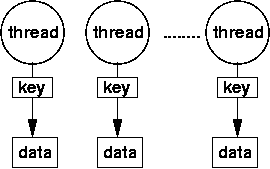
A classic real-world example is the errno variable in C. In a single-threaded world, errno is a global variable. In a multithreaded environment, if two threads make a system call that fails, they would race to set the single errno variable, leading to one thread getting the wrong error code. Modern C libraries solve this by making errno a thread-local variable, ensuring each thread sees its own last error.
The Pthreads API for Thread-Local Storage
The POSIX threads library provides a specific API for managing TLS. It revolves around creating a "key" that acts as a handle for a particular piece of thread-local data.
Thread-Specific Data and Signal Handling in Multi- ...
This article from Linux Journal provides a great conceptual introduction to TLS and why it's needed, contrasting it with simple global data.
Read the section 'Thread-specific data' up to the numbered list. This section provides the motivation for TLS and introduces the three key functions we'll be discussing.
The core API consists of four main components:
-
pthread_key_t: An opaque type that represents the key. You declare a variable of this type to hold your key. It's typically a single global variable for the data you want to manage. -
pthread_key_create(): Creates a new key for the entire process. This function is the cornerstone of TLS. -
pthread_setspecific(): Associates a value (avoid*pointer) with a key, but only for the calling thread. -
pthread_getspecific(): Retrieves the value associated with a key for the calling thread.
Let's examine these functions more closely.
Thread-Specific Data - Computer Science - JMU
This reference from JMU's Computer Science department provides a concise summary of the function signatures and purposes.
Review the definitions for pthread_key_create(), pthread_setspecific(), and pthread_getspecific(). Pay close attention to the parameters of pthread_key_create, especially the destructor.
pthread_key_create() - The Heart of TLS
The most important function is pthread_key_create():int pthread_key_create(pthread_key_t *key, void (*destructor)(void *));
key: A pointer to yourpthread_key_tvariable. The function will initialize this variable with the new key.destructor: A pointer to a function that will be called automatically when a thread exits. This destructor receives one argument: thevoid*value that the exiting thread had stored for this key.
The destructor is absolutely critical for memory management. If your threads allocate memory on the heap (using malloc) and store a pointer to it as their thread-specific data, this destructor is your mechanism to free that memory. Without it, you would have a memory leak every time a thread terminates.
Thread-Specific Data and Signal Handling in Multi- ...
Let's revisit the Linux Journal article to understand the importance of the destructor and other practical considerations.
First, read numbered point 4, which explains exactly why the destructor is necessary to prevent memory leaks. Then, read numbered points 1, 2, and 3, which cover important practical details like key limits (PTHREAD_KEYS_MAX), deleting keys, and the fact that you store pointers, not large data objects directly.
The Standard Implementation Pattern
Using TLS correctly involves a clear, established pattern to handle key creation and the initialization of data within each thread.
-
One-Time Key Creation: The
pthread_key_createfunction should only be called once for a given key in the entire process. If multiple threads could potentially start using the TLS feature at the same time, you have a race condition on who creates the key. The standard solution is to usepthread_onceto ensure the creation function is run exactly once. -
Per-Thread Data Initialization: When a thread needs to use its local storage for a given key, it first tries to retrieve it using
pthread_getspecific. If this is the first time for that thread, the function will returnNULL. ThisNULLcheck is the signal that the thread must now allocate its private data block and associate it with the key usingpthread_setspecific.
This complete pattern is often called the "get, check-if-null, create-and-set" pattern.
Thread-Specific Data - Computer Science - JMU
The JMU resource contains a perfect, self-contained C code example that demonstrates this exact pattern. It shows how to use pthread_once for safe key creation and how each thread initializes its own data on first use.
Study the 'An Example Using Thread-Specific Data' code block. Trace the logic of the letter_grade function. See how pthread_once calls create_key once, and how the function checks if letter is NULL to malloc the buffer for the current thread.
Test your understanding!
A program creates a single key, log_key, with a destructor function free_log_buffer.
- Thread A calls
pthread_getspecific(log_key), getsNULL,mallocs a bufferbuf_A, and callspthread_setspecific(log_key, buf_A). - Thread B calls
pthread_getspecific(log_key), getsNULL,mallocs a bufferbuf_B, and callspthread_setspecific(log_key, buf_B).
- If Thread A now calls
pthread_getspecific(log_key), what will it receive? - When Thread B exits, what function will be called, and with what argument?
Show answer
- Thread A will receive
buf_A. Each thread's data is completely separate, even though they use the same key.pthread_setspecificonly affects the storage of the calling thread. - When Thread B exits, the pthreads library will automatically call
free_log_buffer(buf_B). The destructor is invoked with the specific pointer that the exiting thread had stored.
Hands-On: The Local Accumulation Counter with TLS
Let's apply this to the counter problem from our last lesson. You will implement the "local accumulation" strategy, but instead of using a variable on the thread function's stack, you will use true Thread-Local Storage. This makes the pattern more general, as the per-thread data can be accessed from any function called by that thread, not just the top-level one.
Your task is to complete the C code below. The goal is to have each thread increment its own private counter. When each thread exits, its destructor will be called, which will safely add the thread's private sum to a global total.
#include <stdio.h>
#include <stdlib.h>
#include <pthread.h>

#define NUM_THREADS 4
#define NUM_INCREMENTS 1000000

// Global variables for TLS and final sum
pthread_key_t thread_local_counter_key;
pthread_mutex_t global_sum_mutex = PTHREAD_MUTEX_INITIALIZER;
long long global_sum = 0;

// TODO 1: Implement the destructor function.
// This function is called when a thread exits.
// It should add the thread's local sum to the global_sum.
void add_local_sum_to_global(void* data) {
    long long* local_sum_ptr = (long long*)data;
    printf("Thread %p exiting, adding its local sum of %lld\n", (void*)pthread_self(), *local_sum_ptr);

    // Lock the mutex, update the global sum, then unlock
    pthread_mutex_lock(&global_sum_mutex);
    global_sum += *local_sum_ptr;
    pthread_mutex_unlock(&global_sum_mutex);

    // Free the memory that was allocated for this thread's counter
    free(local_sum_ptr);
}

void* worker_thread(void* arg) {
    (void)arg; // Unused

    // TODO 2: Get the thread-specific data pointer.
    long long* local_sum_ptr = (long long*)pthread_getspecific(thread_local_counter_key);

    // TODO 3: If the pointer is NULL, this is the first time for this thread.
    // Allocate memory for this thread's counter, initialize it to 0,
    // and set it as the thread-specific data for our key.
    if (local_sum_ptr == NULL) {
        local_sum_ptr = malloc(sizeof(long long));
        if (local_sum_ptr == NULL) {
            perror("Failed to allocate memory for thread-local counter");
            pthread_exit(NULL);
        }
        *local_sum_ptr = 0;
        pthread_setspecific(thread_local_counter_key, local_sum_ptr);
        printf("Thread %p initialized its local counter.\n", (void*)pthread_self());
    }

    // Main work loop: increment the thread-local counter
    for (int i = 0; i < NUM_INCREMENTS; ++i) {
        (*local_sum_ptr)++;
    }

    // The thread just exits. The destructor will handle cleanup and aggregation.
    pthread_exit(NULL);
}

int main() {
    pthread_t threads[NUM_THREADS];

    // TODO 4: Create the thread-specific data key, associating it with the destructor.
    if (pthread_key_create(&thread_local_counter_key, add_local_sum_to_global) != 0) {
        perror("Failed to create pthread key");
        return 1;
    }

    printf("Starting %d threads...\n", NUM_THREADS);
    for (int i = 0; i < NUM_THREADS; ++i) {
        if (pthread_create(&threads[i], NULL, worker_thread, NULL) != 0) {
            perror("Failed to create thread");
        }
    }

    // Wait for all threads to complete
    for (int i = 0; i < NUM_THREADS; ++i) {
        pthread_join(threads[i], NULL);
    }

    // At this point, all threads have exited, and all destructors have run.

    // Clean up the key itself
    pthread_key_delete(thread_local_counter_key);

    printf("\nAll threads finished.\n");
    printf("Final global sum: %lld\n", global_sum);
    printf("Expected sum:     %lld\n", (long long)NUM_THREADS * NUM_INCREMENTS);

    return 0;
}
Your Task:
The code has four TODO markers. I've filled in the logic for you to study. Your task is to:
- Read through the completed
TODOsections and make sure you understand how each part works. - Compile and run the code:
gcc -Wall -Wextra -pthread your_file.c -o tls_counter - Observe the output. Notice the order in which threads initialize their storage and how the destructors are called as threads exit. Verify that the final sum is correct.
This exercise demonstrates the full lifecycle of TLS: key creation, per-thread lazy initialization, usage, and automatic cleanup/aggregation via the destructor.
Conclusion
You have now learned the standard POSIX mechanism for managing thread-local storage. This is a fundamental tool for writing clean, modular, and performant concurrent code.
Key Takeaways:
- Thread-Local Storage (TLS) gives each thread a private data slot that is accessible via a process-wide key.
- The core API is
pthread_key_create,pthread_getspecific, andpthread_setspecific. - The destructor function provided to
pthread_key_createis essential for avoiding memory leaks when dynamically allocating thread-local data. - The standard usage pattern involves checking for
NULLfrompthread_getspecificto perform one-time initialization of data within each thread. - TLS is the perfect mechanism for implementing patterns like per-thread logging buffers, context objects, and the high-performance "local accumulation" counter.
Preview of the Next Lesson:
In this lesson, we built a new program from scratch using TLS. In the next lesson, we will tackle a common and practical challenge: making a non-thread-safe function safe to use in a multithreaded context by leveraging TLS. We will take an existing function that relies on problematic static variables and refactor it to be fully thread-safe, without changing its public function signature, by applying the TLS patterns you've just learned.