Hello! Welcome back to our course on practical C threading.
In our last few lessons, we dove deep into fine-grained locking, building and traversing a thread-safe sorted linked list using a "hand-over-hand" protocol. You now have a solid understanding of how to protect a data structure's integrity during concurrent reads and writes by locking individual nodes.
Today, we're shifting gears to a different, highly versatile data structure: the hash table. Our module goal is to build a high-performance, concurrent hash table. But before we can tackle the complexities of locking it, we must first design its non-thread-safe counterpart. This lesson focuses on that crucial first step: designing a basic hash table data structure using separate chaining. We will define the C structures and outline the logic that will serve as the foundation for our concurrent implementation.
What is a Hash Table?
At its core, a hash table is a data structure designed for extremely fast key-value lookups, insertions, and deletions. While a linked list search is O(n), the ideal hash table operation is O(1)—constant time, regardless of how many items are in the table.
Let's start with a quick conceptual overview.
Understanding and implementing a Hash Table (in C)
This video from Jacob Sorber provides an excellent introduction to what a hash table is, the problem it solves, and the properties of a good hash function.
Please watch from 02:09 to 04:13. Focus on the three main goals: achieving constant-time lookups, the role of a hash function in mapping a key to an array index, and the three characteristics of a good hash function (consistency, speed, and randomness).
As the video explains, a hash table combines two key components:
- An array (which we'll call the buckets).
- A hash function that maps a given key to an index in that array.
However, this simple model has a problem: what happens when the hash function maps two different keys to the same index? This is called a collision. Our design must handle this gracefully.
Collision Resolution: Separate Chaining
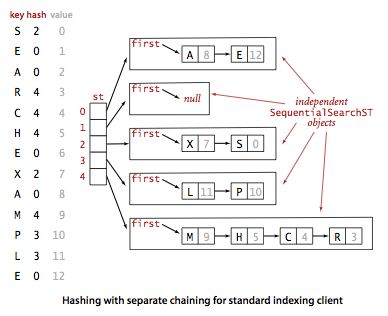
The most common strategy for handling collisions is separate chaining. Instead of storing one item per bucket, each bucket acts as a pointer to the head of a linked list. When a collision occurs, the new key-value pair is simply added to the linked list at that bucket's index.
This image from the Algorithms, 4th Edition textbook website perfectly illustrates the concept.
To see how this looks in practice, let's watch another clip that walks through implementing this.
Understanding and implementing a Hash Table (in C)
This clip, also from Jacob Sorber, demonstrates how to modify the basic C structures and logic to implement separate chaining.
Please watch from 20:33 to 24:18. Pay attention to how the person struct is updated with a next pointer and how the insert, lookup, and delete functions are adapted to work with linked lists at each bucket.
Designing the C Data Structures
Now we get to the core of today's lesson: translating this concept into a robust and generic C design. Since your goal is to build practical, reusable code, we won't hardcode the key and value types (e.g., as char*). Instead, we'll use void* pointers and function pointers to create a generic hash table that can store any data type.
A comprehensive guide from andreinc.net provides an excellent model for this. We will adopt its design.
This article, 'Implementing Hash Tables in C', details a very well-structured, generic implementation. We will focus on the data model it proposes.
Please read the section titled 'The model' (it's inside the 'Separate Chaining' section). Carefully study the definitions of the three key structs: ch_node, ch_hash, and especially the ch_key_ops and ch_val_ops function pointer structs. Understand the role of each member.
Let's break down this design.
1. The Node Structure (ch_node)
This is the building block for our linked lists. Each node stores a single key-value pair.
typedef struct ch_node_s {
    uint32_t hash;      // The pre-calculated hash of the key
    void *key;          // Generic pointer to the key
    void *val;          // Generic pointer to the value
    struct ch_node_s *next; // Pointer to the next node in the chain
} ch_node;
- Storing the
hashvalue directly in the node is a common optimization. It avoids re-calculating the hash when searching within a linked list or when resizing the table. - Using
void *keyandvoid *valmakes our hash table generic. The table itself doesn't need to know if it's storing strings, integers, or complex structs.
2. The Hash Table Structure (ch_hash)
This is the main structure that holds everything together.
typedef struct ch_hash_s {
    size_t capacity;     // The number of buckets in our array
    size_t size;         // The number of key-value pairs currently stored
    ch_node **buckets;   // The array of buckets (array of pointers to nodes)
    ch_key_ops key_ops;  // Function pointers for handling keys
    ch_val_ops val_ops;  // Function pointers for handling values
} ch_hash;
bucketsis ach_node **. This is a pointer to a pointer, which is how you create a dynamic array of pointers in C.buckets[i]will be ach_node *, pointing to the first node in the chain for that bucket.key_opsandval_opsare the key to making this design generic.
3. The Operations Structures (ch_key_ops, ch_val_ops)
Since the hash table uses void*, it doesn't know how to hash a key, compare two keys, or free the memory for a key. We must provide this logic to the hash table when we create it. This is done via function pointers.
// Operations for the KEY
typedef struct ch_key_ops_s {
    uint32_t (*hash)(const void *data, void *arg); // Hash the key
    void* (*cp)(const void *data, void *arg);     // Copy the key
    void (*free)(void *data, void *arg);          // Free the key
    bool (*eq)(const void *data1, const void *data2, void *arg); // Compare two keys
    void *arg; // Optional user-defined argument for the functions
} ch_key_ops;

// Operations for the VALUE (similar, but no hash function)
typedef struct ch_val_ops_s {
    void* (*cp)(const void *data, void *arg);
    void (*free)(void *data, void *arg);
    bool (*eq)(const void *data1, const void *data2, void *arg);
    void *arg;
} ch_val_ops;
This design pattern is extremely powerful. It separates the generic logic of the hash table data structure from the specific logic required for the data types it contains. When we initialize our hash table, we'll pass it a struct populated with pointers to functions that know how to work with, for example, strings.
Component 4: The Hash Function
The quality of the hash function is paramount for performance. A bad function creates many collisions, turning our hash table into a set of slow linked lists. A good function distributes keys evenly across the buckets.
For string keys, simple functions like summing ASCII values are poor. Well-regarded algorithms like djb2 are far superior.
The same article provides a great discussion on hash functions, including how to hash strings and a C implementation of the djb2 algorithm. This level of detail is important for building high-quality data structures.
Please read the subsections 'Hashing strings', 'djb2', and 'sdbm'. You don't need to memorize the formulas, but understand why a simple sum is bad and how djb2 uses multiplication and bit-shifting to achieve better distribution.
Here is the C implementation of djb2 from that resource. This is a function that you would point to from your ch_key_ops struct.
// An example of a hash function for strings (djb2)
uint32_t string_hash_djb2(const void *data, void *arg) {
    // We cast the generic void* back to what we know it is.
    const char *str = (const char*) data;
    uint32_t hash = 5381;
    char c;

    while((c = *str++)) {
        // hash = hash * 33 + c
        hash = ((hash << 5) + hash) + c;
    }

    return hash;
}
The final step is to map this large hash value to a bucket index, which is typically done with the modulo operator: size_t index = hash % table->capacity;.
Test your understanding!
Based on the design presented, if you create a hash table ch_hash* my_table, and you want to insert the key "name" and the value "Alice", what is the sequence of function calls that must happen to find the correct bucket and place the item in the list? (Just list the function types from ch_key_ops and the C operators involved).
Show answer
my_table->key_ops.hash("name", ...): Thehashfunction pointer is called to get theuint32_thash value for the key"name".%operator: The result is used with the modulo operator to get the bucket index:index = hash_value % my_table->capacity;.my_table->key_ops.cp("name", ...): Thecp(copy) function for keys is called to create a new, heap-allocated copy of the key string to store in thech_node.my_table->val_ops.cp("Alice", ...): Thecpfunction for values is called to create a copy of the value string.malloc(): Memory is allocated for the newch_node.my_table->key_ops.eq(...): If the bucket is not empty, theeqfunction is used to traverse the linked list and check if the key"name"already exists.
Conclusion
In this lesson, we have laid the complete architectural groundwork for a generic, non-thread-safe hash table in C.
Key Takeaways:
- A hash table uses a hash function to map keys to an array of buckets.
- Separate chaining is a collision resolution strategy where each bucket is the head of a linked list.
- A robust C design can be made generic using
void*pointers for data and function pointers (struct *_ops) for data-specific operations like hashing, copying, and comparison. - The choice of hash function (e.g.,
djb2for strings) is critical for performance, as it determines how evenly keys are distributed and thus how short the linked-list chains are.
Preview of the Next Lesson:
We have the blueprint. In the next lesson, we will bring this design to life by implementing the non-thread-safe operations for the hash table (insert, lookup, delete). With a working implementation in hand, we will then be ready to tackle the main challenge of this module: making it all thread-safe.