Hello! Welcome to the next lesson in our journey to build a robust thread pool in C.
In the previous lesson, we implemented the "producer" side of our system: the threadpool_add_task function. We learned how to safely add a task to the queue and use pthread_cond_signal to notify that a task is ready.
Today, we'll implement the "consumer" side. This lesson is all about making our worker threads efficient. You will learn how to use pthread_cond_wait to make worker threads sleep when the task queue is empty and wake up only when there is work to do. This will transform our thread pool from a CPU-burning, inefficient prototype into an elegant and performant system.
The Problem of the Idle Worker: Busy-Waiting
In its current form, a worker thread's life is a simple, but highly inefficient, infinite loop:
- Lock the mutex.
- Is the queue empty?
- If not, take a task.
- Unlock the mutex.
- If a task was taken, execute it.
- Repeat.
When the queue is empty, the threads are stuck in a tight loop, repeatedly locking and unlocking the mutex just to check for work. This is called busy-waiting or polling. While correct, it's incredibly wasteful, consuming 100% of a CPU core for no productive reason.
A slightly better, but still flawed, approach is to add a sleep() call in the loop. This reduces CPU usage, but at the cost of responsiveness. A new task might arrive just after a thread goes to sleep, and it will sit in the queue until the sleep timer expires. This creates an undesirable trade-off between CPU waste and task latency.
Let's see this problem in action.
Thread Pools in C (using the PTHREAD API)
The CodeVault video 'Thread Pools in C' provides an excellent demonstration of this exact problem. It starts with a busy-waiting implementation and uses a system monitor to show the direct impact on CPU usage.
Please watch from 8:13 to 17:32. This segment builds the initial worker thread loop and then demonstrates its inefficiency. Pay close attention to the htop output at the end of the segment, which clearly shows the high CPU consumption caused by busy-waiting.
The Solution: pthread_cond_wait
The correct and efficient solution is to use a condition variable to allow threads to sleep until a specific condition is met. In our case, the condition is "the task queue is not empty". The POSIX threads library provides pthread_cond_wait for this purpose.
The function signature is:int pthread_cond_wait(pthread_cond_t *cond, pthread_mutex_t *mutex);
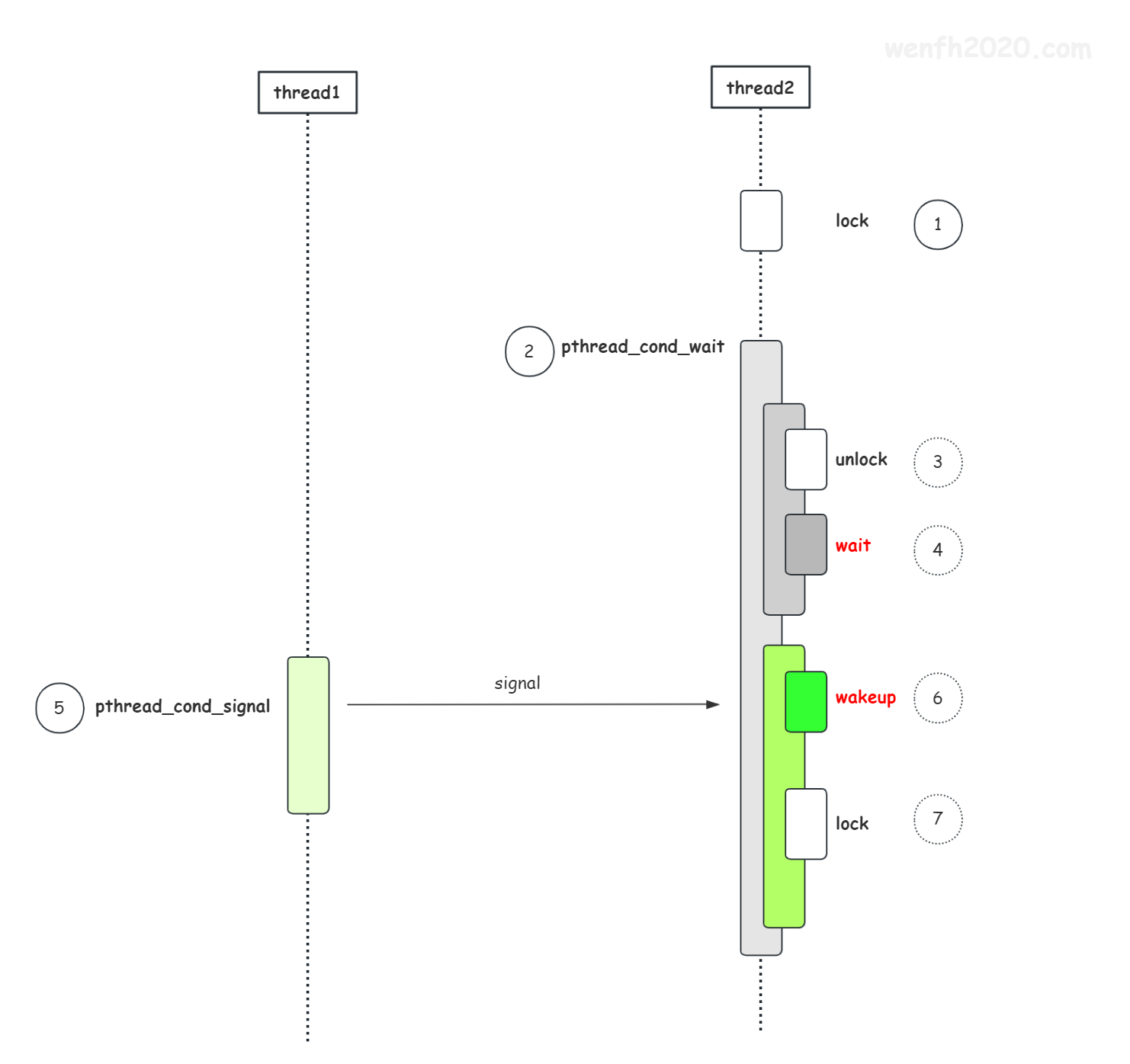
Here’s how it works, and this is one of the most elegant parts of the pthreads API:
- You must call
pthread_cond_waitwhile holding the lock on the associated mutex. pthread_cond_waitatomically performs two actions: it releases the mutex and puts the calling thread to sleep. This atomicity is crucial; it prevents a race condition where a thread could check the condition, decide to wait, but be interrupted before it can sleep, missing the signal from the producer.- The thread remains asleep until it is woken up by a call to
pthread_cond_signalorpthread_cond_broadcaston the same condition variable. - When woken, the thread does not return immediately. It first waits to re-acquire the mutex. Only after it successfully regains the lock does the
pthread_cond_waitfunction return.
This guarantees that when the thread wakes up and continues, it once again has exclusive access to the shared data structure.
The "Wait-in-a-Loop" Idiom
A naive implementation might be to check the condition with an if statement:
// BROKEN - DO NOT USE
pthread_mutex_lock(&pool->lock);
if (pool->task_count == 0) {
    pthread_cond_wait(&pool->notify, &pool->lock);
}
// ... get task ...
This is incorrect and a common source of bugs. The correct way to wait on a condition is to use a while loop. This is known as the "wait-in-a-loop" pattern.
// CORRECT
pthread_mutex_lock(&pool->lock);
while (pool->task_count == 0) { // Re-check the condition in a loop
    pthread_cond_wait(&pool->notify, &pool->lock);
}
// ... get task ...
Why is the while loop mandatory? There are two primary reasons:
- Spurious Wakeups: For implementation reasons on some architectures, a thread might wake up from
pthread_cond_waiteven if no signal was sent. Thewhileloop ensures the condition is re-checked, and if the wakeup was spurious and the queue is still empty, the thread simply goes back to sleep. - Stolen Work Race Condition: Imagine two idle worker threads, T1 and T2, are both waiting. A producer adds one task and signals, waking up T1. Before T1 can run, the OS schedules T2, which was woken up for some other reason (perhaps a spurious wakeup). T2 sees the task, takes it, and unlocks the mutex. Now, when T1 finally runs, the
pthread_cond_waitreturns, but the queue is empty again! Anifstatement would proceed, trying to dequeue from an empty queue. Thewhileloop correctly forces T1 to re-check the condition, see that the queue is empty, and go back to sleep.
Let's read a detailed explanation of this crucial pattern.
The textbook 'Operating Systems: Three Easy Pieces' gives one of the clearest explanations for why the while loop is essential. It walks through a producer-consumer scenario to show exactly how an if statement fails.
Please read the subsection titled 'A Broken Solution' and 'Better, But Still Broken: While, Not If' (pages 8-10 of the PDF). Focus on the thread trace in Figure 30.9, which illustrates the 'stolen work' problem. This will solidify your understanding of why re-checking the condition after waking is not just good practice, but necessary for correctness.
Implementing the Efficient Worker Loop
Now we have all the pieces to write our efficient worker thread function. We will lock the mutex, enter our while loop to wait for tasks, and once we wake up with a task available, we'll dequeue it, unlock the mutex, and finally execute it.
Notice the final step: we execute the task after unlocking the mutex. This is critical for performance. The task itself (e.g., a complex calculation, a file I/O operation) could be long-running. Holding the lock during this time would prevent any other thread—producer or consumer—from accessing the queue, creating a major bottleneck.
Let's see the code come together.
Thread Pools in C (using the PTHREAD API)
Let's return to the CodeVault video, which now fixes the busy-waiting problem by implementing the pthread_cond_wait logic we've just discussed.
Watch from 17:32 to 20:23. This segment demonstrates how to add the pthread_cond_t and integrate pthread_cond_wait inside the while loop. The video then compares the CPU usage, showing the dramatic improvement.
Here is the resulting code for our worker thread function, incorporating everything we've learned.
static void *threadpool_worker(void *arg) {
    threadpool_t *pool = (threadpool_t *)arg;
    thread_task_t *task;

    while (1) {
        // Acquire the lock to access the task queue
        pthread_mutex_lock(&(pool->lock));

        // Wait while the queue is empty.
        // The `shutdown` flag will be added in a future lesson.
        while (pool->task_count == 0 /* && !pool->shutdown */) {
            pthread_cond_wait(&(pool->notify), &(pool->lock));
        }

        // We are now awake and hold the lock.
        // A task is guaranteed to be in the queue.

        // Dequeue a task from the head of the list
        task = pool->head;
        pool->head = task->next;
        if (pool->head == NULL) {
            pool->tail = NULL;
        }
        pool->task_count--;

        // Release the lock BEFORE executing the task
        pthread_mutex_unlock(&(pool->lock));

        // Execute the task function
        (*(task->function))(task->argument);

        // Free the task structure
        free(task);
    }

    // This part is currently unreachable.
    // We will add shutdown logic later.
    pthread_exit(NULL);
    return NULL;
}
Test your understanding!
A colleague suggests 'optimizing' the worker loop by changing the while (pool->task_count == 0) to an if (pool->task_count == 0). They argue that since pthread_cond_signal is only called when a task is added, a worker will only wake up when there is definitely work to do, so re-checking is redundant.
Describe two distinct scenarios where this 'optimization' would cause the program to fail.
Show answer
This change would introduce critical bugs. Here are two scenarios where it would fail:
-
The "Stolen Work" Race Condition: Imagine two idle workers, T1 and T2, are both sleeping in
pthread_cond_wait. A producer adds one task and callspthread_cond_signal, which wakes up T1. Before T1 can run, the OS schedules T2, which just woke from a spurious wakeup. T2 acquires the lock, sees the task, takes it, and unlocks. Now, when T1 finally runs, it returns from itspthread_cond_waitcall (holding the lock) but the queue is empty. With anifstatement, T1 would proceed, incorrectly assuming a task is present, and likely crash trying to dereference aNULLpointer from the empty queue. Awhileloop would cause it to correctly re-check thetask_count, find it to be 0, and go back to sleep. -
Spurious Wakeups: The POSIX standard permits
pthread_cond_waitto return 'spuriously'—that is, without any correspondingpthread_cond_signal. If a worker wakes up spuriously and the queue is empty, theifstatement would allow it to fall through and attempt to process a non-existent task, leading to a crash. Thewhileloop robustly handles this by forcing a re-evaluation of the condition, causing the thread to go back to sleep.
Conclusion
Excellent work! You have now mastered one of the most fundamental and important patterns in concurrent programming. By replacing a wasteful busy-wait loop with an efficient pthread_cond_wait, you've completed the producer-consumer handshake for our thread pool.
Key Takeaways:
- Busy-waiting (polling) wastes CPU cycles and is highly inefficient for idle threads.
pthread_cond_waitallows a thread to sleep until a condition is met, avoiding CPU waste.- The function atomically releases the associated mutex before sleeping and re-acquires it before returning.
- The
wait-in-a-looppattern (while (condition) { pthread_cond_wait(...) }) is mandatory for correctness. It handles both spurious wakeups and race conditions where work is "stolen" by another thread. - To maximize concurrency, long-running operations (like task execution) should be performed after releasing the mutex.
Preview of the Next Lesson:
Our thread pool can be created, can have tasks submitted to it, and can execute them efficiently. However, we currently have no way to shut it down cleanly. The while(1) loop in our worker threads runs forever. In the next lesson, we will design and implement a graceful shutdown mechanism that ensures all pending tasks are completed before the threads are joined and all resources are deallocated.