Hello! Welcome back to our journey into advanced C concurrency.
In our last lesson, we tackled the subtle but critical issue of memory ordering. You learned how to use memory barriers (fences) and the C11 memory model's acquire-release semantics to enforce a "happens-before" relationship between threads, ensuring that data is shared correctly and predictably without locks.
Today, we build directly on that foundation. Our learning outcome is to explain the concept of a compare-and-swap (CAS) operation and its role in optimistic concurrency. CAS is arguably the most important primitive in lock-free programming and is the key that will unlock our ability to build complex, high-performance concurrent data structures.
The Limits of Simple Atomic Operations
We've seen that C11 provides convenient atomic operations like atomic_fetch_add for simple tasks. But what if we need to perform an operation for which there's no built-in atomic function, like multiplication or a conditional update?
Consider this naive attempt to multiply an atomic integer by 2:
_Atomic int value = 10;

// Thread 1
int current_val = atomic_load(&value);   // Reads 10
int new_val = current_val * 2;           // Computes 20
// <-- Context switch! Another thread runs here.
atomic_store(&value, new_val);           // Writes 20
If another thread modifies value between the atomic_load and atomic_store, that modification will be overwritten and lost. This three-step "read-modify-write" sequence is not atomic. We need a way to perform all three steps as a single, indivisible operation.
This is the exact problem that Compare-and-Swap solves.
Compare-and-Swap: The Conditional Atomic Update
Compare-and-Swap (CAS) is a special atomic instruction that allows you to say:
"Atomically update a memory location to a new value, but only if that location currently contains a specific value I expect it to have."
It fuses the read, modify, and write steps into a single, indivisible transaction.
The following video by Herb Sutter provides an excellent mental model for this operation.
CppCon 2014: Herb Sutter "Lock-Free Programming (or, Juggling Razor Blades), Part I"
In this segment from his talk on lock-free programming, Herb Sutter explains the pseudo-code and logic behind the compare_exchange operation. Focus on his key phrase for thinking about CAS.
Watch from 11:11 to 13:28. Pay close attention to the pseudo-code logic and the conceptual framing: 'Am I the one who gets to change this Atomic from expected to desired?'
As you saw, the operation checks if the current value matches an expected value. If it does, it performs the swap and succeeds. If not, it fails and, crucially, tells you what the value actually was.
In C11 (stdatomic.h), this is implemented as atomic_compare_exchange_strong():
bool atomic_compare_exchange_strong(
    _Atomic A *object,
    C *expected,
    C desired
);
Let's break down the parameters:
object: A pointer to the atomic variable you want to modify.expected: A pointer to a non-atomic variable holding the value you believeobjectcurrently has. This is an in-out parameter.- On success (returns
true): Theobjectis updated todesired. Theexpectedvariable is untouched. - On failure (returns
false): Theobjectis untouched. Theexpectedvariable is updated with the actual current value fromobject.
- On success (returns
desired: The new value you want to store inobjectif the comparison succeeds.
This "update-on-failure" behavior of the expected parameter is an efficient design. It saves you from having to perform another atomic_load after a failed attempt, preparing you immediately for a retry.
Optimistic Concurrency: The CAS Loop
The CAS operation is the engine of a concurrency strategy called optimistic concurrency. This stands in contrast to the pessimistic concurrency you've used before with mutexes.
- Pessimistic Concurrency (Locks): Assume contention is likely. Lock a critical section to prevent other threads from interfering, do your work, and then unlock. This is safe but can be slow, as other threads must block and wait for the lock.
- Optimistic Concurrency (CAS): Assume contention is rare. Don't lock anything. Read the data, compute the new result speculatively, and then use CAS to try and publish your change. If CAS fails, it means another thread changed the data first. Instead of blocking, you simply retry.
This image brilliantly contrasts the two approaches for a simple increment operation.
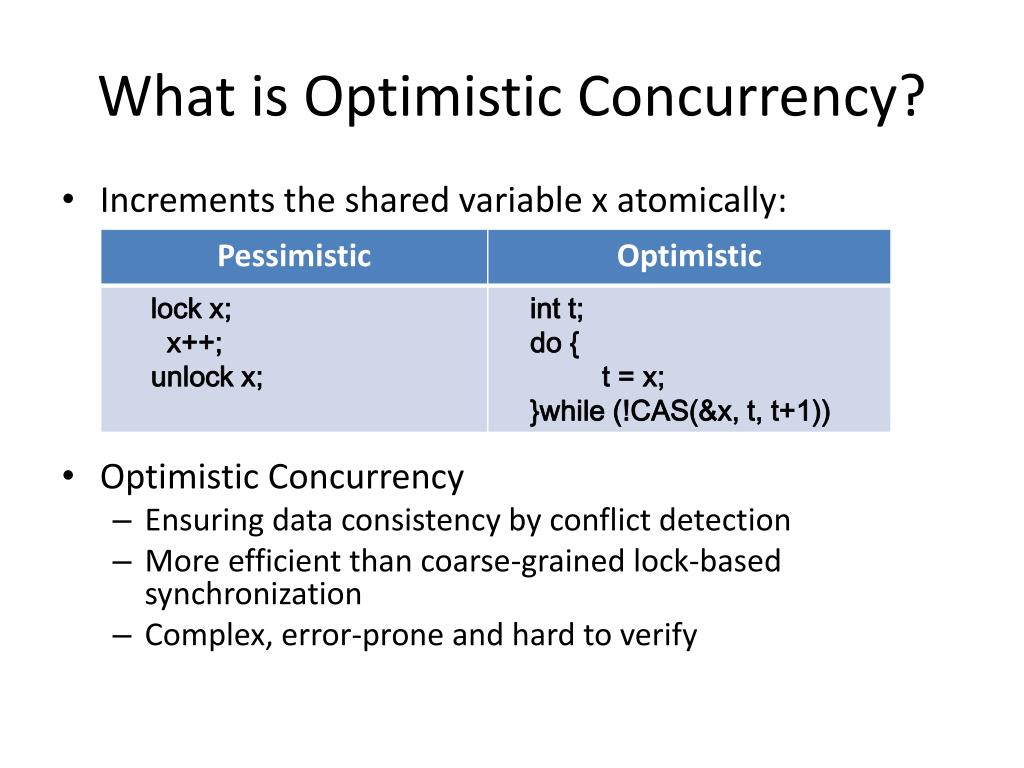
This leads to the most common pattern in lock-free programming: the CAS loop. The following video segment explains this pattern perfectly.
CppCon 2017: Fedor Pikus “C++ atomics, from basic to advanced. What do they really do?”
Fedor Pikus now demonstrates how CAS is used in a loop to build atomic operations that aren't natively supported, like multiplication.
Watch from 15:49 to 18:49. This is the core of today's lesson. Observe how the loop is structured: read the current value, compute the new value, and then use compare_exchange to attempt the update, looping until it succeeds.
Let's translate that C++ example into a C11 function that atomically multiplies a value.
#include <stdatomic.h>
#include <stdbool.h>

void atomic_multiply(_Atomic int *object, int operand) {
    int expected = atomic_load(object);
    int desired;

    do {
        desired = expected * operand;
    } while (!atomic_compare_exchange_weak(object, &expected, desired));
}
Let's trace this loop:
- Load: We start by loading the current value of
objectinto our local variableexpected. - Compute: We calculate the
desiredvalue based on theexpectedvalue. - Compare and Swap: We call
atomic_compare_exchange_weak.- If it returns
true: Success!object's value was what weexpected, and it has now been atomically updated todesired. The loop terminates. - If it returns
false: Failure. Another thread modifiedobjectafter our initial load. The hardware atomically updates ourexpectedvariable with the new, fresh value fromobject. Thewhilecondition is met, and the loop repeats from step 2 with the newexpectedvalue.
- If it returns
This loop is lock-free: at least one thread always makes progress. If your CAS fails, it's because another thread's CAS succeeded. The system as a whole is not blocked.
Test your understanding!
Imagine a function atomic_add_if_less_than( _Atomic int *val, int add, int limit). It should atomically add add to *val, but only if the current value of *val is less than limit. If it's not less than limit, it should do nothing.
How would you implement the core logic of this function using a CAS loop?
Show answer
You would read the current value, and only attempt the CAS if your condition is met.
void atomic_add_if_less_than(_Atomic int *val, int add, int limit) {
    int expected = atomic_load(val);
    int desired;

    do {
        if (expected >= limit) {
            // The condition isn't met. We don't want to change the value.
            return;
        }
        desired = expected + add;
    } while (!atomic_compare_exchange_weak(val, &expected, desired));
}
The key is that the entire loop repeats if a race occurs. If expected is 99 (and limit is 100), we calculate desired. But if another thread changes *val to 101 before our CAS executes, our CAS will fail. The expected variable will be updated to 101, and on the next loop iteration, the if (expected >= limit) check will cause us to correctly exit without making a change.
Strong vs. Weak CAS
You may have noticed my example used atomic_compare_exchange_weak while our first C11 reference was to the strong version.
atomic_compare_exchange_strong: Guaranteed to returnfalseonly if the value ofobjectwas not equal toexpected.atomic_compare_exchange_weak: Can spuriously fail. It might returnfalseeven if the values were equal, forcing an extra loop iteration.
Why would anyone use weak? On some CPU architectures (notably not x86/x64), a weak CAS can be implemented with a more efficient instruction sequence. If you are already using CAS inside a loop, a rare spurious failure just causes one more spin of the loop, which is often a negligible performance cost in exchange for a potentially cheaper instruction. For algorithms that don't use a loop, strong is almost always the correct choice. In practice, when in a loop, weak is a common and often preferred choice.
Conclusion
You have just learned the most fundamental building block of lock-free programming. By understanding Compare-and-Swap, you've moved beyond simple atomics and grasped the core mechanism for implementing complex, non-blocking concurrent algorithms.
Key Takeaways:
- A "read-modify-write" sequence on an atomic variable is not itself atomic and can lead to lost updates.
- Compare-and-Swap (CAS) is an atomic primitive that updates a value only if it currently holds an expected value.
- CAS is the foundation of optimistic concurrency, a strategy that avoids locking by speculatively performing work and retrying if a conflict occurs.
- The canonical pattern for optimistic concurrency is the CAS loop, where a thread repeatedly tries to commit a change until it succeeds.
- The CAS loop provides lock-freedom: it guarantees system-wide progress, preventing the deadlocks and performance bottlenecks associated with blocking locks.
Preview of the Next Lesson:
We are now fully equipped to put this powerful tool to work. In our next lesson, you will implement a simple lock-free stack using atomic compare-and-swap operations. You'll see how the abstract CAS loop pattern translates directly into the core logic of a practical, high-performance concurrent data structure.