Hello! Welcome back to our course on C threads.
In our last lesson, we explored pthread_join, a function that is essential when your main thread needs to wait for another thread to complete and retrieve a result from it. This synchronization is crucial for many parallel algorithms.
However, not all threads are created to return a value. Sometimes, you want to launch a task to run in the background and then forget about it. This lesson addresses exactly that scenario, focusing on the learning outcome: Detach threads using pthread_detach and explain scenarios where this is appropriate.
We will cover what a detached thread is, why detaching is necessary for resource management, two different ways to create detached threads, and, most importantly, the practical situations where this "fire-and-forget" model is the correct design choice.
The Problem: Zombie Threads and Resource Leaks
By default, every thread you create is joinable. This means the system must preserve the thread's resources—like its thread ID and final exit status—even after its task function has returned. The thread enters a "zombie" state, waiting for another thread to collect its exit status by calling pthread_join.
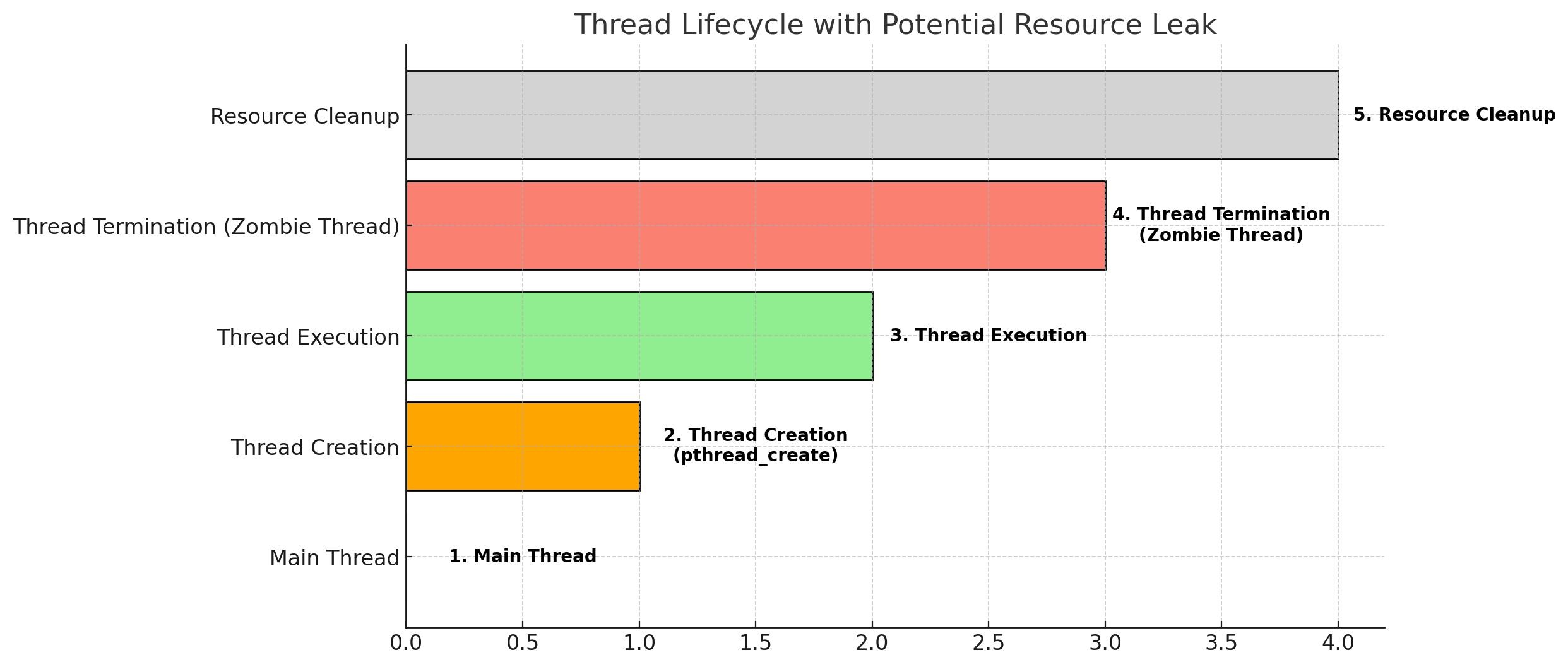
If you create many joinable threads but never join them, you create a resource leak. Each "zombie" consumes a small amount of system memory, and in a long-running application, this can accumulate and eventually cause problems.
To prevent this, you have two options for every thread you create:
- Join it: Call
pthread_joinat some point to clean up its resources. - Detach it: Explicitly tell the system you will not be joining this thread, allowing it to clean up its own resources automatically upon termination.
A detached thread cannot be joined. It runs independently, and when it finishes, its resources are immediately reclaimed by the system.
How to Detach a Thread
There are two primary methods for detaching a thread, each with its own advantages. The following video provides a comprehensive overview of both, which we will break down.
The video 'What are detached threads?' from the CodeVault channel is an excellent, practical guide. It demonstrates both methods for detaching a thread and explains the critical difference between return 0; and pthread_exit(NULL); in the main thread.
Please watch the entire video (up to 07:27). It's packed with crucial information. Pay special attention to: The initial demonstration where main exits and kills the detached threads (00:00 - 01:07). The explanation of pthread_exit and how it allows detached threads to complete (02:23). The introduction of pthread_attr_t for creating a thread as detached from the start, which avoids a potential race condition (04:07).
Let's review the two methods shown in the video.
Method 1: Detach After Creation
The most direct way to detach a thread is to call pthread_detach right after creating it.
#include <pthread.h>

// ... in some function
pthread_t my_thread;
pthread_create(&my_thread, NULL, background_task, NULL);
pthread_detach(my_thread); // Mark this thread for automatic resource cleanup
Key Points:
- Non-Blocking:
pthread_detachis a non-blocking call. It simply flags the thread and returns immediately. - Irreversible: Once detached, a thread cannot be made joinable again. Any attempt to
pthread_joina detached thread will fail. - Main Thread Behavior: As the video highlights, if
mainfinishes and executesreturn 0;, the entire process terminates, taking all threads (detached or not) with it. If you want the process to live on until all threads have completed,mainmust callpthread_exit(NULL);. This terminates the main thread but allows other threads in the process to continue running.
Method 2: Create a Thread in a Detached State
The first method has a subtle race condition: what if the thread you create runs and finishes so quickly that it terminates before your call to pthread_detach? In that brief window, it would become a zombie.
A more robust solution is to configure the thread to be detached at the moment of its creation. This is done using thread attributes.
The steps are:
- Declare a
pthread_attr_tobject. - Initialize it with
pthread_attr_init(). - Set the detach state attribute using
pthread_attr_setdetachstate(&attr, PTHREAD_CREATE_DETACHED). - Pass this attribute object to
pthread_create(). - Destroy the attribute object with
pthread_attr_destroy()once it's no longer needed.
pthread_t my_thread;
pthread_attr_t attr;

pthread_attr_init(&attr);
pthread_attr_setdetachstate(&attr, PTHREAD_CREATE_DETACHED);

pthread_create(&my_thread, &attr, background_task, NULL);

pthread_attr_destroy(&attr); // The attributes are copied into the thread,
                             // so we can destroy this object immediately.
This approach is generally preferred for creating detached threads as it is atomic and avoids any potential race conditions.
When to Use Detached Threads: Appropriate Scenarios
Detached threads are ideal for "fire-and-forget" tasks where the main program does not need to synchronize with the thread's completion or receive a result from it.
1. Background "Daemon" Tasks
These are threads that perform ongoing, background activities for the entire lifetime of the application. The main thread starts them and then carries on with its primary logic, never needing to interact with them again.
Good examples include:
- A logging thread that periodically flushes a log buffer to a file.
- A monitoring thread that collects application health metrics.
- A cleanup thread that periodically deletes old temporary files.
The "logger" example in the following video is a concise demonstration of this pattern.
Detached Threads (pthreads) | C Programming Tutorial
This video from Portfolio Courses, 'Detached Threads (pthreads)', provides a clear conceptual overview and implements a simple background logging task, which is a classic use case for a detached thread.
Watch from the beginning to 01:06 to solidify your understanding of the joinable vs. detached concept, and then from 04:10 to 06:08 to see the implementation of a detached logger thread.
2. High-Throughput Request Handling (e.g., Network Servers)
This is one of the most common and powerful use cases for detached threads. Consider a network server whose main loop listens for incoming client connections.
while (running) {
    // 1. Block and wait for a new client connection
    new_socket = accept(listen_socket, ...);

    // 2. Create a new thread to handle this client
    pthread_create(&thread, &attr, handle_client, (void*)new_socket);

    // 3. Loop immediately back to accept the next connection
}
The server's main thread needs to be available to accept the next connection as quickly as possible. It cannot afford to pthread_join and wait for the previous client's handler thread to finish. By creating the handle_client thread in a detached state, the main loop "fires and forgets" the handler and can immediately go back to waiting for the next connection, maximizing throughput.
The following resource contains a code snippet for a multi-threaded server that perfectly illustrates this pattern in a practical context.
Hands On Threading Practical Insights For Developers And ...
The article 'Hands On Threading' shows several code examples. We will focus on one that demonstrates a practical server application.
In this resource, find the C code block for a multi-threaded server example. You don't need to understand the networking code. Focus on the loop that accepts connections and creates threads. Notice the use of pthread_detach and think about why it is essential for the server's design.
Test your understanding!
Consider the high-throughput server example. Detaching threads works well because each client handler is independent.
Now, imagine a new requirement: the server must not handle more than 10 clients concurrently. If an 11th connection arrives, the server should wait until one of the active handlers finishes before creating a new thread for the 11th client.
Why does the "fire-and-forget" nature of detached threads make this new requirement difficult to implement directly? What additional component would you need to add to your program to manage this limit? (You don't need to write code, just describe the concept).
Show answer
The "fire-and-forget" nature of detached threads makes this difficult because the main thread has no built-in way to know how many handler threads are currently active or when one has finished. It detaches them and loses the ability to synchronize with their termination via pthread_join.
To solve this, you would need to introduce a shared counter for active threads, protected by a mutex.
- Shared Counter: A global variable,
int active_threads = 0; - Mutex: A
pthread_mutex_tto protect access to the counter. - Logic:
- Before creating a new thread, the main thread would lock the mutex, check if
active_threads < 10, and if so, increment the counter and create the thread. - Each client handler thread, just before it exits, would lock the mutex and decrement the
active_threadscounter.
- Before creating a new thread, the main thread would lock the mutex, check if
If the main thread finds active_threads is already 10, it would have to wait. This waiting mechanism would require a condition variable, which we will cover in a future module. The key takeaway is that you lose the simple pthread_join synchronization mechanism and must build a more complex one yourself.
Conclusion
You have now learned how to manage threads that you don't need to synchronize with. By detaching them, you ensure their resources are cleaned up efficiently and prevent memory leaks from "zombie" threads.
Key Takeaways:
- Threads are joinable by default, and failing to join them causes a resource leak.
- Detached threads have their resources reclaimed automatically upon termination and cannot be joined.
- You can detach a thread after creation with
pthread_detach()or, more robustly, create it in a detached state usingpthread_attr_tandpthread_attr_setdetachstate(). - If
main()returns, the process ends. Usepthread_exit(NULL)inmainto allow detached background threads to complete their work. - Detached threads are best for "fire-and-forget" scenarios like background daemon tasks or high-throughput connection handlers in a server.
Preview of the Next Lesson:
In our examples so far, we have mostly ignored the return values from pthread functions like pthread_create and pthread_mutex_init. In professional, production-quality code, every one of these calls can fail. In the next lesson, we will focus on implementing robust thread creation and mutex initialization with comprehensive error checking, building the solid foundation needed for reliable concurrent applications.