Hello! Welcome to the final lesson of your course on "Threads in C."
This is the culmination of everything you've learned. We've journeyed from the fundamentals of thread creation and mutexes, through advanced synchronization with condition variables and read-write locks, to building complex components like thread pools and connection pools. In our last lesson, we implemented a parallel map function, which demonstrated a powerful task-based parallelism pattern using a thread pool.
Today, we will synthesize these concepts to achieve our final learning outcome: Design and implement a basic multi-threaded event processing system with a central dispatcher and worker threads.
This architecture is one of the most common and effective patterns in concurrent programming, forming the backbone of network servers, GUI applications, and other asynchronous systems. By the end of this lesson, you will have designed and built a complete system that effectively decouples event reception from event handling, a key skill for any advanced C programmer.
1. The Architectural Blueprint: The Boss/Worker Pattern
An event processing system needs to be responsive. It cannot get bogged down handling a long-running task while new events are arriving. The key to achieving this is a division of labor. The most common and effective way to structure this is using the Boss/Worker design pattern.
Building a Scalable Multithreaded File Server in C
The following article, 'Building a Scalable Multithreaded File Server in C', provides an excellent description of this pattern. It clearly defines the roles of the 'Boss' and 'Worker' threads.
Please read the section 'Scaling Up with Concurrent Design: The Boss/Worker Pattern'. Focus on understanding: The distinct responsibilities of the Boss Thread (our dispatcher) and the Worker Threads. How the shared queue decouples event reception from event processing. The example application to a server, where the Boss accepts connections and Workers handle them.
As the article explains, the architecture consists of three main components:
- The Dispatcher (Boss) Thread: A single thread whose only job is to wait for incoming events and place them into a shared task queue. In a network server, this "event" would be a new client connection returned by
accept(). By keeping the dispatcher's work minimal, it remains highly responsive and can quickly handle a high rate of incoming events. - The Task Queue: A thread-safe data structure (like the queues we've built in previous lessons) that holds the events waiting to be processed. This queue acts as a buffer, smoothing out bursts of incoming events.
- The Worker Threads: A pool of pre-created threads that wait for tasks to appear in the queue. When a task is available, a worker retrieves it, processes it completely, and then returns to the queue to wait for another. This is where the actual "work" gets done.
This model is visualized perfectly by the thread pool architecture we've seen before.
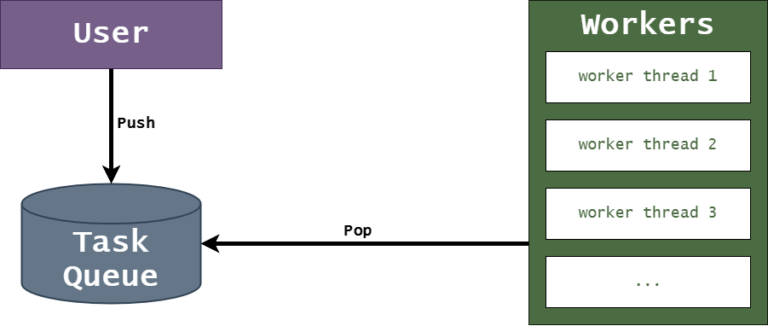
A GitHub project for an event loop in C provides a good summary of how these components fit together in a server context.
The README for the 'event-loop-c' project gives a concise overview of a system just like the one we're building.
Please review the 'Functioning' and 'Functions' sections. Notice how the description maps directly to the Boss/Worker pattern we just discussed. The function list (handle_new_connections, handle_client, etc.) clearly outlines the separate pieces of our system.
2. Implementing the Engine: A Thread Pool with Efficient Waiting
We know from previous lessons that creating a new thread for every event is inefficient due to the overhead of thread creation and destruction. A thread pool is the solution. However, implementing the worker logic requires care to avoid being inefficient in a different way.
Let's watch a video that walks through building a multithreaded server, starting with a simple (but flawed) approach and refining it.
Multithreaded Server Part 2: Thread Pools
This video, 'Multithreaded Server Part 2: Thread Pools' by Jacob Sorber, demonstrates the core problem and the evolution of the solution.
Watch the following segments: The Problem (0:35 - 1:36): Understand why creating unbounded threads is a problem. Basic Pool Setup (1:36 - 4:46): See how a pool of threads is created and how a queue is used to pass connection information (our 'events') from the main thread (dispatcher) to the workers. The Inefficiency (7:02 - 8:06): This is a critical point. The video demonstrates how a simple worker loop that constantly checks the queue leads to 100% CPU usage, a problem known as busy-waiting or spinning. The video ends by teasing condition variables as the solution, which we will implement next.
The busy-waiting problem is exactly what condition variables are designed to solve. Instead of spinning, a worker thread should sleep efficiently when the queue is empty and be woken up only when the dispatcher adds a new event.
This brings us to the canonical implementation of a worker thread's main loop, which you've implemented before: the wait-in-a-loop pattern.
Thread Pools in C (using the PTHREAD API)
The video 'Thread Pools in C' by CodeVault provides an excellent, detailed implementation of a thread pool that correctly uses a condition variable to avoid busy-waiting.
Focus on these parts that show the complete, efficient logic: Worker Logic (8:22 - 10:58): This shows the initial, inefficient attempt at a worker loop. Task Submission & Locking (13:17 - 14:52): Observe how the dispatcher (via submit_task) locks the mutex to safely add a task to the queue. The Efficient Solution (16:15 - 20:37): This is the most important section. Watch how a condition variable and a while loop are introduced into the worker function to wait efficiently. Notice how the dispatcher calls pthread_cond_signal after submitting a task to wake up a waiting worker.
Test your understanding!
In the Boss/Worker pattern, consider two scenarios:
- The dispatcher (Boss) is very slow, but the workers are very fast.
- The workers have very long tasks to complete, but the dispatcher is very fast.
In which scenario would increasing the number of worker threads improve the system's overall throughput (events processed per second)?
Show answer
Scenario 2. If the workers are the bottleneck (i.e., their tasks are long), adding more workers allows more tasks to be processed in parallel, improving throughput. In Scenario 1, the dispatcher is the bottleneck. Since there's only one dispatcher, the rate at which it can enqueue tasks is the system's maximum throughput. Adding more workers won't help because they will just spend more time waiting for the slow dispatcher to give them work.
3. A Complete Implementation
Let's tie this all together into a working C program. We will simulate an event processing system.
- Our "events" will be simple structs containing an ID.
- The dispatcher will be the
mainfunction, generating events in a loop. - The workers will process events by printing the event ID and sleeping for a short time to simulate work.
- We'll use a simple, fixed-size array as our task queue, protected by a mutex and a condition variable.
Here is the complete code:
#include <stdio.h>
#include <stdlib.h>
#include <unistd.h>
#include <pthread.h>

#define NUM_WORKERS 4
#define QUEUE_CAPACITY 16

// Our simple "event" or "task"
typedef struct {
    int id;
} event_t;

// The shared task queue
event_t task_queue[QUEUE_CAPACITY];
int task_count = 0;
int queue_head = 0;
int queue_tail = 0;

// Synchronization primitives
pthread_mutex_t queue_mutex;
pthread_cond_t queue_cond;

// Function for the worker threads
void* worker_function(void* arg) {
    long worker_id = (long)arg;
    printf("Worker %ld started.\n", worker_id);

    while (1) {
        pthread_mutex_lock(&queue_mutex);

        // Wait-in-a-loop pattern to handle spurious wakeups
        while (task_count == 0) {
            printf("Worker %ld: Queue empty, waiting...\n", worker_id);
            pthread_cond_wait(&queue_cond, &queue_mutex);
            printf("Worker %ld: Woke up.\n", worker_id);
        }

        // Dequeue an event
        event_t event = task_queue[queue_head];
        queue_head = (queue_head + 1) % QUEUE_CAPACITY;
        task_count--;

        pthread_mutex_unlock(&queue_mutex);

        // Process the event (outside the lock)
        printf("Worker %ld: Processing event %d.\n", worker_id, event.id);
        sleep(1); // Simulate work
    }

    return NULL;
}

// Function for the dispatcher thread (main)
int main() {
    pthread_t workers[NUM_WORKERS];

    // Initialize mutex and condition variable
    pthread_mutex_init(&queue_mutex, NULL);
    pthread_cond_init(&queue_cond, NULL);

    // Create worker threads
    for (long i = 0; i < NUM_WORKERS; ++i) {
        pthread_create(&workers[i], NULL, worker_function, (void*)i);
    }

    // --- This is the dispatcher loop ---
    int event_id = 0;
    while (1) {
        // "Generate" a new event
        event_t new_event = { .id = event_id++ };

        usleep(500 * 1000); // Dispatcher generates events every 500ms

        pthread_mutex_lock(&queue_mutex);

        // Enqueue the event
        if (task_count < QUEUE_CAPACITY) {
            task_queue[queue_tail] = new_event;
            queue_tail = (queue_tail + 1) % QUEUE_CAPACITY;
            task_count++;
            printf("Dispatcher: Enqueued event %d. (Queue size: %d)\n", new_event.id, task_count);

            // Signal ONE waiting worker thread
            pthread_cond_signal(&queue_cond);
        } else {
            printf("Dispatcher: Queue full, dropping event %d.\n", new_event.id);
        }

        pthread_mutex_unlock(&queue_mutex);
    }

    // In a real application, you would have a graceful shutdown mechanism
    // to join the worker threads. For this example, we'll let it run forever.
    // for (int i = 0; i < NUM_WORKERS; ++i) {
    //     pthread_join(workers[i], NULL);
    // }
    // pthread_mutex_destroy(&queue_mutex);
    // pthread_cond_destroy(&queue_cond);

    return 0;
}
Compile this code with gcc -o event_system event_system.c -pthread and run it. You will see the dispatcher steadily adding events to the queue and the worker threads waking up to process them. You'll see workers waiting when the queue is empty and the dispatcher warning when the queue is full. This is the Boss/Worker pattern in action.
Conclusion
Congratulations on completing the course! In this final lesson, you designed and implemented a multi-threaded event processing system, one of the most fundamental and useful patterns in concurrent C programming.
Key Takeaways:
- The Boss/Worker (Dispatcher/Worker) pattern is a highly effective way to structure concurrent, event-driven applications. It decouples event reception from event processing, improving responsiveness and scalability.
- The Dispatcher's role is minimal: accept an event and enqueue it quickly.
- The Worker's role is to take a task from the queue and process it fully.
- A thread-safe task queue using a mutex for mutual exclusion and a condition variable to avoid busy-waiting is the efficient engine at the heart of this pattern.
You have now built a strong, practical foundation in C multithreading. From the basic building blocks of pthread_create and pthread_mutex_lock to advanced, reusable patterns like thread pools, connection pools, and event-driven systems, you are now equipped to design, implement, and reason about complex concurrent software. The journey from here involves applying these patterns to new problems and continuing to hone your skills in debugging and performance optimization. Well done