Introduction
Welcome back! In our last lesson, you learned to count from 1 to 10 using the Sino-Japanese (kango) system. This was the first crucial step towards handling numbers in practical situations. You'll recall we established that this system (ichi, ni, san...) is the foundation for prices, times, and other abstract numbers.
Today, we'll build directly on that foundation. Our goal is to recognize and state numbers up to 100,000, which is the range you'll most commonly encounter for prices when shopping, eating out, or buying train tickets in Japan. This lesson is designed like a "plug-and-play" system: once you know the core components, you can construct any number you need.
Part 1: From 11 to 99
Let's start by filling in the numbers up to 100. The logic here is straightforward and consistent, which should feel familiar given your background in systems and coding.
To form numbers from 11 to 19, you simply start with 10 (じゅう, juu) and add the next number.
- 11 = 10 + 1 → じゅういち (juu-ichi)
- 12 = 10 + 2 → じゅうに (juu-ni)
- 19 = 10 + 9 → じゅうきゅう (juu-kyuu)
For multiples of ten (20, 30, 40, etc.), you state how many tens there are.
- 20 = 2 x 10 → にじゅう (ni-juu)
- 30 = 3 x 10 → さんじゅう (san-juu)
- 90 = 9 x 10 → きゅうじゅう (kyuu-juu)
Now, you just combine these two patterns. For example, to say 47:
- 47 = 4 x 10 + 7 → よんじゅうなな (yon-juu nana)
The following article from JapanesePod101 explains this simple, additive structure very clearly.
Japanese Numbers: How to Count in Japanese - JapanesePod101
Please read the following section from the article 'Japanese Numbers: How to Count in Japanese' to see how these numbers are constructed.
Read section 2, 'Counting in Japanese: Numbers 10-99'. Pay attention to the tables showing how numbers like 11, 20, and 21 are formed. Notice the 'Literal reading' column, which highlights the logic (e.g., 21 is '2, 10, 1').
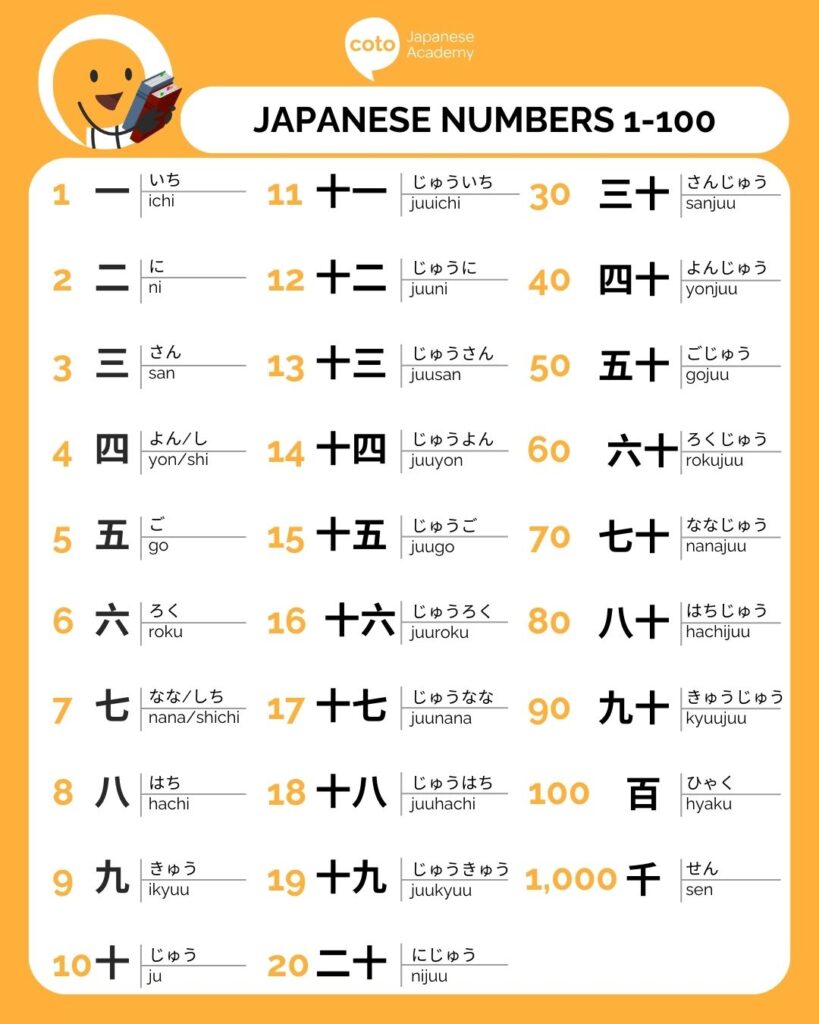
As a handy reference, here is a chart that lays out the numbers up to 100.
Part 2: The Big Units - 百 (hyaku), 千 (sen), 万 (man)
Now we get to the core of reading prices. To handle larger numbers, you only need to learn three new key unit words:
- 100 = 百 (ひゃく, hyaku)
- 1,000 = 千 (せん, sen)
- 10,000 = 万 (まん, man)
The most important concept to grasp here is 万 (man). While English groups large numbers by thousands (thousand, million, billion), Japanese groups them by ten-thousands. This is the single biggest difference and is key to avoiding confusion.
Let's see how this works:
| Number | Western Grouping | Japanese Grouping | Japanese Reading |
|---|---|---|---|
| 5,000 | 5 thousand | 5 thousand | ごせん (go-sen) |
| 10,000 | 10 thousand | 1 ten-thousand | いちまん (ichi-man) |
| 25,000 | 25 thousand | 2 ten-thousands, 5 thousand | にまん ごせん (ni-man go-sen) |
| 100,000 | 100 thousand | 10 ten-thousands | じゅうまん (juu-man) |
Notice for 10,000, you must say いちまん (ichi-man), unlike with 100 (百, hyaku) or 1,000 (千, sen) where the 'ichi' is usually omitted.
To solidify this concept, please read the sections below from our two main resources. They explain these units and the crucial role of man.
Japanese Numbers: How to Count in Japanese - JapanesePod101
First, let's look at the article from JapanesePod101 again. It introduces 'hyaku', 'sen', and then 'man', clearly explaining the four-digit grouping system.
Please read section 3, 'Counting in Japanese: Numbers up to 1000', and section 4, 'Counting in Japanese: More than 10,000'. Focus on the tables and the explanation of how 'man' (万) works as the base for larger numbers.
Japanese Money — Everything there is to know about Yen
This next resource provides a concise list and also introduces some important pronunciation changes, which we'll cover next.
Read the section titled 'Counting Japanese Money'. Look at the list of numbers and how it presents 'hyaku', 'sen', 'man', and 'juu man' (100,000).
Part 3: Important Sound Changes
When certain numbers combine with the units hyaku and sen, their pronunciation changes slightly. This is a very common feature in Japanese phonetics. Learning these will make your spoken Japanese sound more natural and will help you understand native speakers.
Here are the key changes to memorize:
| Number + Unit | Regular Reading | Correct Pronunciation |
|---|---|---|
| 3 + 百 (hyaku) | san hyaku | さんびゃく (sanbyaku) |
| 6 + 百 (hyaku) | roku hyaku | ろっぴゃく (roppyaku) |
| 8 + 百 (hyaku) | hachi hyaku | はっぴゃく (happyaku) |
| 3 + 千 (sen) | san sen | さんぜん (sanzen) |
| 8 + 千 (sen) | hachi sen | はっせん (hassen) |
Note on 1,000: While 千 (sen) is correct for 1,000, you will sometimes hear it as 一千 (いっせん, issen), especially in formal contexts.
The resource "Japanese Money — Everything there is to know about Yen" that you just looked at has a dedicated subsection explaining this. It's worth reviewing it one more time to fix these changes in your mind. Focus on the part titled "What to remember when counting Japanese money," specifically point #2 about "The special 1, 3, 6, and 8."
Part 4: Stating Prices in Yen (円)
Now, let's put everything together. The Japanese currency is the Yen, pronounced えん (en) and written with the kanji 円.
To state a price, you simply say the number you've constructed and add en at the end.
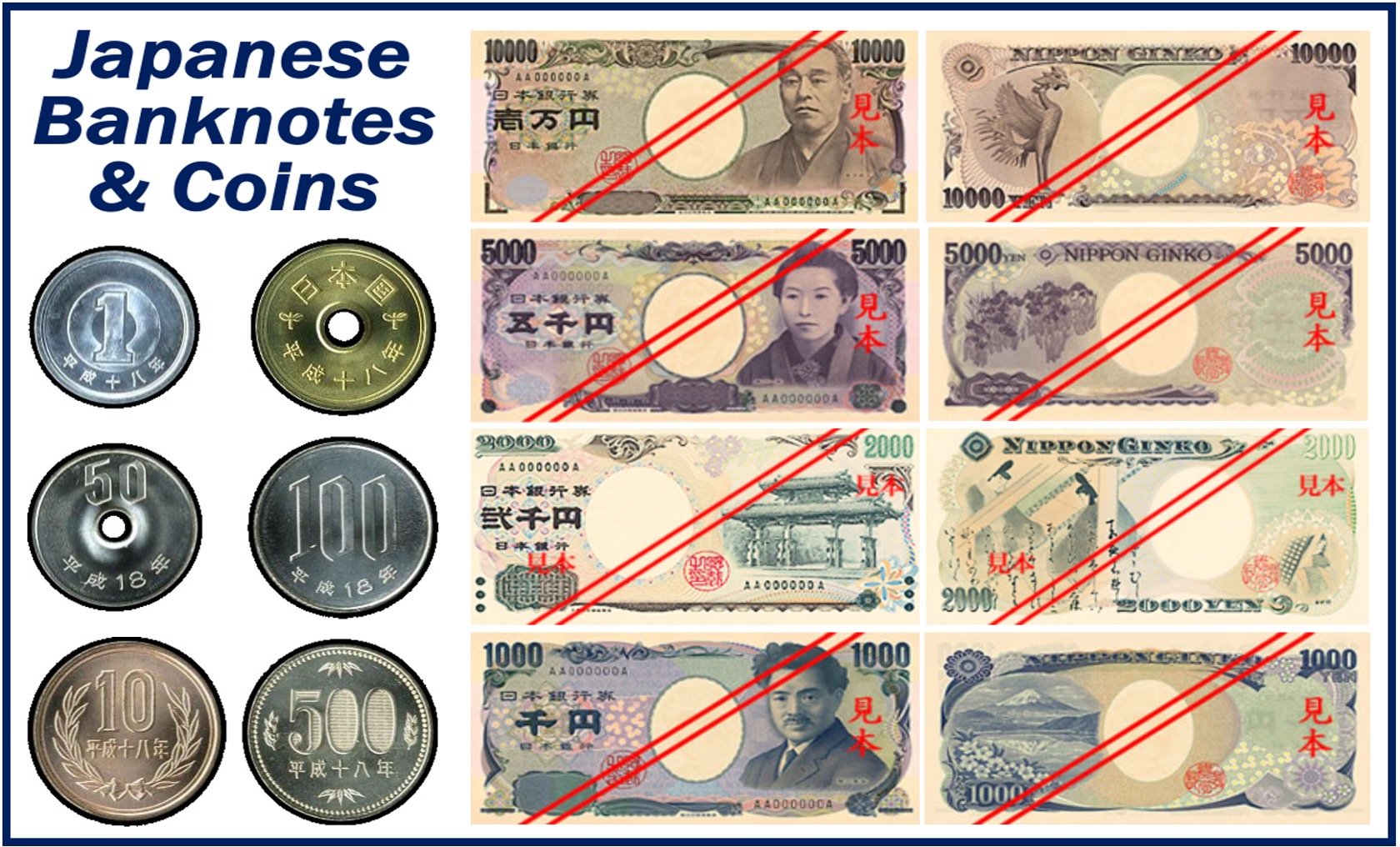
Let's practice breaking down a price. Imagine an item costs 37,500円.
- Isolate the 万 (man) unit: 37,500 has 3 ten-thousands.
- → さんまん (san-man)
- Look at the thousands: There are 7 thousands.
- → ななせん (nana-sen)
- Look at the hundreds: There are 5 hundreds.
- → ごひゃく (go-hyaku)
- Combine and add 円 (en):
- さんまん ななせん ごひゃく えん (san-man nana-sen go-hyaku en)
Let's try a few more:
- 860円 → happyaku roku-juu en (はっぴゃく ろくじゅう えん) — Notice the sound change for 800!
- 4,810円 → yon-sen happyaku juu en (よんせん はっぴゃく じゅう えん) — Again, 800 is happyaku.
- 12,000円 → ichi-man ni-sen en (いちまん にせん えん)
- 99,800円 → kyuu-man kyuu-sen happyaku en (きゅうまん きゅうせん はっぴゃく えん)
This system is very predictable. With a little practice, you'll be able to read any price tag you see.
Conclusion
Excellent work today. You've gone from counting to 10 to being able to decipher and say prices up to 100,000 yen. This is a massive step towards being self-sufficient while shopping and dining in Japan.
Key Takeaways:
- Japanese numbers from 11-99 are built logically:
juu-ichi(11),ni-juu(20),ni-juu ichi(21). - The key units for large numbers are 百 (hyaku) for 100, 千 (sen) for 1,000, and especially 万 (man) for 10,000.
- Remember that Japanese groups large numbers in sets of four digits (based on the man unit).
- Memorize the critical sound changes: sanbyaku (300), roppyaku (600), happyaku (800), and sanzen (3,000).
- To state a price, just say the number followed by 円 (en).
Preview of the next lesson:
Now that you can read a price, the next logical step is to ask for it. In our next lesson, we will learn the simple and essential question, "How much is it?" using the phrase これ は いくら です か? (Kore wa ikura desu ka?).