Introduction
Welcome back! In our last lesson, we finished our dive into handling money by learning how to read prices on tags and menus, focusing on the essential 円 (en) symbol. You're now equipped to understand how much things cost in Japan.
Today, we'll learn another crucial phrase you'll need right when you arrive at a restaurant or café. This lesson covers the final learning outcome for our module on "Core Vocabulary." Our goal is to learn how to state the number of people in your party, specifically for groups of one to four. This is often the very first question you'll be asked upon entering, so knowing the answer is key to a smooth start to your meal.
The First Question: "How Many People?"
When you walk into a Japanese restaurant, a staff member will greet you (usually with a loud and welcoming いらっしゃいませ - irasshaimase!) and then ask how many people are in your group.
To understand this common situation, let's look at a short explanation.
How To Order in Japanese: A Restaurant Walkthrough - Japan Dev
The article 'How To Order in Japanese' from Japan Dev sets the scene perfectly. It introduces the typical question you'll hear when entering a restaurant.
Please read the section titled 'Walking Into The Restaurant: How Many People Are In Your Group?'. Focus on the question the staff will ask: 'Nan mei sama desu ka?' (何名様ですか?).
As the article points out, the staff will likely ask:
何名様ですか? (Nan mei sama desu ka?) - "How many people are in your group?"
This is a polite form of the question. You don't need to memorize how to say it, but recognizing it is very helpful. Now, let's learn how to answer.
Stating Your Party Size: 1 to 4 People
Answering this question is straightforward, but there's a small quirk. The words for one and two people are unique, while three or more follow a more regular pattern. Your goal is to memorize these four key phrases.
The most direct way to learn them is through a simple list.
The Top 10 Survival Japanese Phrases at the Restaurant
The article 'The Top 10 Survival Japanese Phrases at the Restaurant' provides the exact, practical phrases you need. It's concise and perfect for your phrase-based approach.
Read point #1, 'Two people, please,' and its variations. This section gives you the exact phrases for one to four people.
Here are the phrases from the article, which you should aim to commit to memory:
- 1 person: ひとりです。 (hitori desu)
- 2 people: ふたりです。 (futari desu)
- 3 people: さんにんです。 (san-nin desu)
- 4 people: よにんです。 (yo-nin desu)
Notice the pattern:
- Hitori and futari are special words.
- From three onwards, you use the number (
san,yon) followed by the counter for people, nin (人), and end withdesu.
The image below provides a great visual summary and includes the kanji characters.
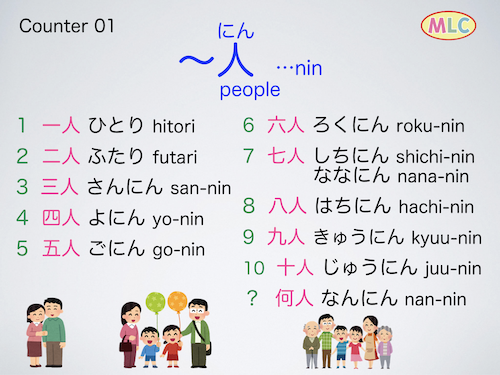
As you can see, hitori is 一人 and futari is 二人. The kanji 人 means "person" and is pronounced nin when used as a counter from three upwards. Recognizing this kanji will be very useful on your trip.
Practice in Context
Now, let's see how this works in a simple, realistic dialogue. The same resource we just looked at provides a perfect example.
The Top 10 Survival Japanese Phrases at the Restaurant
Let's return to the 'Chatty Sensei' article and look at a quick dialogue to see your new phrase in action.
Find the section 'Quick Restaurant Dialogue (Copy & Practice)'. Read through the short script to see how 'futari desu' is used naturally at the start of a restaurant interaction.
Let's break down the first two lines of that exchange:
Staff: いらっしゃいませ。 (Irasshaimase.)
Welcome.
You: 2人(ふたり)です。 (Futari desu.)
Two people.
It's that simple! You state the number of people, and the staff will guide you to a table. The rest of the dialogue in the article gives you a great preview of phrases we'll cover in future lessons, such as asking for a menu and ordering.
Conclusion
Great work! You've just learned one of the most fundamental phrases for dining out in Japan. This completes our module on core numbers and prices, giving you the tools to both understand costs and get seated for a meal.
Key Takeaways:
- When entering a restaurant, you'll likely be asked: Nan mei sama desu ka? (How many people?).
- To state your party size, use these four essential phrases:
- One person: hitori desu (ひとりです)
- Two people: futari desu (ふたりです)
- Three people: san-nin desu (さんにんです)
- Four people: yo-nin desu (よにんです)
- Remember that the counters for one (
hitori) and two (futari) people are irregular.
Preview of the next lesson:
We have now concluded the "Core Vocabulary" module. In our next lesson, we will begin Module 4: "Essential Phrase Patterns." We'll start with the most fundamental sentence structure in Japanese: AはBです (A wa B desu). This pattern is the key to unlocking a wide range of simple statements and will serve as the foundation for building many of the practical phrases you need for your trip.