Introduction
Hello and welcome back! In the last few lessons, you've successfully learned both the hiragana and katakana writing systems, including their modifications like diacritics and combined forms. You now have the foundational tools to read a significant portion of written Japanese.
Today, we'll focus on a crucial practical skill: distinguishing between hiragana and katakana when they appear together in the same text. In Japan, you'll rarely see a sign or menu written purely in one script. They are almost always mixed. This lesson will teach you how to tell them apart by their shape and function, which is the key to quickly spotting and reading important words for your trip, like names of places, food items, and products.
Part 1: The Core Difference - Shape and Function
The Japanese writing system uses three scripts together: hiragana, katakana, and kanji. For now, we'll focus on the two you've learned. The easiest way to tell them apart is by their visual style and their specific job in a sentence.
- Hiragana (ひらがな): Characters are generally rounded, curvy, and flowing.
- Katakana (カタカナ): Characters are sharp, angular, and made of straight lines.
This visual difference exists for a historical reason. As both scripts were simplified from more complex Chinese characters (kanji), hiragana evolved from a cursive, flowing style of writing, while katakana was created by taking just one piece or component of a kanji, resulting in its blocky look.
Let's read a quick overview of their distinct appearances and roles.
Japanese Writing System Explained: Kanji, Hiragana, and Katakana
The following article from Coto Academy provides a concise explanation of the visual differences and the primary jobs of hiragana and katakana. It will clarify why you need to know both.
Please read the sections titled 'Japanese Writing System #1: Hiragana' and 'Japanese Writing System #2: Katakana', and conclude with 'Difference between Hiragana and Katakana'. Focus on the descriptions of their shapes (curvy vs. angular) and their main uses (native words/grammar vs. foreign words/emphasis).
To summarize the key functions:
| Script | Visual Style | Primary Uses |
|---|---|---|
| Hiragana | Curvy, rounded | Native Japanese words, grammatical particles (e.g., は, の, が), verb and adjective endings (e.g., 〜ます, 〜です). |
| Katakana | Angular, sharp | Foreign loanwords (e.g., from English), foreign names, onomatopoeia (sound words), emphasis (like italics). |
Here is a perfect visual breakdown of a simple sentence. Notice how each script has a specific role.

Part 2: Spotting the Difference in Practice
While the "curvy vs. angular" rule is a great starting point, some characters look frustratingly similar. Mastering these tricky pairs is essential for accurate reading.
The most common "lookalikes" are:
- Hiragana し (
shi) and Katakana ツ (tsu) - Katakana シ (
shi) and Katakana ツ (tsu) - Katakana ソ (
so) and Katakana ン (n)
The article below has some great tips for telling these apart, often focusing on the direction of the strokes.
Guide to Hiragana and Katakana | Learn Japanese - Japan Switch
This article from Japan Switch specifically tackles the problem of 'twin katakana' that often confuse learners.
Read the section titled 'Twin Katakana'. Pay close attention to the tips for telling apart シ/ツ and ソ/ン. The author's mnemonics might be helpful.
Here's a visual guide that can help solidify the difference. Notice the angle of the small strokes and the overall shape.
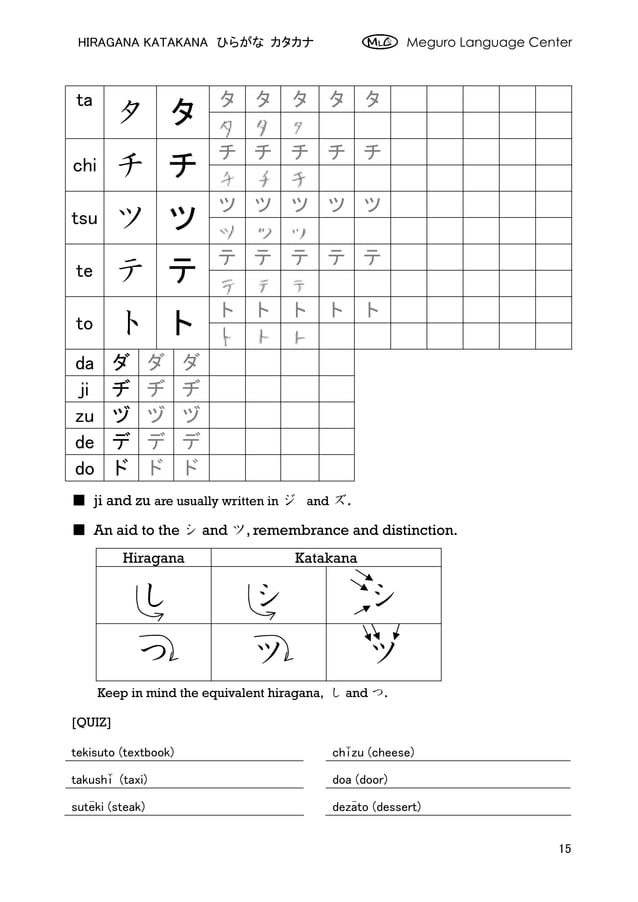
Another huge clue: If you see the long vowel mark ー, you are almost certainly looking at katakana. Hiragana lengthens vowels by adding another vowel character (e.g., おう ou), whereas katakana uses this dash. Spotting this mark is a quick way to identify a word as a foreign loanword.
Part 3: Reading Mixed Text
Now let's put it all together. Your goal on your trip is to read real-world text, so let's practice with a short paragraph that mixes hiragana and katakana.
Your task is not to understand every word. Instead, scan the text and try to identify all the words written in katakana. Look for the angular shapes and the long vowel mark ー.
Guide to Hiragana and Katakana | Learn Japanese - Japan Switch
This passage from the Japan Switch article describes someone's travel plans, using katakana for foreign places, names, and activities. It's a perfect simulation of what you might see in a travel brochure or on a website.
Find the paragraph under the heading 'Yuki's Summer Plans'. Read through it and try to pick out all the katakana words. Write them down if it helps. Then, check your list against the solution below.
Here are the katakana words from that passage. How many did you find?
ワクワク(wakuwaku): An onomatopoeia for being excited.オーストラリア(Ōsutoraria): Australiaサーフィン(sāfin): Surfingフランス(Furansu): Franceイギリス(Igirisu): England (UK)レストラン(resutoran): Restaurantデパート(depāto): Department store
Notice how every one of these is either a foreign word, a name, or onomatopoeia. Seeing this pattern in action is the best way to internalize the rule.
Since you have a background in IT, you might find it interesting that Japanese technical vocabulary is flooded with katakana. Words like サーバー (sābā - server), ネットワーク (nettowāku - network), and プログラミング (puroguramingu - programming) are all written this way. Your ability to spot katakana will be a powerful tool for decoding concepts you already understand.
Conclusion
Great work today! You've moved from learning the scripts in isolation to understanding how they function together in authentic Japanese text. This is a critical step toward reading effectively during your travels.
Key Takeaways:
- You can distinguish hiragana and katakana by their shape: hiragana is curvy, and katakana is angular.
- They also have different jobs: hiragana is for grammar and native words, while katakana is for foreign words, names, and emphasis.
- Watch out for lookalike characters like
シ/ツandソ/ン. Stroke direction is often the key to telling them apart. - The long vowel mark (
ー) is a clear sign that you are reading katakana.
Preview of the next lesson:
Now that you can confidently spot katakana words, it's time to learn what they mean. In the next lesson, we will focus on reading common loanwords you are guaranteed to see on signs and menus in Japan, such as ホテル (hoteru - hotel), レストラン (resutoran - restaurant), and コーヒー (kōhī - coffee).