Introduction
Welcome to the final module of your course, "Accommodations and Asking for Help." In the last few lessons, you learned to read signs to navigate cities and find essential places like a 交番 (kōban) or 病院 (byōin). Now, we'll focus on the specific interactions you'll have once you arrive at your destination, starting with your hotel.
This lesson covers the first, most important step: checking in. By the end of our session, you'll be able to confidently approach the front desk and announce your arrival using the key phrase yoyaku shita [Name] desu, which means "I am [Name], and I have a reservation." This will allow you to smoothly begin the check-in process at any hotel in Japan.
1. The First Step: "I'd like to check in"
When you walk up to the hotel reception, the simplest way to start the conversation is with a polite request to check in. For this, you can use a phrase that combines the English word "check-in" (written in Katakana) with a pattern you've seen before.
The phrase is:
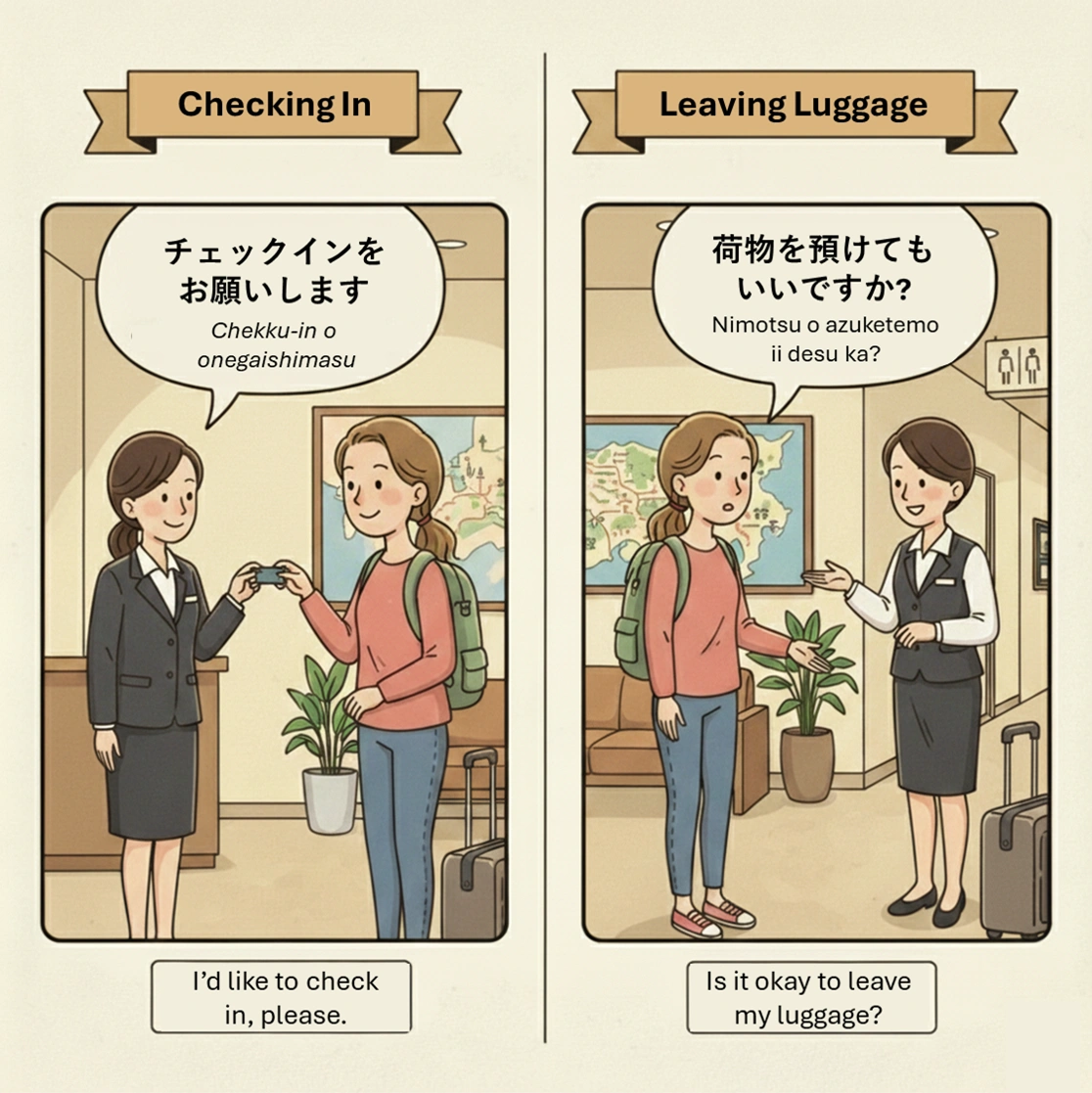
チェックインお願いします。
(Chekkuin onegai shimasu.)
I'd like to check in, please.
You'll recognize お願いします (onegaishimasu) from when you learned to ask for the bill (o-kaikei o onegaishimasu). It's a versatile and polite way to make a request.
This image provides a great visual for this exact situation.
2. Stating Your Reservation and Name
After you say Chekkuin onegai shimasu, the hotel staff will almost certainly ask for your name. You can wait for them to ask, or you can be proactive and provide the information right away using the core phrase for this lesson.
The phrase is:
予約した [Your Name] です。
(Yoyaku shita [Your Name] desu.)
Let's break this down:
- 予約 (yoyaku): This is a key vocabulary word meaning "reservation." It's made of the kanji 予 (yo - beforehand) and 約 (yaku - promise/appointment).
- した (shita): This is the past tense of the verb "to do." So,
yoyaku shitameans "made a reservation." - [Your Name] です (desu): You'll remember this from your very first lesson on introductions. It simply means "I am [Your Name]."
Putting it all together, the phrase literally translates to "I am [Name] who made a reservation." It's the standard, efficient way to identify yourself when you have a booking.
To hear this phrase and see it combined with the check-in request, please study the following resource.
Infographic: Japanese Phrases for Traveling Part 3
The following resource from JapaneseTest4You provides the complete check-in phrase with audio, which will help you with pronunciation.
Please read the second phrase listed: 'My name is Brown. I want to check in.' Focus on the Japanese sentence 予約したブラウンです. チェックインお願いします. (yoyaku shita buraun desu. chekkuin onegai shimasu.). Use the audio player on the page to listen to the pronunciation several times.
As you can see, you can combine both phrases into one confident statement:
予約した [Your Name] です。チェックインお願いします。
(Yoyaku shita [Your Name] desu. Chekkuin onegai shimasu.)
3. Understanding the Conversation Flow
Now that you have the key phrases, let's put them into the context of a short conversation. The following reading provides more examples and shows you what the hotel staff might say in response.
This blog post from Maggie Sensei offers a detailed look at various hotel interactions. We will focus only on the section for checking in.
Please scroll down to the section that starts with 'OK, let’s check in!!'. Read from there until you see the row of asterisks (*****). Pay attention to the following phrases: チェックインお願いします。 (Chekkuin onegai shimasu.) - The initial request. お名前をお願いします。 (Onamae wo onegai shimasu.) - What the staff might ask ('May I have your name please?'). 予約したマギーポップコーンと言います。 (Yoyaku shita... to iimasu.) - This is a slight variation of our main phrase. ... to iimasu also means 'My name is...'. The ... desu version you've learned is simpler and just as effective.
Based on this, here is a typical check-in conversation flow:
Scenario A: You state your name proactively.
- You:
こんにちは。予約した [Your Name] です。チェックインお願いします。
(Konnichiwa. Yoyaku shita [Your Name] desu. Chekkuin onegai shimasu.)
(Hello. I'm [Your Name] with a reservation. I'd like to check in, please.) - Staff:
はい、かしこまりました。(Hai, kashikomarimashita.) (Yes, certainly.)
Scenario B: You wait for the staff to ask.
- You:
こんにちは。チェックインお願いします。
(Konnichiwa. Chekkuin onegai shimasu.)
(Hello. I'd like to check in, please.) - Staff:
お名前をお願いします。(Onamae o onegai shimasu.) (May I have your name, please?) - You:
[Your Name] です。([Your Name] desu.) (I'm [Your Name].)
Both approaches work perfectly. Scenario A is slightly more direct and efficient.
Conclusion
Excellent work! You now have the essential phrases to handle the first and most important interaction at your hotel. By confidently stating your name and reservation, you'll start your stay on the right foot.
Key Takeaways:
- To start the check-in process, say:
チェックインお願いします(Chekkuin onegai shimasu). - The primary phrase to state your reservation is:
予約した [Your Name] です(Yoyaku shita [Your Name] desu). - You can combine these into one clear statement to efficiently communicate your purpose to the hotel staff.
Preview of the next lesson:
Now that you've successfully checked in, what if you need something for your room? In our next lesson, you will learn how to use the ... o onegaishimasu pattern to ask for common hotel amenities, such as an extra towel (taoru) or a key (kagi).