Hello. In the previous lesson, you practised making a specific request for support rather than hoping someone would guess what you needed. That same distinction matters when stress brings an urge to drink or smoke: the urge names a familiar response, but not necessarily the need underneath it. This lesson is about identifying what you expect alcohol or a cigarette to do for you, then choosing a response that addresses that need without either substance.
An urge is a clue, not an instruction
A stressful moment may bring a thought such as “A drink would help” or “I need a cigarette.” Neither thought tells the whole story. You might be hoping for a pause, relief from tension, a way to feel comfortable with other people, something to do with your hands, or help settling down at night. A familiar routine can also prompt an urge even when the original stress has passed.
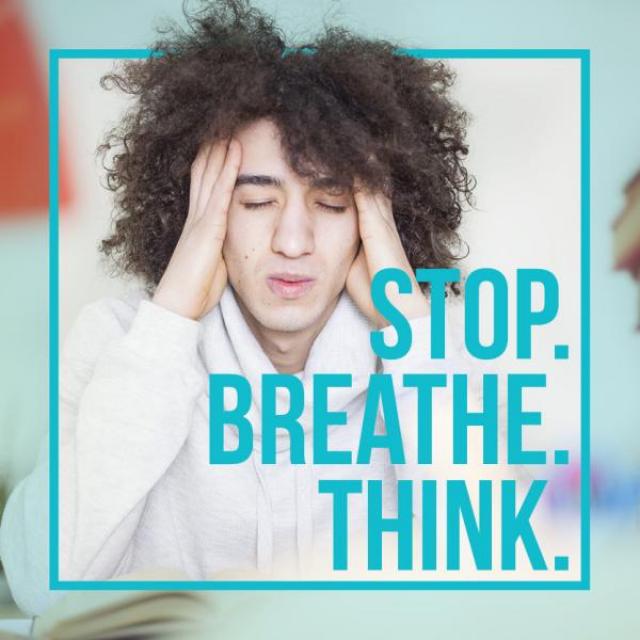
The image below captures a useful pause. Here, “breathe” means the gentle, comfortable breathing you practised earlier—not forcing a deep breath or holding it. The point is to leave enough space to identify the need before choosing a response.
Watch two short portions of Sandstone Care’s Alcohol Use As A Coping Mechanism. The opening shows several different things someone might hope alcohol will change; the later portion offers alternatives. Treat those alternatives as possibilities to match to a need, not as a universal list that works for everyone.
Alcohol Use As A Coping Mechanism | 9 Tips On How To Quit Alcohol | Alcohol Addiction Treatment
Sandstone Care’s Alcohol Use As A Coping Mechanism contrasts reasons for drinking with other ways of coping. Watch for the difference between naming an activity and identifying what that activity is meant to provide.
Watch the reasons for drinking, including tension, social discomfort, sleep, and boredom. Then watch the alternatives. The presentation is playful; focus on whether each suggested alternative would actually meet the particular need at hand.
Expected benefit is the key phrase. You do not have to establish that a substance would reliably deliver relief to understand why it feels appealing. An urge may promise a quick change, while the effects that follow—or the return of the original problem—may be less welcome. Identifying the promise makes it possible to choose something more fitting.
Name what you expect the substance to do
A practical way to interpret an urge is to separate three things: the situation, the hoped-for benefit, and any additional pull from habit or physical craving. These can overlap. Someone might want a break and associate that break with smoking; someone else might want reassurance and expect a drink to make a social setting easier.
The Australian Government Department of Health, Disability and Ageing’s How can you reduce or quit alcohol? places triggers and strategies together in its “Work out a plan” section. Read it for the principle of choosing an alternative based on why drinking is appealing, rather than swapping drinks mechanically.
Read the “Work out a plan” section from the Australian Government Department of Health, Disability and Ageing. It connects drinking triggers with strategies and includes a medical caution relevant to people who drink regularly or heavily.
Under “Work out a plan,” start in “Your goals” at the example of drinking one less glass. Read goals and triggers through the end of “Your triggers.” Then, in “Your strategies,” locate the example about drinking before going out to feel less anxious. Read the alternative and caution, stopping at the warning about reducing or quitting without medical help. Notice that meeting a friend addresses the anticipated need for social ease; it is not simply another beverage.
The same reasoning applies to a cigarette urge. The table below is a set of possible interpretations, not a way to diagnose a need from a situation alone.
| What the urge seems to promise | A cigarette-free and alcohol-free response to consider |
|---|---|
| “I need a break from this task.” | Step away briefly, change position, or take a short movement break suited to your space and energy. |
| “I need to calm my body.” | Try comfortable, slow-paced breathing or gentle movement. Stop a breathing practice if it causes discomfort or dizziness. |
| “I need someone with me.” | Make the specific, manageable support request practised in the previous lesson. |
| “I need something familiar to do.” | Change the routine; try water, gum, or an object to hold if those are comfortable and available. |
| “I need to switch off for the night.” | Begin one feasible part of your wind-down routine rather than expecting instant sleep. |
Notice the limits of each match. Water may give your hands something to do, but it cannot provide reassurance. A supportive conversation may ease loneliness, but it does not necessarily resolve nicotine withdrawal. Choosing well means identifying which need is most pressing now, while remaining open to there being more than one.
Match the response to the kind of trigger
Smokefree’s Know Your Smoking Triggers distinguishes emotional triggers from patterns tied to activities such as coffee or a work break. That distinction helps explain why the same cigarette-free response will not fit every urge. The page also discusses social and withdrawal triggers; those are reminders that changing a routine or calming an emotion may not address every part of a craving.
Know Your Smoking Triggers | Smokefree
Read the opening, “Emotional Triggers,” and “Pattern Triggers” in Smokefree’s Know Your Smoking Triggers. Focus on how a response to an emotion differs from a replacement for a familiar routine.
At the top of the page, read the trigger explanation. In “Emotional Triggers,” read emotions and options. Finally, in “Pattern Triggers,” start where a pattern trigger is defined and read routine replacements. When the page suggests deep breathing, use the gentle approach from your breathing lesson rather than forcing deep breaths.
Suppose the stressful episode is a difficult workday, followed by an urge for a cigarette during the usual afternoon break. There are at least two plausible stories. If the strongest need is distance from work, keeping the break but taking it somewhere different may help. If the strongest pull is the familiar hand-to-mouth routine, gum or another comfortable replacement may be more relevant. If the person has stopped smoking and is experiencing nicotine withdrawal, a change of scenery alone may not be enough. Smokefree notes that nicotine replacement therapy may help with withdrawal; decisions about treatment are best made with an appropriate healthcare professional, particularly where medical circumstances call for advice.
This is why “just take a walk” can be either useful or beside the point. Movement may discharge restlessness and provide a break. It is less likely, by itself, to meet a need for company or to address physical withdrawal. There is no failure in discovering that an initially reasonable choice did not address the main need.
See the choice in a complete situation
Consider a fictional person arriving at a gathering after a tense day. They notice an urge to drink before talking to anyone. The obvious trigger is the gathering, but the anticipated benefit is more precise: feeling less exposed and having an easier way to enter a conversation. Holding an alcohol-free drink may preserve the familiar social action of having something in hand. Arranging to meet a trusted person on arrival, or asking them to stay and talk for the first few minutes, more directly addresses the need for social ease. Leaving early is another reasonable option if the setting remains too much.
Now change only the hoped-for benefit. Imagine the person is not worried about conversation; they want the gathering to mark the end of an exhausting day. In that version, meeting a friend may still be pleasant, but a quiet break before entering—or choosing not to attend—could be the closer match. The same urge and setting can call for different responses when the underlying need differs.
A useful choice can be modest. It need not erase stress, guarantee that the urge disappears, or solve every problem in the situation. It needs to be feasible and to give the underlying need some attention without alcohol or cigarettes. If the first option is unavailable—for example, a trusted person cannot answer—a smaller alternative such as stepping into a quieter space can still create a pause.
One safety boundary matters here. For someone who drinks regularly or heavily, abruptly reducing or stopping alcohol can be medically dangerous; a self-guided coping substitute is not a replacement for medical advice. Likewise, persistent or difficult-to-manage substance-related symptoms deserve more support than a list of stress techniques can provide. The next lesson will look more closely at signs that professional or urgent help is needed.
The central takeaway is to translate “I want a drink” or “I want a cigarette” into the benefit being sought: a pause, calm, connection, familiarity, sleep, or relief from withdrawal. Then choose an alcohol- and cigarette-free response that fits that benefit and the situation. An urge can contain several needs, so an imperfect first choice is information, not a verdict. Next, you will learn when stress or substance-related symptoms call for professional or urgent help rather than self-guided coping alone.