Hello. In the previous lesson, you mapped a stressful episode by separating its trigger, bodily signals, thoughts, and coping actions. That map helps with the next decision: is there a feasible way to change what is causing the stress, or is managing your response the immediate priority? The answer can differ from one part of a situation to another—and from one hour to the next. Allow about 35–40 minutes for this lesson, including the reading and video.
Two targets for coping
A coping action can aim at either of two targets. Problem-focused coping aims to change a stressor: clarify a confusing request, negotiate a deadline, repair something broken, or seek practical help. Emotion-focused coping aims to make a difficult experience more manageable without necessarily changing its cause: take a pause, talk through feelings, or settle enough to think clearly.
These are targets, not labels for good and bad coping. A pause may be exactly what enables a useful conversation later. Conversely, a plan to change the stressor may do little for the distress you feel while waiting for the plan to work.
Regulating Stress | Introduction to Psychology
Read “Regulating Stress” for its distinction between problem-focused and emotion-focused coping, then for the role of perceived control.
In “Coping Styles,” read the comparison, from the opening sentence about Lazarus and Folkman through the bereavement example. Then, in “Control and Stress,” read the opening discussion, ending with the sentence about reactivity to daily stressors. Notice the difference between influencing an outcome and feeling that you can influence it.
The reading describes some emotion-focused responses as avoidance or as putting an unrealistically positive interpretation on events. Neither is required. Managing a response can mean acknowledging, “This is hard, and I do not know the outcome yet,” while making room to rest, feel upset, or carry on with the next necessary task. Likewise, a sense of control is useful only when it is tied to something you can actually influence; you do not have to persuade yourself that everything is under your control.
The following infographic offers a quick visual distinction. Its central yes-or-no split is a starting point, not a complete rule.
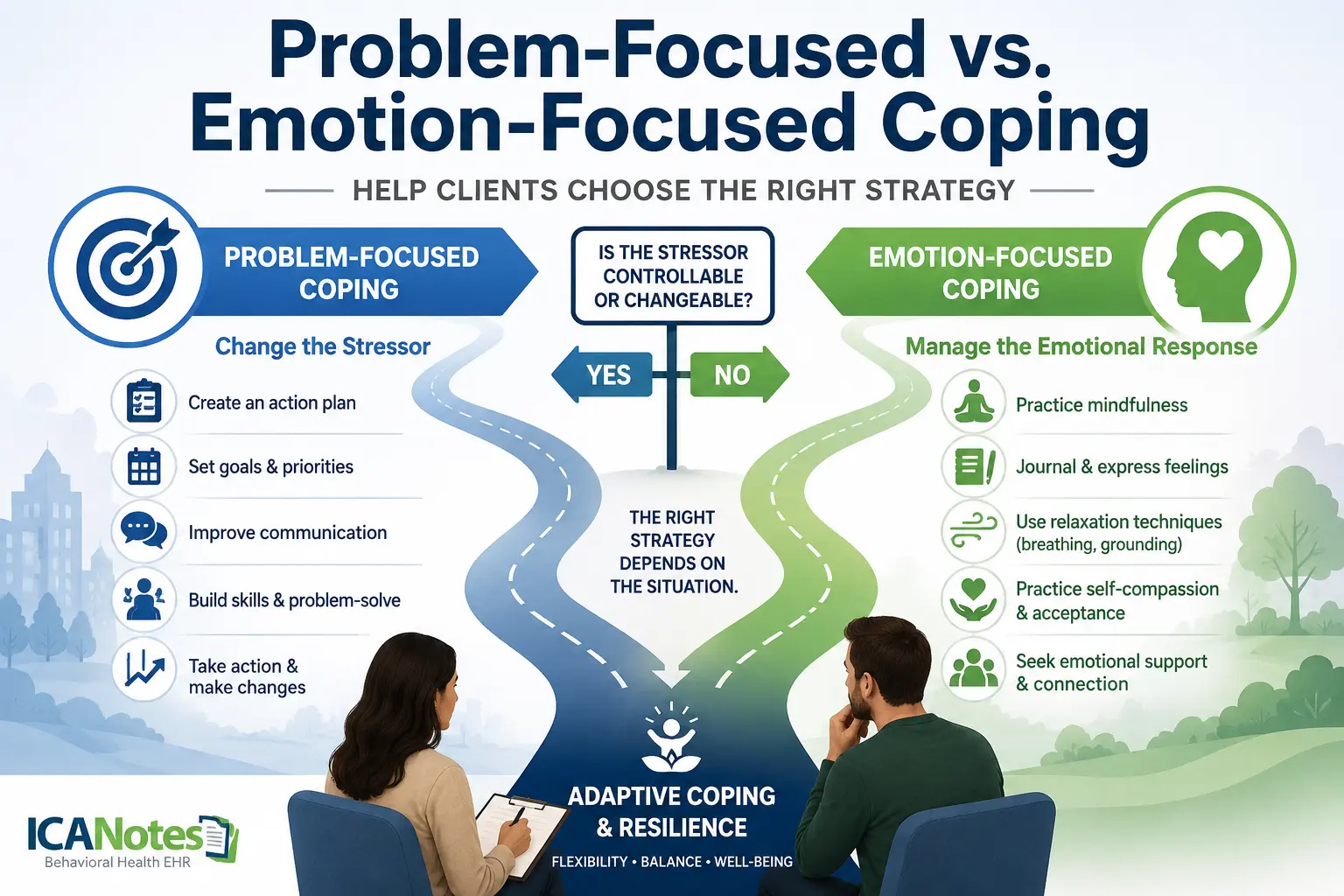
Feasibility depends on the problem, the moment, and your resources
“Can this be changed?” is often too broad to be useful. A more precise appraisal has three parts:
- Name the specific concern. “The entire week is going badly” is difficult to act on; “I need to know which task takes priority” is more specific.
- Identify your actual influence. You may be able to ask a question, prepare, set a boundary, or request assistance without being able to control another person’s decision.
- Check what is feasible now. Time, safety, money, access, energy, and other obligations matter. An action can be possible in principle but unavailable tonight.
This is not a test you must pass before allowing yourself to feel stressed. It is a way to avoid spending effort on an outcome that cannot be settled right now, while still finding any worthwhile action within reach.
Turn Worry into Action: Solve Problems, Don't Dwell
Watch “Turn Worry into Action: Solve Problems, Don’t Dwell” from Self-Help Toons for a practical way to separate an actionable concern from an uncertain outcome.
Watch the decision test, where the video considers whether a concern is plausible, influenceable, and actionable now. Then watch the worked examples: preparing for a presentation, arranging a medical appointment, and waiting afterward. Focus on how the available action changes over time. Treat the test as a guide, not a rule that makes understandable worry “pointless” or rules out seeking help when a concern needs attention.
The presentation example shows why influence is not the same as control over the result. Preparation may improve the chances of a good presentation; it cannot guarantee one. At three in the morning, preparing may not be sensible or possible. Setting a reminder for a suitable time may be the available problem-focused step, while rest and managing the immediate worry take priority.
The medical example makes a related distinction. Arranging an appropriate assessment is an action; deciding the result of that assessment is not. Once an appointment is arranged, further planning may be limited until new information arrives. Response-focused coping during that wait does not mean the concern was imaginary or that the appointment was unnecessary.
A situation can call for both approaches
Return to the ambiguous message from the previous lesson: “Can we discuss the revision tomorrow?” The message prompted a faster heartbeat, the thought “I must have done something badly wrong,” and repeated checking for updates. The stressor is not simply “the message.” It includes an uncertain revision, an upcoming conversation, and the possibility of criticism.
There may be a feasible problem-focused step: review the relevant section once, note what needs clarification, or send a brief reply arranging the discussion. None of those actions can settle what the other person thinks before the conversation happens. After a useful step has been taken—or if no action is available until tomorrow—managing the response becomes the immediate task. A pause, a supportive conversation, or a deliberate return to another activity may help more than checking again for information that has not arrived.
The same reasoning applies to less easily changed situations. If a service has cancelled an appointment, rescheduling may be within reach; reversing the cancellation may not be. If someone is grieving a loss, the loss cannot be undone, though practical arrangements and requests for support may still be possible. It would be inaccurate to call either situation wholly “controllable” or wholly “uncontrollable.”
| Part of the situation | Likely target right now |
|---|---|
| A specific change is feasible, such as asking for clarification or rearranging an appointment | Act on the stressor, with support or a pause if needed |
| A useful step is possible later, but not now | Note or schedule the step; manage the response in the meantime |
| The outcome depends on another person, missing information, or an event that has already happened | Manage the response while remaining alert to any new, feasible action |
Response-focused coping is not a substitute for addressing a changeable problem. Nor is problem-solving a requirement to stay activated until everything is resolved. If a stressor persists, repeatedly trying to relax without addressing a feasible source of strain may leave the source in place. If the outcome is not currently changeable, repeatedly trying to solve it may keep you engaged with uncertainty rather than help you recover.
Key takeaway
Use the stress map to identify which part of a situation is causing strain. Then distinguish a feasible action on the stressor from an outcome you cannot secure right now. Both forms of coping can belong in the same episode: take a worthwhile step when one is available, and manage your response when the next step must wait. Limited options are not a personal failure, and accepting a present limit does not mean accepting an unsafe or harmful situation indefinitely.
In the next module, you will practise specific response-focused options—beginning with gentle, slow-paced breathing—so that “manage the response” becomes a usable choice rather than vague advice.