In the previous lesson, you made three if–then responses for recurring stress situations, each with a fallback if the first action is blocked. A plan can look workable on paper and still meet an unexpected obstacle: the cue is hard to notice, the action takes longer than expected, or something you need is not at hand.
This lesson is a low-stakes rehearsal of one response. You will choose a manageable situation, try the first action, and note what made it easier or harder. The aim is not to prove that you can cope with intense stress. It is to discover a practical adjustment before you need the plan in a more demanding moment. Allow about 35–40 minutes, including time to carry out the rehearsal.
Treat the plan as a small test
A useful rehearsal has a narrower purpose than “see whether I feel better.” It tests whether you can notice a cue and begin the response you planned, in a setting that resembles where you would use it. Feeling calmer may happen, but it is not required for the rehearsal to teach you something.
Behavioural experiments are often used in cognitive behavioural therapy to test predictions in everyday life. The short video below uses a social-anxiety example. You do not need to adopt its larger programme of increasingly difficult experiments; take from it the ideas of starting with a manageable step, anticipating an obstacle, and recording what actually occurred.
How To Use CBT Behavioural Experiments
Watch How To Use CBT Behavioural Experiments by Teresa Lewis | Lewis Psychology for a concrete example of planning a small real-world test and learning from its result.
Watch the first test, focusing on why the person begins with a doable situation and notes a possible obstacle beforehand. Then watch the recorded result. For your coping-plan rehearsal, the result to record is whether the planned action was feasible, not whether another person reacted in a particular way.
Keep the stakes genuinely low. If a plan concerns a difficult message, use an ordinary, nonurgent message for practice. If it concerns an urge to drink or smoke, practise the first substance-free action during a routine moment when you want a break; do not try to create a strong urge. A simulated cue can test the mechanics of your response, though it cannot establish how well the technique will work during severe stress.
Set up one rehearsal
Choose one of your three plans—preferably the one whose first action you can try safely within the next few minutes. Copy its cue, first action, and fallback onto a scrap of paper or a note. Then make the trial specific:
- Choose the setting. Use the place where the action would normally happen if it is accessible and comfortable. Otherwise, choose a close approximation.
- Choose a mild cue. Wait for an ordinary version of the cue, or briefly simulate it. For example, review a small change to a to-do list rather than creating a consequential deadline.
- Name one prediction. Make it about feasibility: “I expect to notice the cue and start my first action within two minutes.” A prediction makes a snag easier to recognize; it is not a pass mark.
- Set a stopping point. Stop after the first planned action, or after a few minutes. You need not manufacture more stress or complete an entire coping routine.
The Psychology Tools guide How To Use Behavioral Experiments separates anticipating obstacles from carrying out a test and recording what happened. Read just those steps; its clinical examples are not requirements for this rehearsal.
How To Use Behavioral Experiments | Psychology Tools
Read the short practical sequence from Psychology Tools to see why an obstacle is useful information rather than a failed attempt.
In “How can I do a behavioral experiment?”, find “Step 4: Identify any obstacles that could make it difficult to carry out the experiment.” Read Steps 4 through 6, ending with the sentence about recording what happened. Focus on the questions about people, place, and safety, then on the distinction between doing the test and recording its result.
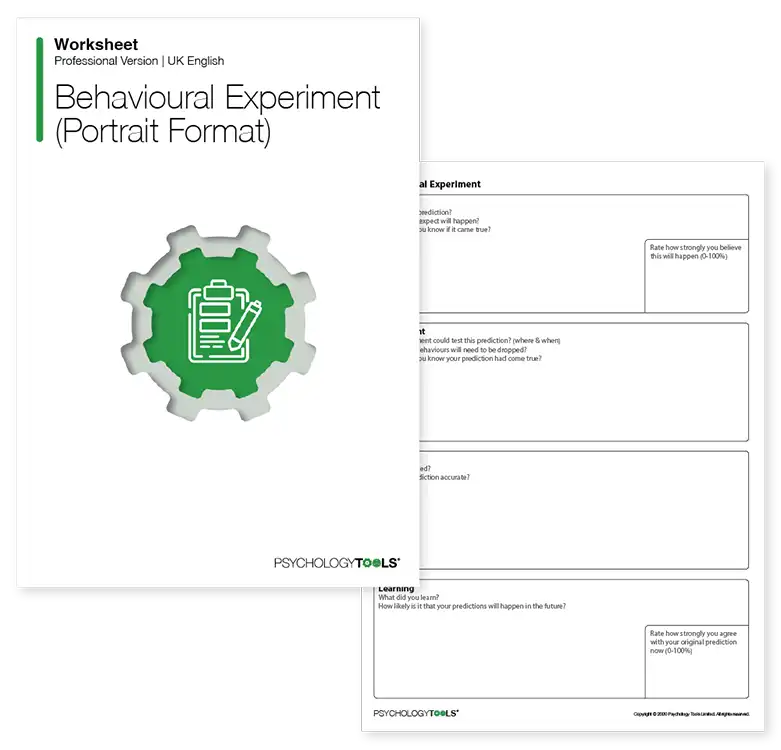
The worksheet pictured here uses separate spaces for a prediction, a plan, a result, and learning. You can use those same distinctions in a few lines of your own; no worksheet is necessary.
Carry out the first action
Allow about 10–15 minutes for setup and one attempt. Read your chosen if–then statement once, arrange the mild cue, and try to follow it as written. Keep your attention on the practical details. You may notice that you were waiting for a stronger signal, that you needed more privacy, or that the action took more steps than your plan allowed.
Here is a fictional example using the unexpected-demand plan from the previous lesson:
Plan: “If a new task arrives and I notice my shoulders tighten, then I will put my feet on the floor, take three comfortable breaths, and write down the first task to address.”
Low-stakes cue: At a desk, the person considers a minor change to tomorrow’s to-do list.
Prediction: “I can begin the response and identify a first task within two minutes.”
What happens: They put their feet down and breathe comfortably, but their paper and pen are elsewhere. Finding them takes longer than the response itself.
The rehearsal has uncovered a materials obstacle, not a lack of coping ability. A more portable first action might be to name the first task silently, then write it down when something to write with is available. Trying that revised first action once would check whether it removes the snag.
For your own attempt, use the response you selected rather than the example’s response. If it involves breathing, keep breaths gentle and unforced; stop if you feel dizzy or uncomfortable and use another settling action. Adapt movement to your available space and physical abilities. If your plan involves contacting someone, the part you control is preparing or making a respectful, specific request—not receiving an immediate reply.
A cue that never appears is also information. Use a mild simulation if one is appropriate, or rehearse the opening action on its own and note that cue recognition remains untested. Avoid escalating distress just to make the trial feel realistic. If distress or a substance-related urge feels unsafe or unmanageable, stop the rehearsal and seek appropriate professional support; seek urgent help if there is immediate danger.
Capture the obstacle while it is fresh
Take about five minutes immediately afterward to make a brief rehearsal note. This is a record of one attempt, not yet the ongoing coping log you will use in the next lesson.
| Note | Record briefly |
|---|---|
| Cue and first action | The cue you used and the action you intended to begin |
| Prediction and observation | What you expected to be feasible, and what actually happened |
| Practical obstacle | One concrete barrier, if any: noticing the cue, time, space, materials, energy, privacy, or access to another person |
| Small adjustment | A simpler first action or fallback that addresses that barrier |
Write observations rather than a verdict on yourself. “I looked for a pen for two minutes” is more useful than “I’m bad at following plans.” Likewise, “I could do the first step here, but I do not know how it would feel when highly agitated” is a sound conclusion from a calm rehearsal. One attempt reveals feasibility under these conditions; it does not guarantee the same result in every situation.
If nothing got in the way, note what helped: perhaps the cue was unmistakable or the action required no equipment. Keep the plan available for ordinary use. If an obstacle did appear, make one small revision rather than redesigning all three responses at once. A fallback should remove the barrier you found, not depend on the same missing time, privacy, or materials.
Key takeaways
A low-stakes rehearsal lets you test the first usable step of a coping plan without waiting for a difficult day. Choose one plan, try it with a mild real or simulated cue, and compare a specific feasibility prediction with what happened. An obstacle is useful evidence for making the response smaller, more portable, or easier to recognize.
In the next lesson, you will use a brief coping log across actual situations to decide whether a technique is worth keeping, adapting, or replacing.