Welcome to the first lesson. This course begins with a classification question: which O-1 pathway corresponds to the work a person proposes to do in the United States? That question comes before evaluating awards, publications, or other credentials. A highly accomplished researcher, for example, would ordinarily look to O-1A for proposed research work; an impressive résumé does not itself decide the pathway or establish eligibility.
You will learn to distinguish O-1A from the two forms of O-1B—arts and motion picture or television—and to handle cases where creative work crosses into filmed or streamed productions. This lesson identifies the relevant pathway, not whether a hypothetical petition would be approved.
Start with the proposed work
USCIS describes three pathways for the person whose achievements are at issue, called the beneficiary. O-1A covers work in the sciences, education, business, or athletics. O-1B (Arts) covers work in the arts. O-1B (Motion Picture or Television), abbreviated here as O-1B (MPTV), covers work in motion picture or television productions. Each pathway also requires the person to continue working in the relevant area of ability or achievement.
Chapter 2 - Eligibility for O Classification | USCIS
Read the USCIS Policy Manual's concise definitions to establish the three-way map before considering borderline cases.
In Section B, "Eligibility Requirements," read the O-1A, O-1B (Arts), and O-1B (MPTV) subsections. Begin with the O-1A bullet at the three pathways, and stop after the second O-1B (MPTV) bullet, before the O-2 subsection. Focus on both the field or production named in each pathway and the requirement to continue work in that area.
A first-pass classification can be made from the services the person is coming to perform:
| Proposed U.S. work | Relevant pathway |
|---|---|
| Conducting scientific research, teaching in an area of recognized educational ability, directing a business venture, or competing or coaching in athletics | O-1A |
| Creating or performing artistic work outside motion picture or television productions—for example, exhibiting paintings or performing in a stage production | O-1B (Arts) |
| Performing services for a motion picture or television production—for example, acting in a series or editing a film | O-1B (MPTV) |
This table identifies a pathway, not a shortcut to qualification. A research appointment does not become O-1B because its holder is also a musician; a stage role does not become O-1A because its performer has a science degree. Conversely, choosing a pathway does not establish that the person meets its demanding achievement standard. Those are separate questions, addressed in later lessons.
The infographic below is a useful visual orientation, but its broad label “media” is not a classification rule. The kind of production and the services performed matter more than a general job label.
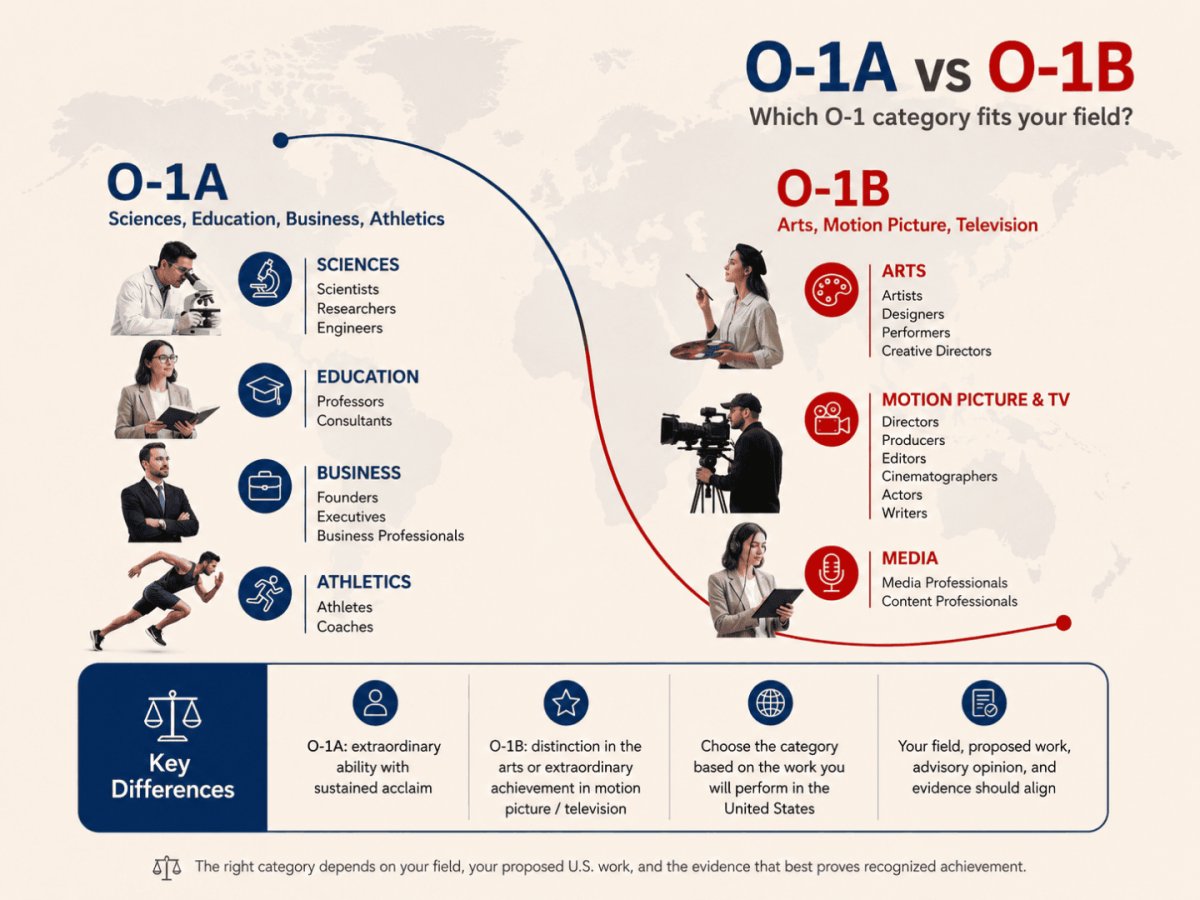
The arts–screen boundary
The difficult distinction is often not O-1A versus O-1B. It is O-1B (Arts) versus O-1B (MPTV). An artist might make work for galleries and also take part in a streaming production. A production might appear online without resembling traditional television. USCIS therefore looks beyond the screen on which something appears and considers what the production is and what the person will do for it.
Chapter 4 - O-1 Beneficiaries | USCIS
Read the USCIS Policy Manual's treatment of overlapping artistic and screen work. It supplies the distinctions that a list of occupations cannot.
In Section A, "Standard for Classification," find the subsection "Determining the Relevant Standard for Artists with Some Connection to MPTV." Read the overlap analysis, from its opening paragraph through the paragraph contrasting people hired to make a reality-based production with its contestants. Pay particular attention to the examples of streaming programs, self-produced content, incidental appearances, and paid production roles.
Two points from that guidance are especially important. First, online distribution does not rule out MPTV: streaming movies, web series, commercials, and programs with formats corresponding to traditional film or television generally fall within its scope. Static web material and self-produced video blogs or social media content generally do not fall within MPTV merely because they appear on a screen.
Second, appearing in a production is not always the same as working in that production’s industry. USCIS says an artist who is interviewed on a program to discuss or promote their non-MPTV artistic work is not necessarily performing MPTV services. By contrast, people employed to conduct or film the interview generally are. Similarly, a paid host or judge cast in a reality-based production is generally working in MPTV, whereas a contestant generally is not.
For an artist who will perform services for MPTV productions, USCIS generally applies the MPTV requirements even if the artist also plans non-MPTV work. The qualification is important: an appearance that is merely incidental to the artist’s non-MPTV work may instead leave O-1B (Arts) as the appropriate pathway. Mixed schedules deserve attention to the actual duties, rather than a quick choice based on which activity sounds most prestigious.
Follow the services, not the résumé
Consider how the classification changes—or stays the same—when a person’s background and proposed assignment differ.
A researcher interviewed for a documentary. Suppose the proposed U.S. work is to lead a laboratory research program, and a documentary crew will interview the researcher about that work. The research assignment points to O-1A. The interview does not, by itself, turn the researcher into a motion picture or television professional. The researcher’s publications may later matter greatly as evidence, but they are not what makes this proposed work O-1A; the research services do.
An artist with an exhibition and a brief televised appearance. Suppose a painter will create work for an exhibition and appear on a program to discuss the paintings. O-1B (Arts) is the relevant starting point. The televised appearance is connected to explaining or promoting the non-MPTV artistic work, rather than necessarily providing services to make the program. The facts would need closer examination if the painter were instead hired for an ongoing production role.
An editor engaged for a streaming series. An editor may describe their profession as creative or artistic. If the proposed assignment is to edit episodes of a streaming series, however, it is work on a production of the sort USCIS generally treats as MPTV. O-1B (MPTV) is the relevant pathway. Calling the output “digital content” would obscure the production’s nature rather than clarify it.
An athlete cast as a reality-show judge. Athletic achievements might suggest O-1A at first glance. But if the proposed services are as a paid judge cast in a reality-based television production, USCIS generally regards that role as MPTV work. O-1B (MPTV) is the relevant classification to examine for that assignment. Whether the athlete has the record of MPTV achievement needed to qualify is a different—and potentially difficult—question. A pathway can be relevant even when the available evidence may not support approval.
These examples show why choosing the category solely from a profession, employer, award, or degree can mislead. The useful first facts are the proposed services, the setting in which those services will be performed, and whether any screen-production involvement is substantive or merely incidental.
A boundary on what this classification tells you
Identifying a pathway is an exercise in applying the right rule, not predicting an immigration decision. In particular, it does not show that the person has the required acclaim or achievement, that the supporting evidence is sufficient, or that the other petition requirements are met. Where a proposed engagement combines research, artistic work, and substantial production duties—or where it is unclear whether an online project is an MPTV production—the precise arrangements can matter. A qualified U.S. immigration lawyer can assess those facts before a petitioner commits to a classification.
Key takeaways
O-1A corresponds to proposed work in sciences, education, business, or athletics. O-1B (Arts) corresponds to artistic work outside MPTV production services. O-1B (MPTV) is the pathway to examine for services performed for motion picture or television productions, including qualifying streamed productions. An incidental on-screen appearance is not automatically MPTV work, and a creative job title does not automatically make production work an arts case.
The next lesson examines the distinct achievement standard attached to each pathway. That will make clear why selecting the relevant category is only the beginning of an eligibility analysis.