Hello. Earlier parts of the course examined which O-1 standard applies and why strong credentials do not, by themselves, establish eligibility. This module turns to a different question: who can file the petition for the proposed U.S. work? A researcher can have a persuasive record of achievement and still need a properly structured petition from an eligible filing party.
This lesson distinguishes a U.S. employer, a U.S. agent, and a company owned by the person seeking O-1 status. The central rule is straightforward, but its application matters: the beneficiary cannot file an O-1 petition as an individual; a separate legal entity the beneficiary owns may be able to file on their behalf.
The filing party and the beneficiary are different roles
The beneficiary is the person for whom O-1 classification is requested. The petitioner files Form I-129 with U.S. Citizenship and Immigration Services (USCIS). Evidence of the beneficiary’s ability addresses one part of the case; identifying an eligible petitioner and genuine proposed work addresses another.
USCIS identifies a U.S. employer and a U.S. agent as potential petitioners. It also expressly says that an O beneficiary may not petition for themselves. Read its policy statement first, paying particular attention to the sentence about a beneficiary-owned corporation or limited liability company.
Chapter 3 - Petitioners | USCIS
Read USCIS’s policy-manual chapter for the governing distinction between a person filing for themselves and a separate entity filing for that person.
In Chapter 3, subsection A, “Eligible Petitioners,” read eligible petitioners, from the opening sentence about a U.S. employer through the final sentence about a beneficiary-owned corporation or limited liability company. Focus on who is named as the petitioner in each case, rather than who owns the petitioner.
The following diagram is a useful first map of the ordinary filing routes. It is simplified: it does not show the separate-legal-entity qualification for a beneficiary-owned U.S. company.
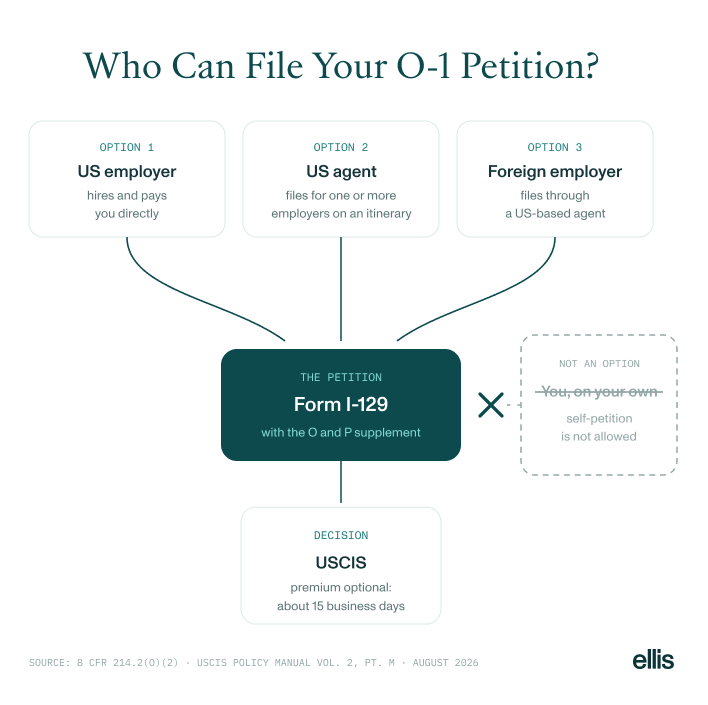
A direct-employer case is the simplest to picture. Suppose a U.S. research organization offers a researcher a defined position. The organization, not the researcher, files the petition for that work. A prestigious publication record might help establish the researcher’s qualifications, but it does not make the researcher their own petitioner or substitute for the proposed position.
An agent can file without always being the employer
Some O-1 work is organized through engagements rather than a single conventional employer. A U.S. agent can be the beneficiary’s actual employer, represent both the employer and beneficiary, or be authorized by an employer to act in its place for the petition. A U.S. agent can also file where a foreign employer authorizes it to act on the foreign employer’s behalf.
These descriptions refer to different relationships, not a blanket permission for anyone to call themselves an “agent.” For example, if a researcher has defined engagements with several organizations and an agent files on their behalf, USCIS needs to understand the engagements and the agent’s authority to represent the other employers. The agent does not necessarily have to be a longstanding professional representative or receive a fee to qualify; what matters is the relationship and authority established for the work covered by the petition.
Chapter 3 - Petitioners | USCIS
Continue in the same USCIS policy-manual chapter to see how the agency distinguishes an agent’s claimed role from evidence that the agent is authorized to file.
In Chapter 3, subsection C, “Agents,” begin after the opening list of possible agent roles. Read agent filing conditions, starting with petitions involving multiple employers and continuing through the end of subsection C. Focus on why an itinerary, agreements, and evidence of authorization matter when one agent files for work involving several employers. Do not treat those multiple-employer requirements as an identical checklist for every agent arrangement.
Notice the distinction between arranging work and having authority to file for it. In a multiple-employer arrangement, identifying engagements alone does not show that the agent may act for each employer. USCIS says that, for example, a document signed by another employer authorizing the agent to file in its place can help establish that authority. Conversely, the fact that an agent is not ordinarily in the agency business outside these engagements does not automatically defeat the arrangement; USCIS examines the facts of the petition.
A foreign employer presents another variation. The foreign employer does not simply file an O-1 petition directly in its own name without the U.S. intermediary specified by the rules. It uses an authorized U.S. agent to file. The distinction becomes especially important when the foreign employer is itself owned by the beneficiary.
Owning the company does not mean filing as yourself
“Self-petitioning is prohibited” and “a company I own may petition for me” can sound contradictory. The difference is legal identity. A person filing for their own O-1 classification is not an eligible petitioner. A corporation or limited liability company that is a separate legal entity may file for its owner as the beneficiary. The company is the petitioner; its owner is the person for whom classification is sought.
That distinction does not make incorporation a shortcut. USCIS may request evidence of a company’s ownership and control to assess whether it is a bona fide U.S. employer, whether the proposed employment is real rather than speculative, and whether its terms qualify for O classification. The USCIS guidance does not state a universal rule that a beneficiary must give up ownership or appoint an outside director. It does mean that forming an entity on paper, without identifiable qualifying work, does not settle the petition question.
The same principle has a different filing structure when the beneficiary owns a foreign corporation. USCIS says the foreign company may be wholly or partly beneficiary-owned, but it must use a U.S. agent to file. Ownership of the foreign employer neither permits the individual to self-petition nor removes the U.S.-agent requirement.
O Nonimmigrant Classifications: Question and Answers | USCIS
Read USCIS’s answers on self-incorporation and beneficiary-owned foreign companies to see how it applies the no-self-petition rule in each setting.
Find the question “Can partially or fully self-incorporated persons petition for themselves in the O classification?” Read its answer beginning ownership guidance, continuing through the following question, “Can a foreign employer be a corporation owned by the beneficiary?” Stop at the sentence about documentation showing work in place in the United States, before the final paragraph on employer sanctions. Compare who files when the owned company is a U.S. entity with who files when it is a foreign employer.
Consider two otherwise identical research plans. In one, the researcher signs and submits a petition as an individual for their own future work: that is prohibited self-petitioning. In the other, a separately established U.S. company owned by the researcher files for defined work it will employ the researcher to perform: ownership alone does not bar the filing, although USCIS may scrutinize whether the company and work are genuine. If that company is instead a foreign employer, an authorized U.S. agent is needed to file on its behalf.
A practical way to classify a filing arrangement
When reading a hypothetical O-1 case, identify the proposed work, then the legal identity and role of the party filing. Do not infer the petitioner from the beneficiary’s reputation, the source of their funding, or the mere fact that they own a business.
| Proposed arrangement | Filing-party conclusion |
|---|---|
| One U.S. organization directly employs the beneficiary | The U.S. employer may file. |
| A U.S. agent files for engagements with multiple employers | An agent may file if the applicable arrangement and its authority are established. |
| A foreign employer offers the work | An authorized U.S. agent files on the foreign employer’s behalf. |
| The beneficiary owns a separate U.S. corporation or LLC offering genuine work | That entity may file for the beneficiary; the beneficiary does not file as an individual. |
| The beneficiary owns the foreign employer | The foreign employer must use an authorized U.S. agent to file. |
| The beneficiary has only a personal plan to find work later | Neither calling themselves an agent nor forming an empty entity, by itself, establishes qualifying proposed employment. |
This framework answers who may file, not whether a particular petition will be approved. Agent arrangements, ownership and control, and the reality of proposed employment can turn on documents and facts that a short description omits. Where those features are contested or complicated, qualified U.S. immigration legal advice is more reliable than treating a general example as an approval rule.
Key takeaways
An O-1 beneficiary cannot self-petition. A U.S. employer may file; a U.S. agent may file in an appropriate, supported role; and a foreign employer files through an authorized U.S. agent. A separate U.S. legal entity owned by the beneficiary may petition for that beneficiary, but its ownership does not dispense with the need for genuine qualifying work.
The next lesson examines the documents that support these arrangements—such as agreements, descriptions or itineraries of proposed work, and consultation opinions—and why they serve a different purpose from evidence of extraordinary ability or achievement.