Hello! Welcome to the first lesson in our journey to design your expert Power BI course.
Given your background as a business analyst, you're already skilled at diagnosing business problems and identifying stakeholder needs. We're going to start by applying that same analytical mindset, but this time, the "stakeholder" is your future learner. Everything in a great course—from the topics you choose to the examples you use—starts with a deep understanding of the person you're teaching.
Today's goal is to lay that essential foundation. We will focus on creating a detailed learner persona for your target audience. This persona will be your North Star, guiding your decisions throughout the course design process and ensuring you build a course that truly solves your learners' business problems.
What is a Learner Persona and Why Does It Matter?
A learner persona is a semi-fictional character that represents your ideal student. It's not just a list of demographics; it's a detailed sketch that includes their professional role, goals, daily challenges, and what frustrates them about their current data analysis process. In short, it helps you answer the question: "Who am I creating this course for?"
Creating a persona ensures you build a course that is:
- Problem-focused: It addresses the real-world challenges your learners face.
- Relevant: The content, language, and examples resonate with their experience.
- Effective: The learning activities are designed in a way that suits their preferences and constraints.
To get a solid grasp of the concept, let's start with an article that explains what a learner persona is in the context of instructional design.
Learner Personas in Instructional Design: Why You Need Them and How to Create Them
This article from Cathy Moore's blog provides an excellent overview of learner personas, why they are critical for moving beyond 'one-size-fits-all' training, and how to create them.
Please read the first half of the article, down to the section titled 'Do you only need one persona? Or more?'. Focus on the definitions and the four reasons that make learner personas important.
The Anatomy of a Powerful Learner Persona
Now that you have the "what" and "why," let's break down the "how." A useful persona goes beyond surface-level details. It needs to capture the core elements that will influence your course design.
A comprehensive learner persona typically includes:
- Identity & Background: A name, a stock photo, and a brief bio (job role, industry, experience level). This makes the persona memorable.
- Goals & Motivations: What do they hope to achieve? This could be professional (e.g., "get a promotion," "automate my weekly sales report") or personal (e.g., "feel more confident presenting data to my boss").
- Challenges & Pain Points: This is the most crucial part for your problem-first approach. What are their biggest frustrations? (e.g., "Our source data is a mess," "I spend hours every Monday manually updating Excel sheets," "DAX feels like a foreign language").
- Learning Context & Preferences: How, when, and where do they learn? (e.g., "Prefers short, 5-minute videos during their lunch break," "Wants hands-on projects they can do on a weekend," "Learns best from real-world case studies").
- A "Day in the Life" Scenario: A short story that describes their current work reality, highlighting the specific moments where their data challenges arise.
Here are two excellent visual examples of what a completed persona looks like. Notice how they combine professional context with personal goals and challenges.
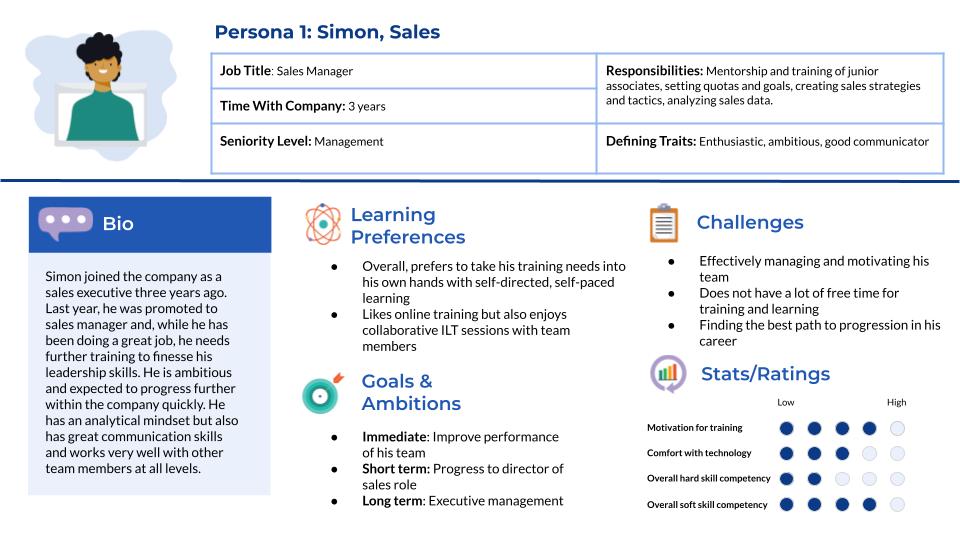

To see these components brought to life, the following resource provides two fantastic, detailed examples: 'Maya, the tech-savvy learner' and 'Carlos, the reluctant learner'.
How to Create Learner Personas for Effective Training
This article from ELM Learning gives a concise breakdown of a persona's 'anatomy' and provides two contrasting examples that are very helpful for understanding how different learner types can exist within the same organization.
Read the sections 'What is a learner persona?' and 'Examples of learner personas'. Pay close attention to the profiles of Maya and Carlos and think about which one (or a blend of the two) best represents the audience you want to attract.
How to Gather the Data: Go into Detective Mode
Your persona must be based on real data, not just assumptions. Your experience as a business analyst is perfect here—think of this as the requirements-gathering phase. You need to listen to your target audience.
Where can you find them? Go to the places where beginner and intermediate Power BI users ask questions and share frustrations.
- Reddit: Explore communities like
r/PowerBI,r/businessintelligence, and evenr/excel. Look for posts titled "How do I...?", "I'm stuck with...", or "What's the best way to...?". - LinkedIn Groups: Join groups focused on Power BI and data analytics. Observe the discussions and the problems members are trying to solve.
- YouTube Comments: Find popular Power BI tutorials (especially for beginners) and read the comments. You'll find a goldmine of questions and points of confusion.
The following video, while aimed at marketers, has an excellent segment on this research process.
How to Find Your Target Audience in 2025 6 Step Framework + Free Templates
This HubSpot video offers a great 'detective mode' strategy for understanding an audience. We will focus on the part about researching online communities.
Watch the segment from 03:44 to 05:24. The speaker explains how to use platforms like Reddit to find the exact language people use to describe their pain points. This is exactly what you need to do for your learner persona.
Test your understanding!
Based on the resources, you find two common posts in a Power BI forum:
- "How do I write the DAX to calculate Year-over-Year growth?"
- "My boss wants a 'simple' sales dashboard by tomorrow, but the data is in 5 different messy Excel files. HELP! Where do I even start?"
Which of these posts reveals a more foundational business pain point that would be a great focus for your problem-first course, and why?
Show answer
Post #2 reveals a much deeper and more common business pain point. While post #1 is a technical DAX question, post #2 describes a classic business scenario: a vague, urgent request from a stakeholder, combined with messy, disparate data sources. This is a perfect problem to build a module around because it involves data cleaning (Power Query), data modeling, and stakeholder management—all key skills for a business analyst using Power BI. It speaks directly to the learner's real-world stress and pressure.
Your Action Task: Build Your First Learner Persona
Now it's time to put this into practice. Your task for this lesson is to create one detailed learner persona for your Power BI course.
- Do the Research (15-20 mins): Spend some time in "detective mode" on Reddit, LinkedIn, or YouTube. Jot down recurring questions, frustrations, and goals you observe.
- Build the Persona (15-20 mins): Using a simple document or a template inspired by the images above, create your persona. Give them a name and a role (e.g., "Marketing Analyst Maria," "Junior Financial Controller David").
Your final persona document should include:
- A name, role, and brief background.
- 3-4 key Goals/Motivations related to their job and career.
- 3-4 major Challenges/Pain Points they face with data and reporting.
- Their preferred Learning Style and context.
- A short "Quote" that captures their primary frustration or goal.
Focus on creating a persona that represents the "Beginner to Intermediate" business professional you want to help. Think about someone who is comfortable in Excel but is either new to Power BI or has been using it without a structured, analytical approach.
Conclusion
Congratulations on completing your first step! You've learned what a learner persona is, why it's the cornerstone of effective course design, and how to build one based on real-world data. Having this clear picture of your ideal learner is essential for crafting a course that doesn't just teach software features, but solves tangible business problems.
Key Takeaways:
- A learner persona is a detailed, semi-fictional representation of your ideal student.
- It guides all your course design decisions, ensuring relevance and impact.
- Building a persona requires research into your audience's real goals, pain points, and learning preferences.
- Focus on the problems they face, not just the technical skills they lack.
In our next lesson, we will take this understanding of who you're teaching and explore how to engage them. We'll analyze successful communities on the Skool platform to identify the key structural and engagement tactics you can use for your own course.