Hello! Let's begin your revision for the English Core exam. We'll start with the first item in the Short Writing Skills section: Notice Writing.
This first lesson is designed for a quick and effective review of the fundamental format. Your goal is to be able to recall every required element of a CBSE notice instantly. Getting the format right is crucial as it carries dedicated marks and creates the first impression on the examiner.
Let's lock in the format.
The Standard Format of a Notice
A notice is a formal announcement, so it must follow a strict, predictable structure. Every notice you write must be enclosed in a box.
Here are the essential components in order:
- Name of the Issuing Authority/Institution: The name of the school, organisation, or RWA issuing the notice. This should be centered at the top.
- The word 'NOTICE': Written in all capital letters, centered directly below the issuing authority's name.
- Date: The date of issue, placed on the left-hand side, below 'NOTICE'.
- Heading/Title: A brief and catchy title that summarises the purpose of the notice. This should be centered.
- Body: The main content of the notice. It must answer the questions: What? When? Where? Who? and Why?
- Signatory Details: The name and designation of the person issuing the notice, placed on the left-hand side at the bottom. A signature is often placed above the name.
The image below provides a clear visual breakdown of these components and the marking scheme. Note that the format itself is worth 1 full mark.

A Closer Look at the Format Rules
To ensure you don't miss any details, let's watch a short video that explains the nuances of the format, such as capitalisation and line spacing.
Notice Writing Class 12 | CBSE 2025 Format & Example
The presenter, Simran Sahni, will walk you through each element of the notice format with specific instructions.
Please watch the section that breaks down the format step-by-step. Then, pay close attention to the detailed discussion on formatting rules, especially regarding line spacing and the correct way to write the date, as these are common areas of confusion.
Key Takeaways from the Video:
- Centering: The Name of the Institution, 'NOTICE', and the Heading should all be centered.
- Capitalisation: 'NOTICE' must be in capital letters. The heading and the institution's name are also typically capitalized for emphasis.
- Date Format: Always write the date out in full (e.g.,
21 March 2025). Avoid using shortcuts like21/03/25or21.03.2025, as this can lead to a loss of marks. - Line Spacing: While there isn't a rigid rule enforced by CBSE, leaving a line between sections (e.g., after 'NOTICE', after the heading, before the signatory) makes your notice look neat and easy to read. The video advises not leaving a line between the Institution Name and 'NOTICE'.
Seeing the Format in Action
Now, let's look at a handwritten example, similar to what you would produce in an exam. Try to identify each of the six format components we've just discussed.
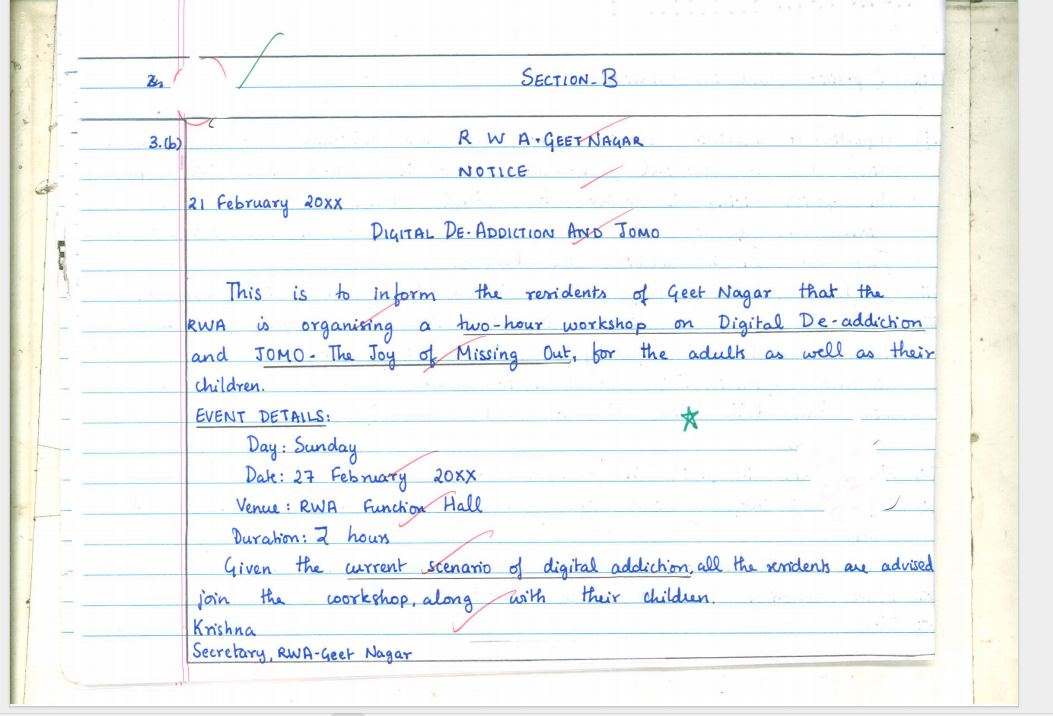
In the image "Digital De-addiction and JOMO," you can clearly see:
- Issuing Authority: RWA Geet Nagar
- 'NOTICE': In capitals and centered.
- Date: 21 February 20XX, on the left.
- Heading: 'Digital De-addiction and JOMO', centered.
- Body: Details about the workshop.
- Signatory: Krishna (Name) and Secretary, RWA-Geet Nagar (Designation) at the bottom left.
- The Box: The entire content is enclosed in a box.
This example perfectly demonstrates how the rules translate into a finished product.
Key Takeaways
To score full marks for format, you must remember these key points:
- Box: Always draw a box around your notice.
- Order: Follow the sequence: Issuing Authority -> NOTICE -> Date -> Heading -> Body -> Signatory.
- Alignment: Center the main titles (Authority, NOTICE, Heading). Keep the Date and Signatory details on the left.
- Date: Use the full date format (e.g., 21 March 2025).
- Signatory: Include both the name and designation.
In the next lesson, we will focus on the content of the notice. We'll analyse how to write a clear and concise body within the 50-word limit and look at how to avoid common mistakes, using another board exam question as our example.