Hello! In our last session, we focused on the cover letter, the first of the two essential parts of a job application. We revised its formal structure, from the opening reference to the job advertisement to the crucial closing line that mentions the enclosures.
Today, we'll complete the topic by concentrating on the second part: the bio-data. This lesson is designed to help you quickly recall the standard format and key components of a compelling bio-data, as required by the CBSE syllabus. By the end, you'll be confident in structuring a bio-data that effectively showcases your qualifications, experience, and skills.
What is a Bio-Data?
A bio-data, also known as a Curriculum Vitae (CV) or résumé, is a structured summary of your personal, academic, and professional profile. While your cover letter is a formal request, your bio-data provides the evidence to support your application.
A crucial point of presentation is that the bio-data should always start on a fresh page, separate from the cover letter. Let's hear a quick tip on this.
Job Application & Bio Data | Class 12 | Job Application Format | Resume Format | Boards 2025
The instructor in this video explains the best practice for presenting your bio-data in the exam.
Watch the short segment from 00:09:16 to 00:09:41. The key takeaway is to avoid starting your bio-data on the same page where your cover letter ends. Always begin on a new page for clarity and a professional appearance.
The Standard Format and Components
A well-structured bio-data should be easy for an employer to scan. It is traditionally not enclosed in a box. You should start with the title "Bio-data" or "Curriculum Vitae" at the top of the page. Let's break down the essential sections that follow.
The video below walks through each component, offering practical advice for your exam.
Job Application & Bio Data | Class 12 | Job Application Format | Resume Format | Boards 2025
This video provides a detailed breakdown of each section required in a CBSE-compliant bio-data, from personal details to the final declaration.
Please watch the following segments, paying close attention to the specific details for each section: Personal Details (00:10:06 - 00:11:20): Note the list of essential information: Name, Father's/Mother's Name, Email, Contact Number, and Nationality. The instructor also gives a useful tip on what to write if full names aren't provided in the question. Academic Qualifications (00:11:59 - 00:14:13): This is a critical section. Focus on the advice to always use a table. Pay attention to the recommended columns: Degree, School/University, Year of Passing, and Percentage. Notice the emphasis on tailoring your qualifications to the job (e.g., mentioning a CA qualification for an accounting job). Achievements, Hobbies, and References (00:14:13 - 00:16:32): Understand how to include relevant achievements, one or two hobbies, and professional references. The Declaration (00:16:32 - 00:16:54): This is a mandatory closing statement. Memorize the standard line: "I hereby declare that the information given above is true to the best of my knowledge..."
To give you a clear visual summary, here is a simple template outlining the key sections and the table format for your qualifications.
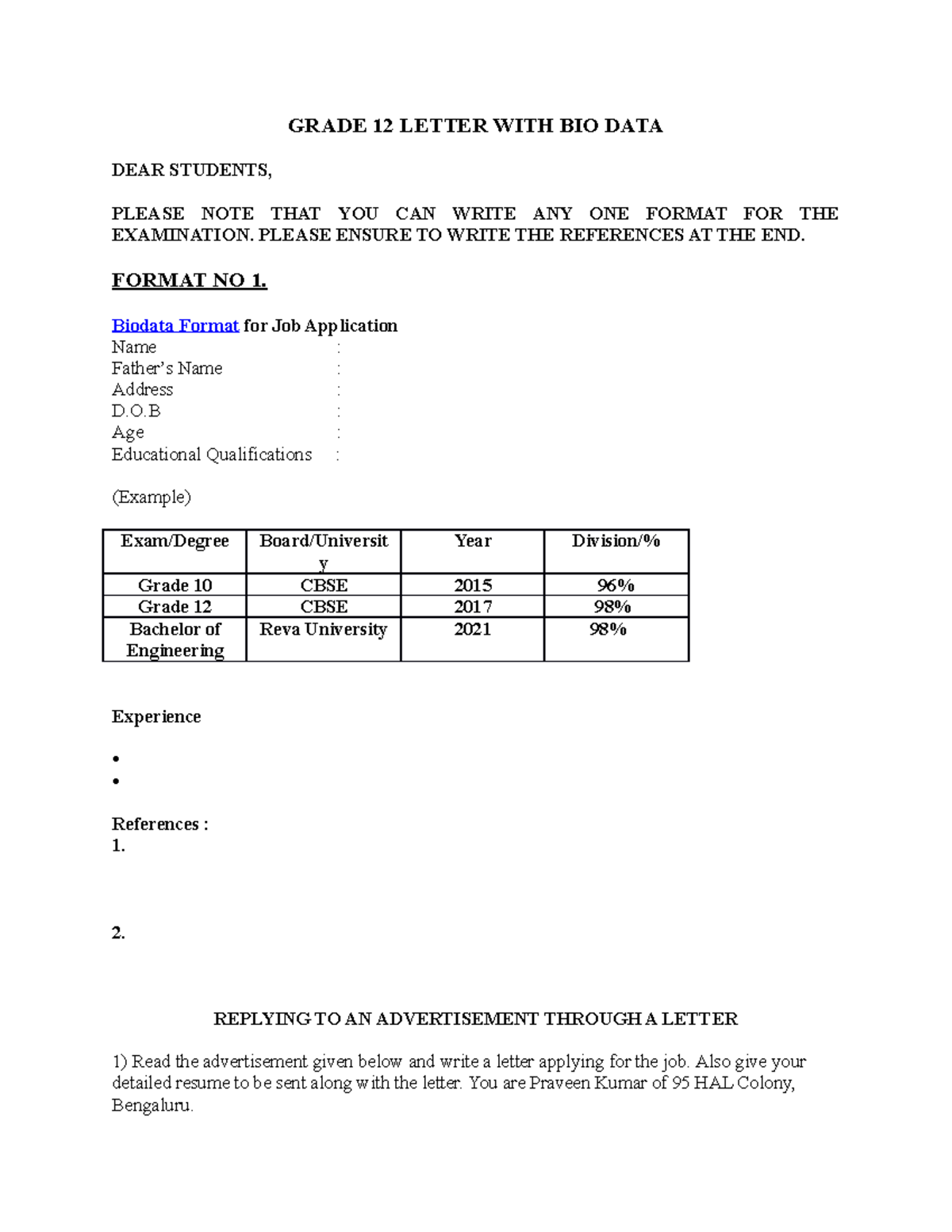
Analyzing a CBSE Board-Level Example
Now, let's see how these components come together in a solved example from a CBSE sample question paper. This will help you understand the expected standard of presentation and content.
CBSE Class 12 English Core Solved Question Paper
This PDF contains a complete solved question for a job application. We will focus on the bio-data part of the answer.
Please scroll down to question 5(a) about applying for the post of Business Development Executive. First, read the cover letter to understand the context, then carefully study the BIO-DATA section that follows. As you read, identify the following components we've just discussed: The clear, centered heading. The list of Personal Details. Educational Qualifications, listed in reverse chronological order (most recent first). Work Experience, also in reverse chronological order. Skills relevant to the job. The statement for References.
An Example Tailored to Your Background
To make this even more relevant, let's look at another example. Since your background is in Accountancy, reviewing a bio-data for an Accounts Officer will be particularly useful.
CBSE – Class 12 – Job Application
This resource provides another excellent board-level example, this time for an Accounts Officer position.
Find the sample answer for the question where the applicant, Ashita Kapoor, is applying for a post at Hind Chemicals, Pvt. Ltd. Read the CURRICULUM VITAE section. Notice how it follows the same structure, reinforcing the standard format: Personal Details are clearly listed. Academic Qualifications are in a table, showing Class X, Class XII, and B.Com (which aligns with an accounting role). Work Experience is listed with the duration at each company. It also includes sections for Achievements and Hobbies, which you can add if they strengthen your application.
By comparing these two examples, you can see that while the core structure remains consistent, the content is always tailored to the specific job being applied for.
Conclusion
In this lesson, we have thoroughly revised the format and essential components of a bio-data. You are now prepared to create the second, crucial part of any job application for your exam.
Key Takeaways:
- The bio-data is a separate document that should start on a new page.
- It must be neatly structured with clear headings for each section: Personal Details, Educational Qualifications, Work Experience, Skills, References, and the final Declaration.
- Academic Qualifications should always be presented in a table.
- Always tailor the content (especially qualifications, experience, and skills) to match the requirements of the job mentioned in the advertisement.
- End with the mandatory declaration statement, followed by the date and your name/signature.
With this, we have completed the Job Application format. In our next lesson, we will move on to another long writing task: Article Writing. We will review its structure and analyze how to develop arguments effectively.