Welcome to the final lesson of your rapid revision course on writing formats. In the last session, we focused on the newspaper report, learning its distinct "inverted pyramid" structure and format, which includes the place and date. Today, we'll master the second type of report you'll encounter: the school magazine report.
This lesson will complete your preparation for the long writing tasks. We will break down the specific format for a magazine report and analyse a solved CBSE sample question. By the end, you'll be able to confidently write a descriptive and well-structured report for a school event or function, covering all the essential details like what, when, where, who, and how.
1. The School Magazine Report Format
While a newspaper report is factual and direct, a school magazine report is slightly more descriptive and narrative. It aims to give readers a feel for the event. The core structure is similar, but there's a crucial difference in the byline.
Let's review the standard format.
Format of a Report for Class 12
This guide from SuccessCDS provides a clear, concise breakdown of the components of a report.
Please read the section titled "Format of a Report for Class 12". Focus on the five key elements listed: Heading, Byline, Opening paragraph, Account of the event, and Conclusion. This structure will be the foundation for your magazine report.
As you just read, the format is as follows:
- Heading (Title): A catchy and descriptive title that reflects the event.
- Byline: The writer's name and designation (e.g., By Amita Raazdan, Editor).
- Body: Usually structured into three paragraphs.
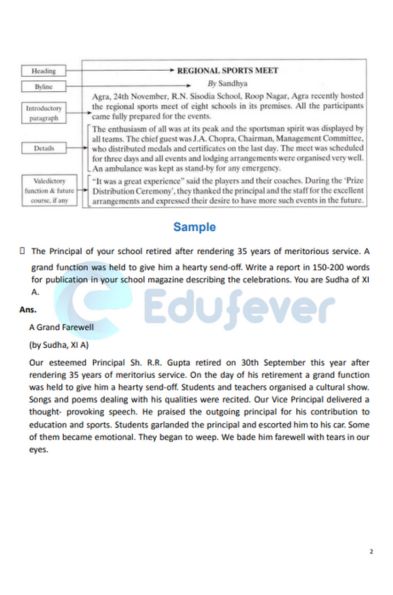
- Paragraph 1 (Introduction): Covers the '5 Ws'—What the event was, When and Where it took place, Why it was organised, and Who the chief guest or key participants were.
- Paragraph 2 (Detailed Account): Describes the main activities and highlights of the event in a logical sequence. What were the performances? What were the key moments? This is where you elaborate on How the event unfolded.
- Paragraph 3 (Conclusion): Summarises the event's outcome. It often includes audience reactions, a quote from the chief guest or principal, a mention of the prize distribution, and ends with a vote of thanks.
A Crucial Formatting Note: Place and Date
Unlike a newspaper report, the standard format for a school magazine report does not include the place and date at the beginning of the body. The context is already known (the school), and the report isn't breaking news.
This is an important distinction. While some guides or teachers might show slight variations, sticking to this rule is the safest and most widely accepted convention for the CBSE exam. In one of the videos we'll see, an instructor even points out that a board exam topper mistakenly included the date and place in a magazine report.
Report Writing Format Class 12
This resource from PW Store reinforces the format and adds an important point about the writing style.
Read the sections "Points to Remember" and "Report Writing Format for Class 12". Note the specific advice: "Write in a less formal and more descriptive manner, while writing a report for a school magazine." Also, observe that the format breakdown does not include a place or date.
2. Analysing a CBSE Sample Question
Now, let's see how this format is applied to a real board exam-level question. We will watch a detailed walkthrough of a school magazine report.
A quick heads-up: The instructor in this particular video does include the place and date in his example. As we've just discussed, this is not the standard convention. Therefore, please focus on how he constructs the content of the paragraphs—how he uses the cues from the question to build a narrative—rather than copying his byline format.
🔥 Report Writing in English | Class 10, 11, 12 | FORMAT With FIX LINES | Board 2026
This video by Sunil Panda provides an excellent step-by-step creation of a magazine report based on a CBSE sample paper question about a school's cultural festival.
First, quickly review the question breakdown from 06:43 to 07:50. Then, watch the detailed walkthrough of the answer from 07:50 to 13:36. As you watch, pay close attention to: How he crafts a suitable Heading and Byline. How the first paragraph introduces the event, date, and purpose, directly using the cues given in the question. How the subsequent paragraphs provide details on performances, exhibitions, and participant engagement. How the report concludes by mentioning feedback and the overall success of the event.
3. A Perfected Example
To give you a final, clear model that follows the standard format perfectly (without the place and date), here is an excellent visual guide and example.
Conclusion
This lesson completes your rapid revision of all the essential writing formats for the English Core exam. You are now prepared to distinguish between and correctly structure both newspaper and school magazine reports.
Key Takeaways:
- Format: A magazine report consists of a Heading, a Byline (Name and Designation only), and a Body structured in paragraphs.
- No Place/Date: Unlike a newspaper report, you should not add the place and date.
- Tone: The style is more descriptive and narrative, aiming to capture the atmosphere of the event.
- Content: The body should logically cover the 5 Ws and 1 H: What, When, Where, Why, Who, and How the event unfolded, from introduction to conclusion.
You have successfully revised Notices, Invitations and Replies, Letters to the Editor, Job Applications, Articles, and now, Reports. The next step is to put this knowledge into practice. Best of luck with your exam