Welcome to our third lesson. In the previous session, we broke down the essential three-paragraph structure for the body of a Letter to the Editor: introducing the problem, analysing its causes and effects, and proposing solutions.
Today, we will build on that foundation by conducting a detailed analysis of a complete, board-exam-level letter. Our goal is to see how the external format and the internal body structure work together to form a cohesive and persuasive argument, all while staying within the prescribed word limit. By deconstructing a high-scoring example, you'll gain a clear understanding of what examiners look for when they award marks for content, organisation, and expression.
Before we analyse the example, let's quickly review the complete format.
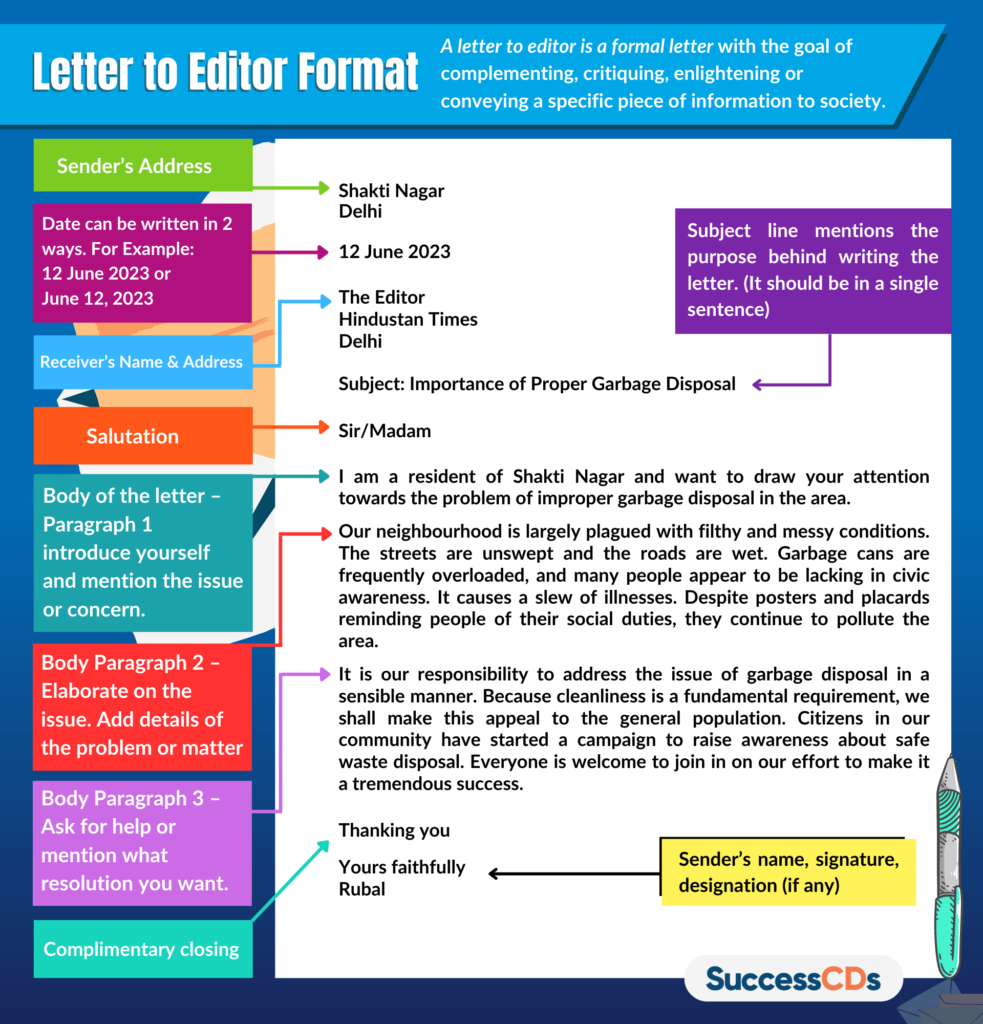
Understanding the Marking Criteria
To analyse a letter effectively, we first need to understand how it's graded. Your letter is not just marked on format; it's evaluated on content, organisation, and accuracy. Knowing the criteria will help you see why certain parts of the example letter are so effective.
CBSE Marking Scheme for Letter Writing
This resource provides the official CBSE marking scheme for letter writing. It breaks down the marks awarded for different components.
Read the sections titled "Format", "CONTENT", "ORGANISATION OF IDEAS", and "ACCURACY". Pay attention to how marks are allocated. For example, 'Content' requires that all points are included and well-developed, while 'Organisation' focuses on logical paragraphing and a formal tone.
As you can see, a successful letter must be strong in all four areas. Simply getting the format right is not enough to score well.
Deconstructing a Board Exam Example: Screen Addiction
Now, let's analyse a complete letter to the editor. The following video provides an excellent walkthrough of a letter addressing the modern-day problem of screen addiction in toddlers. The instructor breaks down the letter paragraph by paragraph, explaining how to build a strong argument.
Class 12 English Complete Writing Section✍️📝| Full Revision with Format |Board Exam 2026 Preparation
This video presents and analyses a sample letter on screen addiction among toddlers.
Watch the entire segment from the question walkthrough to the end of the letter analysis. As you watch, focus on the following: Format Application: Notice how the sender's address, date, receiver's address, subject, and salutation are correctly placed. Paragraph 1 (Introduction): How does the writer introduce the problem? Look for the opening lines that grab the editor's attention ("Through the columns..."). Paragraph 2 (Analysis): What specific causes (parents keeping children occupied) and effects (speech delay, irritability, stifled imagination) are discussed? Note the use of strong vocabulary like "digital nannies". Paragraph 3 (Conclusion): What concrete solutions are proposed? Listen for suggestions like "parents must lead by example", encouraging "outdoor play and traditional story-telling", and organising "gadget-free hours". Concluding Appeal: How does the letter end with a powerful appeal to both the editor and society? Pay attention to the final lines like "screen is no substitute for a parent's touch".
Analysis Summary
The example in the video is effective because it perfectly aligns with the CBSE marking criteria. Let's summarise how the argument was structured:
| Paragraph | Purpose | Content from the Example |
|---|---|---|
| Para 1: Introduction | State the problem | Opens with a formal address to the editor and introduces the "alarming rise in screen addiction among toddlers," framing gadgets as "digital nannies." |
| Para 2: Analysis | Explain causes & effects | Causes: Parents use gadgets to keep children occupied. Effects: Details the psychological impact, including speech delay, reduced social interaction, irritability, and stifled creativity. |
| Para 3: Conclusion | Propose solutions & appeal | Solutions: Suggests parents lead by example, promote outdoor play, revive storytelling, and community centers host gadget-free events. Appeal: Concludes with a powerful call to action. |
This clear, logical progression ensures the argument is easy to follow, persuasive, and covers all necessary points, satisfying the "Content" and "Organisation" criteria.
Another Example: Analysing Argument Structure
To reinforce your understanding, let's look at another solved example from a CBSE sample paper. This time, read the letter and try to identify the three-part body structure yourself.
Sample Letter: Harmful Advertising
This text provides a question about misleading "wonder diet" advertisements and a complete, solved letter in response.
Read the question first, where you are asked to address harmful advertising and propose a 'Wholesome Lunch Month'. Then, read the solved letter. As you read the body, identify: The Introduction: Which sentence introduces the problem of the posters? The Analysis & Solution: How does the letter immediately shift to proposing the solution ('Wholesome Lunch Month') and explaining its benefits? The Conclusion: How does the letter elaborate on the solution (puppet shows, talks) and end with an appeal for awareness?
This example shows that while the three-part structure is a reliable guide, the "Analysis" and "Solution" sections can sometimes be woven together, especially when the question directly asks you to propose an idea. The core logic remains: state the problem, explain your perspective/solution, and conclude with a call to action.
Conclusion
In this lesson, we moved from theory to practice by analysing how a well-structured argument is built within a Letter to the Editor. By breaking down board-exam-level examples, you've seen how to combine the correct format with a logically developed body to create a compelling letter that meets all the marking criteria.
Key Takeaways:
- Argument is Key: A high-scoring letter presents a clear, logical argument.
- Structure Creates Clarity: The three-paragraph body (Introduction, Analysis, Conclusion/Solutions) is the most reliable way to structure your argument.
- Address the Prompt: Directly use and expand upon the cues given in the question to build the core of your letter.
- End with a Purpose: Always conclude with concrete suggestions and a clear appeal to the editor or relevant authorities.
Now that you have analysed how a strong letter is written, you are ready to write one yourself. In our next lesson, you will draft a complete Letter to the Editor based on a board exam prompt, putting all these skills into practice.