Welcome to the third lesson in your English writing revision course. In the previous lessons, we focused on the short writing tasks of invitations and replies, which are capped at 50 words. Now, we are shifting our focus to a long writing task: the Letter to the Editor. This is a five-mark question with a word limit of 120-150 words.
Today, your goal is to master the fundamental structure of this letter. As with all formal writing, adhering strictly to the prescribed format is the first and most crucial step to securing good marks. This lesson will break down each component of the format, ensuring you can recall and apply it correctly in your exam.
The Standard Format of a Letter to the Editor
A Letter to the Editor is a formal letter written to a newspaper or magazine editor to voice an opinion, highlight a social issue, or draw the attention of authorities to a problem. Because it is a formal letter, it must follow a strict, universally accepted format. All elements are aligned to the left margin.
For a quick visual overview of the entire format, study the following mind map. It lays out every component from the sender's address to the closing signature, providing a clear blueprint.
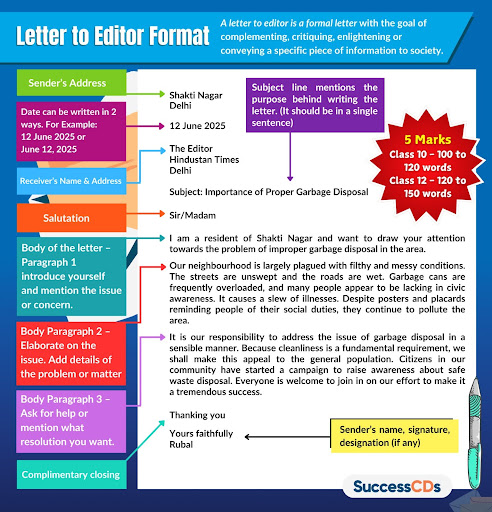
Now, let's break down each of these components step-by-step.
1. Sender's Address
This is your address (the person writing the letter). It should be written at the very top on the left side. It's usually written in two to three lines. If the question provides an address, you must use it. If not, you should create a plausible, but not personal, address.
Letter to editor|Letter to editor class 12 format|Letter to editor format class 12|Letter to editor
Watch this short clip from the video "Letter to editor" by Simran Sahni for a clear explanation of how to write the sender's address.
Focus on the part explaining how to write the address and what to do if one is not provided in the question. Notice the instruction to leave a line after the address.
2. Date
After leaving a single blank line below the sender's address, you write the date. The preferred format is to write the date out in full, for example, 15 March 2024. Avoid using formats like 15/03/24 or March 15, 2024.
Letter to editor|Letter to editor class 12 format|Letter to editor format class 12|Letter to editor
This next clip explains the correct format for writing the date.
Pay close attention to the recommended date format for your board exam.
3. Receiver's (Editor's) Address
After leaving another blank line, you write the address of the person you are sending the letter to. This should be written in three lines:
- The Editor
- The Name of the Newspaper (e.g., The Times of India, The Hindu)
- The City (e.g., New Delhi, Mumbai)
Letter to editor|Letter to editor class 12 format|Letter to editor format class 12|Letter to editor
Now, learn how to correctly format the receiver's address.
Watch the section from "The Editor" to understand the three-line structure for this address.
4. Subject
The subject line is crucial. It should be brief, clear, and summarise the main purpose of your letter in a single line. It is written after leaving a blank line below the receiver's address. It always starts with "Subject:".
Letter to editor|Letter to editor class 12 format|Letter to editor format class 12|Letter to editor
This clip explains how to formulate an effective subject line.
Focus on how to derive the subject from the question itself, making it concise and impactful.
5. Salutation
This is the formal greeting. Leave a line after the subject and write "Sir/Madam," or "Respected Sir/Madam,".
Letter to editor|Letter to editor class 12 format|Letter to editor format class 12|Letter to editor
The salutation is simple but must be formal.
Watch the brief explanation on using "Respected Sir/Madam".
6. Body
The body of the letter is where you detail your issue. It is typically structured into three paragraphs:
- Paragraph 1: Introduce yourself and the problem in brief.
- Paragraph 2: Explain the issue in detail, including its causes, effects, and relevant examples.
- Paragraph 3: Conclude by offering suggestions, solutions, or making an appeal.
We will focus on how to write the body effectively in the next lesson. For now, just remember its place in the overall structure.
7. Complimentary Close and Name
After the body, leave a line and write a polite closing phrase like "Yours sincerely," or "Yours truly,". Note the comma at the end. Finally, after the complimentary close, write your name as given in the question. If a designation is provided (e.g., 'Head Boy', 'Concerned Citizen'), it should be written below your name.
Letter to editor|Letter to editor class 12 format|Letter to editor format class 12|Letter to editor
This final clip explains the closing elements of the letter.
Pay attention to the instructions for writing "Thank you" and the sender's name and designation.
Format Summary
To reinforce what you've just learned, review the following table. It summarises every component in a clean, easy-to-read format.
Letter to Editor Format Sample
This table from the Vedantu article "Letter To Editor Format Examples" provides a clear, structured breakdown of each part of the letter format.
Focus on the 'What to Include' and 'Example' columns. This provides a perfect template for you to memorize and follow.
Finally, watch this quick recap to see all the pieces come together in the correct sequence.
Letter to editor|Letter to editor class 12 format|Letter to editor format class 12|Letter to editor
This clip provides a quick summary of the entire format.
Watch the full format recap to consolidate your understanding of the sequence and line spacing.
Conclusion
Mastering the precise format of a Letter to the Editor is non-negotiable for scoring well. Getting it right demonstrates your attention to detail and understanding of formal communication protocols, which examiners value highly.
Key Takeaways:
- Structure is Key: The letter must follow a specific sequence: Sender's Address, Date, Receiver's Address, Subject, Salutation, Body, Complimentary Close, and Sender's Name.
- Left Alignment: All elements are aligned to the left margin.
- Line Spacing: A blank line must be left between each major section to ensure clarity and readability.
- Formal Tone: The language, salutation, and closing must remain formal throughout.
In our next lesson, we will dive deeper into the content of the letter. We'll explore how to structure the three paragraphs of the body to introduce your topic, develop your arguments with causes and effects, and conclude with impactful suggestions or appeals.