Hello! In our previous lessons, we explored formal and informal invitations and replies separately. We looked at the official tone of formal communications and the friendly style of informal ones. Now, it's time to bring all that knowledge together.
This lesson is designed to help you master the art of distinguishing between formal and informal formats, a critical skill for your exam. Your ability to correctly identify the required tone and structure based on the question is the first step to scoring full marks. By the end of this quick revision, you'll be able to confidently choose and apply the right format for any invitation or reply scenario.
The First Choice: Formal or Informal?
Your first decision when you see an invitation question is to determine if it requires a formal or informal response. This choice hinges on two factors: the event and your relationship with the invitee.
- Formal invitations are for official functions, public events, or when inviting a large audience or a special guest (like a chief guest or a dignitary). Think of school annual days, inaugurations, or weddings.
- Informal invitations are for personal events with friends, family, and close acquaintances. Think of birthday parties, holiday visits, or casual get-togethers.
To quickly grasp this distinction, watch the beginning of this helpful video from Shipra Mishra. Her analogy makes the difference easy to remember.
Invitation & Replies -How to write Invitations and replies | FORMAL & INFORMAL | Format & Body #cbse
This video uses a simple analogy to explain when to use formal versus informal invitations.
Watch the segment from 0:32 to 4:44. The presenter distinguishes between inviting a relative (informal) and interacting with a school principal (formal). This will help you quickly figure out the context of a question.
The Second Choice (Formal Only): Card or Letter?
Once you've decided on a formal invitation, there's another crucial choice: should it be a card or a letter?
- Use the card format when inviting a large number of people to an event (mass audience). The text is centered and presented within a box.
- Use the letter format when inviting a specific, important individual (a VIP), such as a chief guest for a school function. This is more personal than a generic card.
The following video provides an excellent explanation of this specific point.
Invitation Writing & Reply | Class 12 English | Formal & Informal | Format & Examples | Boards 2025
This video from Sunil Panda clearly explains the difference between a formal card and a formal letter invitation.
Watch the section from 1:26 to 2:39. The speaker uses the example of inviting many guests to a wedding (card) versus inviting the Prime Minister (letter) to illustrate this key difference.
Distinctions at a Glance
To consolidate your revision, here is a table that summarizes the key differences between formal and informal invitations and replies. Keep these points in mind as a mental checklist.
| Feature | Formal Invitation / Reply | Informal Invitation / Reply |
|---|---|---|
| Tone | Official, polite, conventional | Warm, personal, friendly, relaxed |
| Person | Third Person (e.g., "Mr. & Mrs. Sharma request...") | First & Second Person (e.g., "I would be delighted if you...") |
| Format | Invitation: Card (for many) or Letter (for VIPs). Reply: Letter style. |
Invitation & Reply: Personal letter style. |
| Structure | Card: Centered text, key details only. Letter/Reply: Full formal letter format. |
Simple letter: Sender's address, date, salutation, body. |
| Presentation | Card: Always in a box. Letter/Reply: Generally no box. |
No box. |
| Salutation | Letter: 'Sir' or 'Madam'. Card/Reply: No salutation. |
'Dear [Name],' |
| Closing | Letter: Yours faithfully/sincerely Reply/Card: No signature needed. |
Yours affectionately/lovingly |
Deep Dive: Language and Format
The most significant differences lie in the language (person) and the overall structure.
Formal: Third Person & Official Structure
Remember, formal writing is objective and impersonal.
- Formal Invitation (Card): It's written from a third-person perspective. The host's name appears, but not as "I" or "we".
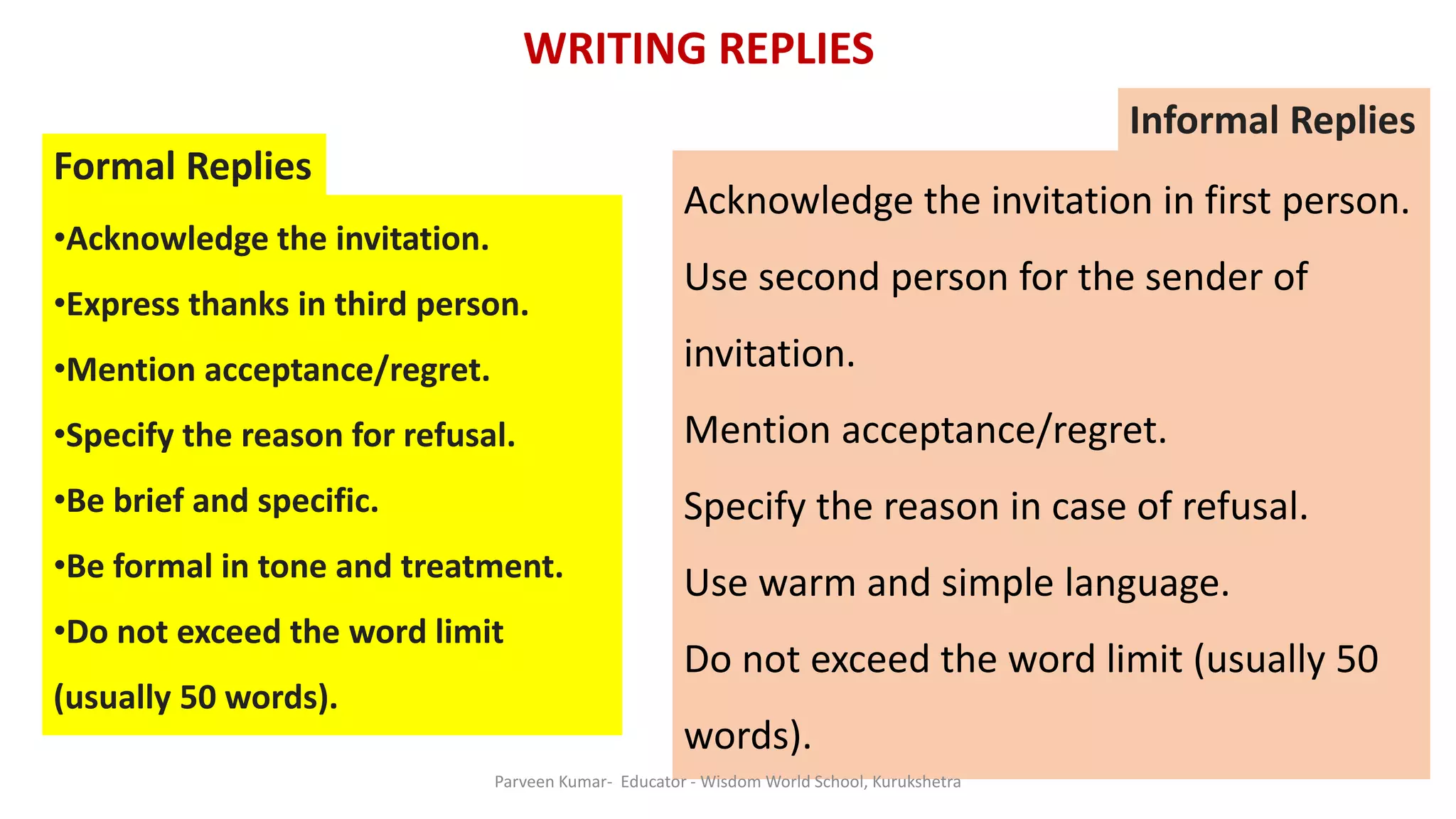
- Formal Reply: You also reply in the third person. You don't say, "I am happy to accept." Instead, you write, "Mr. Vikram Gaur has great pleasure in accepting the invitation..."
This image clearly shows the structure and third-person language of a formal reply.
And here is an excellent example of a formal invitation in the card style.

Informal: First/Second Person & Personal Structure
As we covered in the last lesson, informal writing is like a short, friendly letter.
- Informal Invitation: You write directly to the person: "I'm so excited to invite you to my party..."
- Informal Reply: You reply in the same direct manner: "I would love to come. Thank you for inviting me."
To see these differences in action across several board-level examples, review the solved questions on the following page.
Invitation and reply writing Examples
This resource from SuccessCDS provides a large collection of solved CBSE questions. Comparing them is an excellent way to revise.
Scroll through the "Invitation and reply writing Examples" section. Pay special attention to the difference in format and wording between: Q6 (Formal Reply - Acceptance): Notice the letter format and third-person phrasing. Q7 (Formal Reply - Inability): See how the refusal is expressed politely and formally. Q15 (Informal Reply - Inability): Contrast this with the formal refusal. The tone is personal and uses 'I' and 'you'. Q16 (Informal Reply - Acceptance): A clear, friendly acceptance in a simple letter format.
Conclusion
Mastering the distinction between formal and informal styles is key to excelling in this section of your exam. The right choice of format, tone, and person will show the examiner that you understand the context of the communication.
Key Takeaways:
- Formal: Think official, polite, and third-person. Use a card in a box for many people or a formal letter for a VIP. Replies are in the third person.
- Informal: Think personal, friendly, and first-person (
I,we,you). Use a simple letter format for both the invitation and the reply. No box is needed. - Check the Question: The relationship (friend vs. official) and event (party vs. school function) are your biggest clues.
You have now completed your revision of the "Invitations and Replies" module. In our next lesson, we will move to the long writing tasks, beginning with the Letter to the Editor. This will require a different skill set, focusing on structuring arguments and presenting opinions on social issues.