Welcome to the next part of your quick revision course! In the previous module, we mastered Notice Writing, a key short composition skill. Now, we're moving on to another 4-mark question: Invitations and Replies.
Today's lesson focuses on the first half of this topic: Formal Invitations. By the end of this session, you will be able to recall the format of a formal invitation and, crucially, distinguish between the two types your syllabus requires: the card style for general events and the letter style for inviting specific individuals. Understanding when to use each format is key to scoring full marks.
Formal vs. Informal: The First Distinction
Before diving into the formats, it's important to know that invitations are broadly divided into two categories: formal and informal. As the names suggest, you use formal invitations for official functions, large gatherings, or to invite dignitaries. Informal invitations are for close friends and family.
This lesson concentrates only on formal invitations. These themselves come in two distinct styles. Let's watch a short video to understand this primary distinction.
Invitation & Reply Class 12 | Invitation Writing Class 12 | Formal/Informal Invitation Format
The presenter, from the Educational Bhaiya channel, clearly explains the difference between formal and informal invitations and then introduces the two types of formal invitations: card and letter.
Watch the initial overview from the start to understand the main categories. Then, focus on the section from 03:50 to 05:06, where the presenter explains exactly when to use the card type (for events like marriages, birthdays) versus the letter type (for a chief guest or special invitee). This directly addresses the core of today's learning outcome.
As you saw, the choice between the two formal styles depends entirely on your audience:
- Card Style: Used when inviting a large number of people to an event (e.g., a wedding, a school's annual day).
- Letter Style: Used when inviting a specific, important individual (a VIP) to act as a chief guest, judge, or special guest of honour.
1. The Card-Style Formal Invitation
This is the most common type of formal invitation, used for events like weddings, inaugurations, or anniversaries. It is printed and distributed to many people.
Key Characteristics:
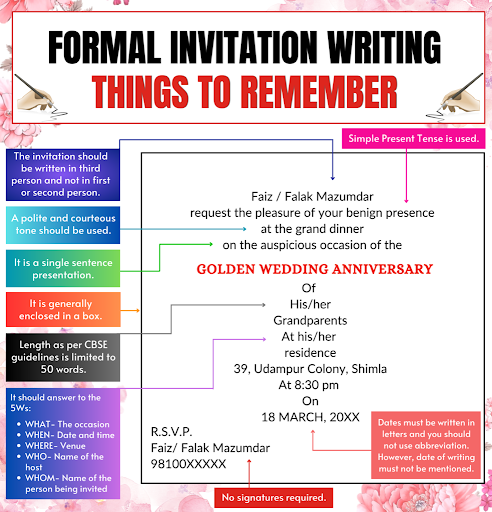
- It is written in the third person (e.g., "Mr. and Mrs. Sharma request the pleasure of your company...").
- It is enclosed in a box.
- The content is centered and presented in separate lines, not as a running paragraph.
- The name of the invitee is not included in the card.
- The date of writing and the writer's signature are not present.
- The abbreviation RSVP (from the French Répondez s'il vous plaît, meaning "Please reply") is written on the bottom left, with the host's contact details.
- The word limit is 50 words.
The infographic below provides an excellent visual summary of the format and rules for a card-style invitation.
Now, let's see how this format is applied in a board-exam context. The following video walks through the format and then solves a question for a marriage ceremony.
Invitation & Reply Class 12 | Invitation Writing Class 12 | Formal/Informal Invitation Format
This video provides a step-by-step breakdown of the card-style format and then applies it to a real exam-style question.
First, watch the detailed explanation of the card-type format. The presenter breaks down each component, from the host's name to the RSVP. Then, immediately watch the solved example for a marriage invitation. This will solidify your understanding of how to apply the format.
2. The Letter-Style Formal Invitation
This format is used when you need to extend a personal and formal invitation to a VIP to preside over a function as a chief guest, judge, or guest of honour. It follows the structure of a formal letter.
Key Characteristics:
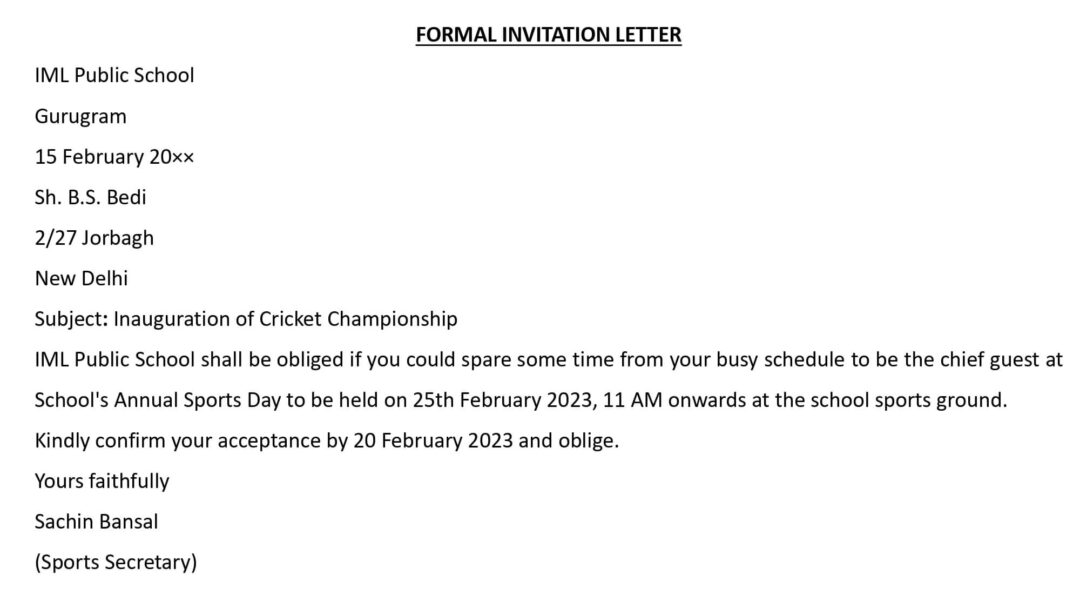
- It follows the standard formal letter format.
- It is written in a polite, formal tone. You can use first person ("We would be honoured...") or third person ("The school requests...").
- It includes the sender's address, date, and receiver's address.
- It has a subject line.
- A box is not used.
- It ends with a complimentary close and the sender's name and designation.
- The word limit is still 50 words.
Here is a clear example of a letter-style invitation.
To understand the structure in detail, let's return to the video resource.
Invitation & Reply Class 12 | Invitation Writing Class 12 | Formal/Informal Invitation Format
This part of the video explains the format for the letter-style invitation and then demonstrates it with a solved example for inviting a chief guest to a school's annual day.
Watch the detailed explanation of the letter-style format. Pay close attention to the components like addresses, subject, and salutation. Afterward, watch the solved example to see how these elements come together in an answer.
For further reinforcement, you can look at another board exam question.
Previous Years’ CBSE Examination Questions
This resource from Learn CBSE contains several solved questions from past board exams.
Scroll down to Question 2. It asks you to draft an invitation inviting a famous writer to be the guest of honour for a school play. Read the question and the provided answer to see another example of the letter-style formal invitation.
Summary: Card vs. Letter Style
Here is a quick summary table to help you remember the key differences for your revision.
| Feature | Card-Style Invitation | Letter-Style Invitation |
|---|---|---|
| When to Use | For a large number of invitees (mass audience). | To invite one specific VIP (chief guest, judge, etc.). |
| Format | Centered text in separate lines. | Standard formal letter format. |
| Box | Yes, enclosed in a box. | No box. |
| Invitee's Name | Not included. | Included in the receiver's address and body. |
| Person | Third person only. | Formal tone, can use first or third person. |
| Signature | No signature. | Signed by the host/organizer with designation. |
| RSVP | At the bottom left. | Confirmation is requested within the body of the letter. |
Conclusion
In this lesson, you've revised the two essential formats for formal invitations. The most important takeaway is to first analyze the question to determine the audience: are you inviting a crowd or a single VIP? This will immediately tell you whether to use the card style or the letter style.
Key Takeaways:
- Card-style invitations are for mass audiences, written in the third person, and enclosed in a box. They do not name the invitee.
- Letter-style invitations are for specific VIPs, follow a formal letter format, and directly address the invitee. They are not enclosed in a box.
- Both formats must contain the key information: occasion, host, date, time, and venue (the 5 Ws: Who, What, When, Where, Why).
In the next lesson, we will build directly on this knowledge by learning how to write formal replies of acceptance and refusal to these invitations.