Welcome back! In our last lesson, we explored the two-pointer technique, a powerful method for optimizing problems on sorted arrays by moving pointers from opposite ends. Today, we'll delve into a closely related yet distinct pattern that you specifically highlighted as crucial for your interview preparation: the sliding window technique.
This lesson will equip you to solve a common category of array and string problems, often concerning contiguous subarrays or substrings. We'll start by understanding the core idea and its efficiency advantage over brute-force methods. Then, we will dissect the two primary types of sliding windows—fixed-size and variable-size—and apply them to classic problems that frequently appear in technical interviews.
1. From Brute Force to an Efficient "Window"
Imagine you're asked to find the maximum sum of any contiguous subarray of size 3 in a given array. The naive, or brute-force, approach would involve two nested loops. The outer loop picks a starting point, and the inner loop iterates through the next 3 elements to calculate their sum. You'd repeat this for every possible starting point.
While this works, its time complexity is , where is the array size and is the subarray size. For a large array, this is inefficient. This is where the sliding window technique provides a significant optimization, reducing the complexity to a clean .
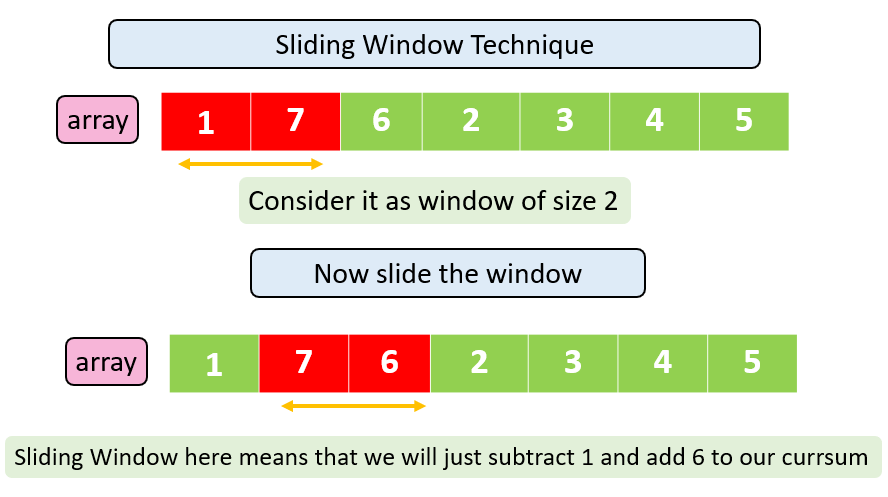
The core idea is to maintain a "window" of a certain size that "slides" over the array. Instead of recalculating the sum of the entire window every time it moves, we perform a simple and efficient update: subtract the element that leaves the window from the left and add the element that enters from the right.
This video from the TAP ACADEMY YouTube channel provides an excellent introduction, first by explaining the problem and then by showing the inefficient brute-force solution.
Solve Subarray Problems Quickly With Sliding Window Technique | FREE DSA Course in JAVA | Lecture 79
Watching the brute-force approach first will help you appreciate the efficiency of the sliding window.
First, watch the problem explanation to understand the goal. Then, see the naive approach, which uses nested loops and results in an O(n^2) solution. Pay attention to how it repeatedly recalculates sums.
Now that you've seen the slow way, let's look at the elegant, efficient alternative.
2. The Fixed-Size Sliding Window
The most straightforward application of this technique is with a fixed-size window. Let's tackle the same problem: Find the maximum sum of a contiguous subarray of size k.
The algorithm is as follows:
- Initialize: Calculate the sum of the first
kelements. This is your initialwindowSumand your currentmaxSum. - Slide: Start a loop from the
k-th element to the end of the array. In each iteration:
a. Add the current element (the one entering the window from the right) towindowSum.
b. Subtract the element that is falling off the left side of thewindow. This element will be at indexi - k.
c. Compare the newwindowSumwithmaxSumand updatemaxSumif it's larger. - Return: After the loop,
maxSumholds the result.
The same video you just watched provides a fantastic explanation and implementation of this exact logic.
Solve Subarray Problems Quickly With Sliding Window Technique | FREE DSA Course in JAVA | Lecture 79
This part of the video explains the intuition and implementation of the fixed-size sliding window.
Start by watching the conceptual analogy of a sliding window. Then, focus on the core intuition, which explains how to efficiently update the sum. Finally, follow the step-by-step coding process to see how this translates into a complete Java solution.
This pattern is your go-to solution for any problem that asks for an optimal value (max, min, etc.) over a contiguous subarray of a fixed length. The article "Sliding Window Technique in Java" from dev.to offers a concise code template for this.
🔍 Sliding Window Technique in Java – The Ultimate Guide 🚪
This article provides clear, templated code for both fixed-size and variable-size windows.
In the section "Java Code Examples," review the code under the heading "Maximum Sum Subarray of Size K". Notice how it directly implements the logic we just discussed: add the new element, and once the window size is met, find the max and subtract the old element.
3. The Variable-Size Sliding Window
Things get more interesting when the window size isn't fixed. In these scenarios, the window grows and shrinks dynamically based on a certain condition. A classic example is: Find the minimum length of a contiguous subarray whose sum is greater than or equal to a target value S.
Here, we don't know the size of the subarray beforehand. The logic adjusts:
- Expand the Window: Use a
rightpointer to iterate through the array, adding each element to awindowSum. This expands the window to the right. - Check and Shrink: As soon as
windowSummeets the condition (i.e.,windowSum >= S), we have a potential answer.
a. Record its length (right - left + 1) and update ourminLengthif this one is smaller.
b. Now, try to find an even smaller valid window by shrinking it from the left: subtract the leftmost element fromwindowSumand increment theleftpointer.
c. Keep shrinking as long as the conditionwindowSum >= Sremains true. - Continue: Once the condition is violated, the inner shrinking loop stops, and the outer loop continues expanding the window to the right.
This "expand-and-shrink" dynamic is the essence of the variable-size window. The article from Labuladong provides a robust mental framework for this pattern.
Sliding Window Algorithm Code Template
This article provides a powerful, generalized template for all sliding window problems.
Read the section Sliding Window Framework Overview. Pay close attention to the pseudocode and the three key questions it poses. This framework is invaluable for structuring your thoughts during an interview.
Now, let's see this variable-size pattern in action with a video walkthrough.
Sliding Window Technique - Algorithmic Mental Models
This video from the Ryan Schachte channel provides a clear visual and coding demonstration of the variable-size window.
Watch the segment from this timestamp. It animates the process of finding the smallest subarray whose sum is >= 8, showing how the window expands to meet the condition and then shrinks to find the optimal length. The code walkthrough clearly distinguishes between the windowEnd (for expansion) and windowStart (for shrinking).
4. How to Spot the Pattern in an Interview
Recognizing when to apply an algorithm is just as important as knowing how to implement it. Here are the tell-tale signs of a sliding window problem:
- The problem involves an array or a string.
- You are asked to find properties of a contiguous subarray or substring. This is the biggest clue.
- The problem asks for a longest, shortest, minimum, or maximum value that satisfies a certain condition.
- The problem might state a fixed window size
k, clearly pointing to a fixed-size window.
This video section summarizes these points perfectly.
Sliding Window Technique - Algorithmic Mental Models
This segment focuses specifically on identifying keywords and problem types that are a great fit for the sliding window technique.
Watch the section from how to recognize these problems. The speaker highlights keywords like "contiguous sequence," "min/max/longest/shortest," and "contains," which are dead giveaways.
Conclusion
Today, you've added another essential interview pattern to your toolkit. The sliding window technique is a powerful way to turn seemingly complex subarray problems with or complexity into highly efficient solutions.
Here are the key takeaways:
- Core Idea: The sliding window technique efficiently processes contiguous subarrays by avoiding redundant calculations. It updates a window's value by adding the incoming element and subtracting the outgoing one.
- Fixed-Size Window: Used when the subarray length
kis given. The window slides one element at a time, and you update your answer at each step. - Variable-Size Window: Used when the subarray length is unknown. The window expands until a condition is met, then shrinks from the left to find the optimal solution while the condition still holds.
- Problem Recognition: Look for problems on arrays/strings involving "contiguous subarrays/substrings" and optimizing for a "longest/shortest/min/max" value.
In our next lesson, we will explore another common interview pattern: solving frequency-counting problems using a HashMap. You'll see how a HashMap can be a powerful auxiliary data structure used inside a sliding window to solve even more complex problems, like finding the longest substring with no repeating characters.