Hello! Welcome to the final lesson of our module, "Speaking with Structure and Precision."
In our last lesson, we focused on bringing structure to a formal work setting by practicing how to deliver clear, concise project status updates. You learned a powerful three-part framework: starting with a headline (your main point), organizing the details (progress, challenges, next steps), and ending with a clear closing.
Today, we'll shift our focus from the conference room to the coffee shop. The goal of this lesson is to adapt the principles of structured communication to the world of casual conversation. You'll learn how to structure your stories and explanations so they are engaging, easy to follow, and memorable, whether you're talking to friends, family, or colleagues in a more relaxed setting. This will help you transform potentially messy anecdotes into captivating narratives.
The Hidden Structure of Casual Stories
You might think that casual stories are spontaneous and unstructured. However, linguists have found that the most effective and satisfying stories, even in everyday conversation, follow a predictable pattern. Just as your engineering projects follow a lifecycle, stories have a natural flow that guides the listener from beginning to end.
A very useful model for this was developed by linguists Suzanne Eggins and Diana Slade, who analyzed patterns in real-life conversations. I'd like you to read about their narrative framework.
A story framework based on casual conversation
The article 'A story framework based on casual conversation' by Dr. Lizzy Tanguay explains this structure clearly. It breaks down a narrative into six 'moves' or stages.
Please read the section titled 'A transformational narrative'. Focus on understanding the six components: Abstract, Orientation, Complication, Resolution, Evaluation, and Coda.
Let's break down this framework with a simple example. Imagine you're telling a friend about a frustrating experience at the train station.
- 1. Abstract: A brief opener that signals a story is coming and what it's about.
"You will not believe what just happened to me at the station."
- 2. Orientation: Sets the scene—who, what, where, when.
"I was at Central Station about an hour ago, trying to buy a ticket for my trip this weekend."
- 3. Complication: The core problem or conflict that drives the story.
"All the ticket machines were broken, and the line for the ticket office was a mile long. I was starting to panic that I'd miss the advance fare."
- 4. Resolution: How the problem was solved.
"But then I remembered the railway company has a mobile app. I downloaded it right there, and managed to buy my ticket in two minutes."
- 5. Evaluation: The point of the story, or the feeling it evokes. This is the "So what?".
"I was so relieved. It’s amazing how a simple app can save you from so much stress."
- 6. Coda: A closing signal that bridges back to the present conversation.
"Anyway, that's why I'm a few minutes late."
This structure is a conversational version of the classic story arc you might be familiar with.
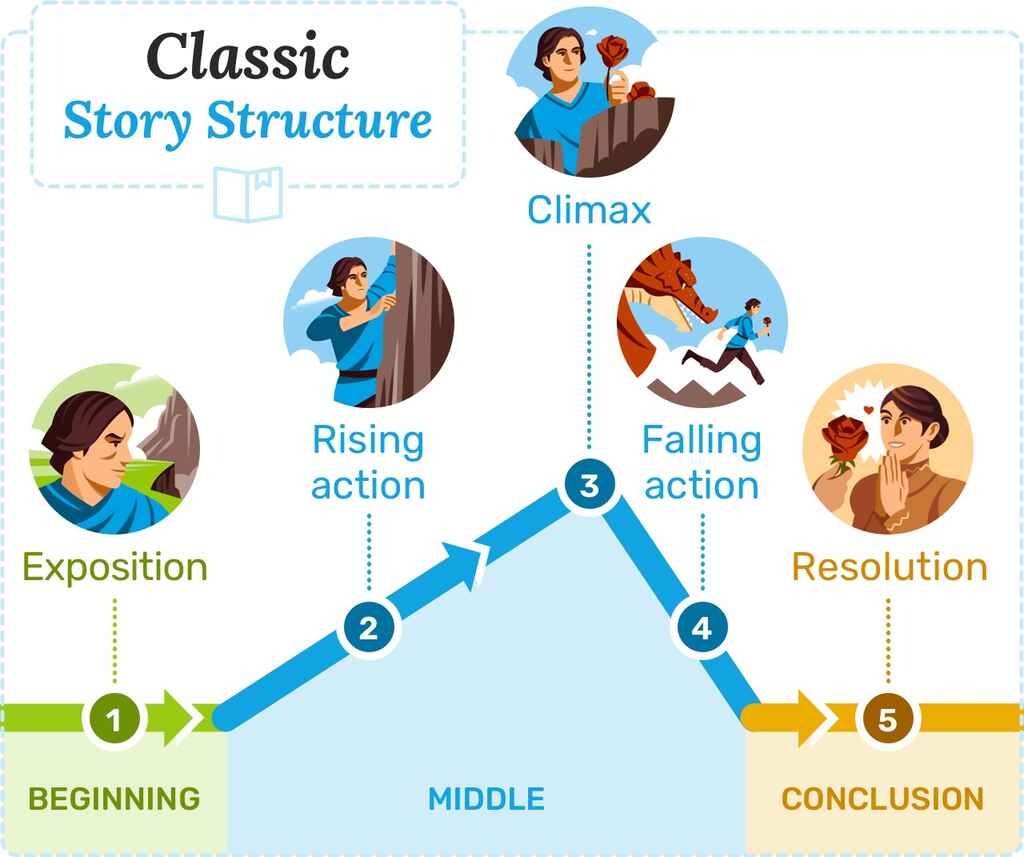
Having this structure in mind provides a mental "blueprint" that can prevent you from rambling or losing your point.
From "What Happened" to "Being There"
A good structure is the skeleton of a story, but the details are what bring it to life. A common mistake is simply summarizing events. To make a story truly engaging, you need to "zoom into the moment" and make the listener feel like they are there with you.
The following video brilliantly explains five techniques to do just that.
Give me 9min, and I'll improve your storytelling skills by 176%
In 'Give me 9min, and I'll improve your storytelling skills by 176%', Philipp Humm breaks down how to add vivid, compelling details to your stories.
Please watch from the beginning up to the 6:52 mark. This covers the introduction and the five core techniques: Location, Actions, Thoughts, Emotions, and Dialogue. Pay close attention to the 'before' and 'after' examples for each technique.
Let's recap those five powerful techniques for adding detail:
- Location: Briefly state where you are to help the listener visualize the scene. (e.g., "I'm standing in the airport security line...")
- Actions: Describe what you are doing. Verbs create momentum. (e.g., "...and I open my bag to get my passport.")
- Thoughts: Share your raw, unfiltered internal monologue at that moment. (e.g., "And I think, 'Oh no, where is it?'")
- Emotions: Show the emotion through physical reactions, not just by naming it. (Instead of "I was anxious," say "My heart started pounding, and I could feel my hands getting clammy.")
- Dialogue: Quote what was said directly. It's often more powerful than reporting it. (Instead of "My friend asked what was wrong," say "My friend looked at me and said, 'What on earth happened?'")
You don't need to use all five in every story. Just adding one or two can make a huge difference. Notice how these techniques prevent you from overloading the listener with unnecessary background information—a common pitfall discussed in the article "How to Tell a Good Story." You're not adding more information, you're adding the right information.
A Framework for Short, Punchy Stories
Sometimes you need to tell a story in under a minute. The TED talk "The Secret to Telling a Great Story — in Less Than 60 Seconds" offers a great framework for this, which complements the structures we've discussed. The speaker, Jenny Hoyos, suggests a four-part model:
- Hook with a Question: Start with something that makes people curious. (e.g., "Have you ever wondered if you could cook a burger faster than a drive-through?")
- Build Progression: Show clear steps toward the answer.
- Introduce Conflict: Add a problem or an obstacle.
- Create Tension & Deliver the Answer: Make the outcome feel uncertain before providing a clear, satisfying conclusion.
This is particularly effective for short, entertaining anecdotes where the goal is to quickly grab and hold attention.
Practice Time: Structuring Your Own Story
Now it's your turn to practice. This exercise is designed to train your brain to find a structure before you start speaking.
Think of a simple personal story. The article "How to Tell a Good Story" suggests having a few of these ready, like a travel tale, a funny family story, or a defining life moment. Choose one. For example:
- A time you got lost while traveling.
- A funny mistake you made at work.
- A memory of learning a new skill.
Test your understanding!
Take about 10-15 minutes to plan out your story using the following steps. You don't need to write the full story, just the key points for each stage.
Step 1: Use the Conversational Narrative Framework
Organize your story's key events into the six stages we discussed (based on resource LINK).
- Abstract: (How will you start?)
- Orientation: (Who, when, where?)
- Complication: (What was the main problem/event?)
- Resolution: (How was it solved?)
- Evaluation: (What was the point or your feeling about it?)
- Coda: (How would you wrap it up?)
Step 2: Enhance with Engaging Details
Now, look at your "Complication" and "Resolution" stages. Pick one or two "zooming in" techniques (from resource LINK) to make these moments more vivid.
- Action, Thought, Emotion, or Dialogue: What specific detail could you add? For example, what were you thinking? What did someone say? What physical sensation did you feel?
Show answer
Here’s an example based on a "getting lost while traveling" story:
Step 1: The Structure
- Abstract: "Let me tell you about the time I got completely lost in Tokyo."
- Orientation: "It was my first solo trip, about five years ago. I was trying to find this famous ramen shop in the Shinjuku district."
- Complication: "My phone battery died, so I lost my map. The streets all looked the same, and I couldn't read any of the signs. I was getting really hungry and frustrated."
- Resolution: "I finally stumbled into a tiny convenience store and used my last few coins to buy a paper map. An elderly shopkeeper saw me struggling and, using a lot of gestures, pointed me in the right direction."
- Evaluation: "It was stressful at the time, but it ended up being my favorite memory. It taught me that sometimes the best adventures happen when your plans fall apart, and that people are kind everywhere."
- Coda: "So yeah, that's why I always carry a power bank now!"
Step 2: The Enhancements
- Adding a 'Thought' to the Complication: "I remember standing on a street corner, cars whizzing by, and just thinking, 'Okay, you're officially an idiot. You're going to starve in the world's biggest city.'"
- Adding 'Dialogue' to the Resolution: "The shopkeeper didn't speak English, but he just smiled, pointed at my map, then pointed down the street and said, 'Ramen... oishii!' which means delicious. It was all I needed to hear."
Notice how those small additions make the story much more personal and vivid.
Conclusion
Congratulations on completing this module! You've journeyed from structuring formal updates to crafting engaging personal stories. While the context changes, the core principle remains the same: a clear structure is the foundation of clear communication.
Key Takeaways:
- Casual stories have structure: Use the Abstract, Orientation, Complication, Resolution, Evaluation, Coda framework as a mental guide to keep your stories on track.
- Bring stories to life with details: Instead of just summarizing, "zoom in" by describing specific actions, thoughts, emotions, and dialogue. This makes your listener feel like they are part of the experience.
- Match the structure to the situation: Use the comprehensive six-part model for longer anecdotes and a punchier framework (like Hook -> Conflict -> Resolution) for quick stories.
Preview of the next module:
You now have a powerful set of tools for structuring your thoughts for both professional and casual communication. But how do you make using them a habit? In our final module, "The Habit of Self-Correction," we will focus on the crucial skills of reviewing, revising, and refining your own writing and speaking to ensure you are consistently clear, structured, and impactful.