Hello! Welcome back to our module, "Speaking with Structure and Precision."
In our last lesson, we focused on making an immediate impact by delivering your main point first—the BLUF (Bottom Line Up Front) principle. You learned to structure your initial thought using the "What? So What? Now What?" framework. This ensures your listener immediately understands your core message.
Today, we'll address what comes next. Once you've stated your main point, how do you guide your listener through your supporting reasons, examples, and details without them getting lost? The answer is signposting. This lesson is dedicated to mastering the use of signposting phrases to act as a clear roadmap for your listener. Think of these phrases as the verbal equivalent of well-placed comments in code or section headers in a technical document; they clarify the logic and structure, making the information much easier to process.
What is Signposting and Why Is It Crucial for Speaking?
Signposting is the practice of using specific words and phrases to signal the structure of your message to your audience. They tell the listener where you've been, where you are, and where you're going next.
In writing, structure is visual. You have paragraphs, headings, and bullet points. When speaking, however, your listener relies entirely on you to provide that structure. Without signposts, even a well-organized set of ideas can sound like a continuous, messy stream of consciousness. Signposting solves this by making your internal structure explicit.
Let's start by exploring this concept in more detail.
Signposting: How to reduce cognitive load for your reader
The article 'Signposting: How to reduce cognitive load for your reader' by Wes Kao explains this concept from a powerful perspective: reducing the mental effort for your audience. It clearly defines signposting and explains its value, especially in verbal communication.
Please read two parts of this article: Start from the beginning and read down to the section titled 'List of my favorite signposting words'. Focus on the definition of signposting and its main benefit. Then, find the section 'When signposting is most valuable' and read the paragraph that begins with 'You should signpost verbally too.' This part is key to our lesson today.
As the article emphasizes, signposting is even more valuable when speaking because your listener can't pause and reread. By using signposts, you guide them through your thoughts in real-time, preventing them from feeling lost or overwhelmed.
The Toolkit: Categories of Signposting Phrases
To use signposting effectively, you need a toolkit of phrases for different situations. We can group these phrases by their function, such as sequencing ideas, adding information, or drawing a conclusion.
The following video provides an excellent overview of different categories of transition words, which are the building blocks of signposting.
50+ Transition Words For English Conversations
The video '50+ Transition Words For English Conversations' by JForrest English breaks down these useful phrases into logical categories. We'll focus on the most common ones for structuring speech.
Please watch the following short segments to see examples for different functions: For Chronology/Sequencing (03:44 - 05:27): Notice phrases like 'First, secondly, next, finally'. For Addition (06:34 - 07:22): Pay attention to 'In addition, furthermore, also'. For Examples (07:51 - 08:23): Note 'For example, for instance'. For Conclusions (08:59 - 10:11): Focus on 'In conclusion, to summarize, ultimately'.
To have a quick reference, here are two excellent visual summaries of signposting phrases organized by their function.

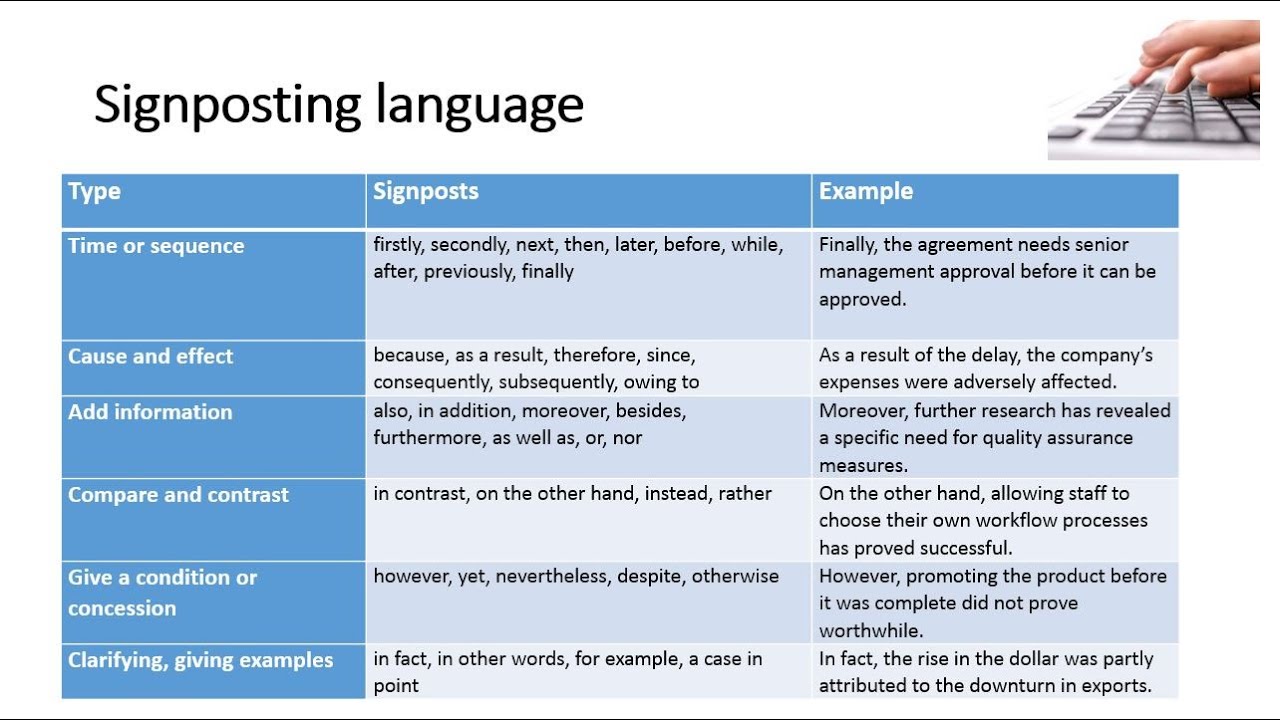
These tables are valuable resources. You can save them or keep them handy as you practice incorporating these phrases into your daily communication.
Combining BLUF with Signposting
Now, let's integrate today's skill with what we learned in the last lesson. The most effective communication often starts with the main point (BLUF) and then uses signposting to structure the supporting details.
Here's the pattern:
- State your main point (BLUF): "The project deployment needs to be postponed."
- Introduce your structure with a signpost: "There are two main reasons for this."
- Elaborate on each point using sequencing signposts: "First, we discovered a critical bug during final testing. Second, the marketing assets for the launch are not ready yet."
- Provide a concluding signpost: "In short, we need to resolve the bug and wait for marketing before we can go live."
Let's see this in a professional context you might encounter.
Scenario: A colleague asks you why the team decided to use a PostgreSQL database instead of MySQL for a new service.
-
Response without signposting: "PostgreSQL has better support for complex queries. It also has more advanced features like native JSONB support which is useful for our data model. MySQL is good too but we felt PostgreSQL was a better fit for the long term."
This is understandable, but the points blend together. -
Response with signposting: "The main reason we chose PostgreSQL is its superior support for our long-term feature roadmap. I can highlight two specific advantages that were decisive. First, its handling of complex queries and transactions is more robust, which we need for the planned analytics module. In addition, its native JSONB support is a perfect fit for our flexible data structure, which saves us a lot of development overhead. Ultimately, while both are great databases, PostgreSQL gave us a clearer path forward."
This response is clearer, more persuasive, and much easier to follow.
Test your understanding!
In our last lesson, you created a response to your manager about a deployment delay. Here it is:
"The deployment is facing a minor delay due to an unexpected issue with the production data format. This means we'll likely miss the initial deadline tomorrow, but the impact should be limited to a one- or two-day slip. I'm already coordinating with the data engineering team to get the right schema, and I'll have a revised timeline by the end of the day."
Now, let's enhance this. Imagine you want to detail your action plan. Rewrite the last sentence using signposting phrases to clearly lay out your next steps.
Show answer
Here's one possible way to do it:
"The deployment is facing a minor delay due to an unexpected issue with the production data format. This means we'll likely miss the initial deadline tomorrow, but the impact should be limited. To fix this, I have a three-step plan. First, I'm coordinating with the data engineering team to get the correct schema. After that, I'll update the data processing script. Finally, I'll rerun the deployment pipeline. To sum up, I'm confident in this plan and will have a revised timeline for you by the end of the day."
Notice how the signposts ("three-step plan," "First," "After that," "Finally," "To sum up") create a crystal-clear structure for your listener.
Conclusion
Today we added a critical tool to your communication toolkit: signposting. By using these verbal guideposts, you make your structured thoughts visible and audible to your listeners, ensuring they can follow your logic from start to finish.
Key Takeaways:
- Signposting creates a verbal map: Use phrases like "First," "In addition," and "In summary" to signal the structure of your message.
- Speaking requires explicit structure: Unlike writing, spoken communication has no visual cues. Signposting provides the necessary structure to prevent your listener from getting lost.
- Combine BLUF and Signposting: Start with your main point, then use signposting to guide your listener through the supporting details. This creates communication that is both direct and easy to follow.
Preview of the next lesson:
We have now covered several core techniques for structured speaking: pausing to plan, delivering the main point first, and using signposts. In our next lesson, "Practice structuring verbal explanations for common work scenarios, such as status updates," we will apply this entire toolkit to real-world situations you face in your professional life. We will practice constructing clear, concise, and structured responses from scratch.