Hello! Welcome to the first lesson in our new module, "Writing with Cohesion and Flow."
In our last lesson, you learned how to translate a structured outline into a coherent written or spoken summary. We briefly touched upon the idea of using "glue"—connecting words and phrases—to link your ideas together. Today, we're going to build a comprehensive toolkit of that very glue.
This lesson focuses on a fundamental skill for clear communication: selecting appropriate transitional words and phrases to signal the relationship between ideas. We'll explore how these words act as signposts that guide your reader or listener, making the logical structure of your thoughts explicit. For someone with a background in mathematics and informatics, you can think of transitions as the operators and control flow statements of language; they define the logical relationship between different blocks of information.
What are Transitions and Why Do They Matter?
Before we dive into categories of transitions, let's establish their purpose. They aren't just verbal decoration to make your writing sound more sophisticated. They are functional, carrying specific logical meaning.
A great way to see their impact is to compare sentences with and without them.
Use Linking Words for Smooth Transitions When Speaking English
Let's start with the video 'Use Linking Words for Smooth Transitions When Speaking English' by Speak Confident English. It opens with a perfect example of how adding just a few words can transform a series of disconnected sentences into a clear narrative.
Please watch from the beginning until 02:09. Pay close attention to the 'before and after' example about Helen. Notice how the second version is much easier to follow.
As the video demonstrates, transitions make your ideas flow. They create a logical path for your audience, telling them how to connect one thought to the next.
Transitions - The Writing Center
The UNC Writing Center's handout on 'Transitions' provides a superb explanation of this concept.
Please read the first three paragraphs of this resource, under the headings 'What this handout is about' and 'The function and importance of transitions'. Focus on the idea that transitions are 'signs that tell readers how to think about, organize, and react to old and new ideas'.
To put it simply, transitions answer the reader's unspoken question: "What is the relationship between the idea I just read and the one I am reading now?" Are you adding more information, providing a counter-argument, or showing a result? The transition word you choose provides the answer.
A Toolbox of Transitions: Categorizing by Logical Relationship
The key to selecting the right transition is to first identify the logical relationship between your ideas. Just as you wouldn't use a + operator to perform a logical AND, you wouldn't use "in addition" when you mean to show a contrast.
The following video provides an excellent, structured overview of the main categories of transitions. As you watch, think about which categories you use most often and which ones might be new to you.
50+ Transition Words For English Conversations
The video '50+ Transition Words For English Conversations' by JForrest English organizes transitions into clear, functional groups. It also helpfully distinguishes between formal and informal usage, which is useful for both professional and casual communication.
Please watch the following sections to get a solid grasp of the main categories: Introduction (00:20 - 01:25) Cause and Effect (01:25 - 03:44) Contrast (05:13 - 06:34) Addition (06:18 - 07:22) Example (07:51 - 08:23) Emphasis (08:23 - 09:14) Conclusion (08:59 - 10:17) Don't worry about memorizing all 50 words. The goal is to understand the categories and have a few examples for each.
Let's consolidate these categories into a reference list.
1. Addition / Similarity: To add a similar idea or show a parallel.
- Words:
and,also,in addition,furthermore,moreover,similarly,likewise - Example: "We need to document the new API endpoints. Furthermore, we should create a tutorial for the junior developers."
2. Contrast / Exception: To introduce an opposing idea or an exception.
- Words:
but,however,on the other hand,in contrast,nevertheless,yet,despite - Example: "The refactor improved performance by 20%. However, it introduced a minor bug in the user authentication module."
3. Cause and Effect (Causation): To show that one thing is a result of another.
- Words:
so,therefore,as a result,consequently,thus,hence - Example: "The server ran out of memory. As a result, the application crashed."
4. Example / Illustration: To introduce a specific example to clarify a point.
- Words:
for example,for instance,specifically,to illustrate - Example: "Our codebase has too much technical debt. For example, the payment processing module hasn't been updated in three years."
5. Sequence / Time: To show chronological order or the order of steps.
- Words:
first,next,then,finally,afterward,meanwhile,subsequently - Example: "First, run the unit tests. Then, deploy the build to the staging environment."
6. Emphasis: To highlight or strengthen a point.
- Words:
in fact,indeed,of course,truly - Example: "The bug was hard to find. In fact, it took three developers a full day to isolate it."
7. Conclusion / Summary: To signal the end of an argument or a summary of points.
- Words:
in conclusion,to summarize,in short,overall,finally - Example: "In conclusion, while the new framework is powerful, the team will need significant training to use it effectively."
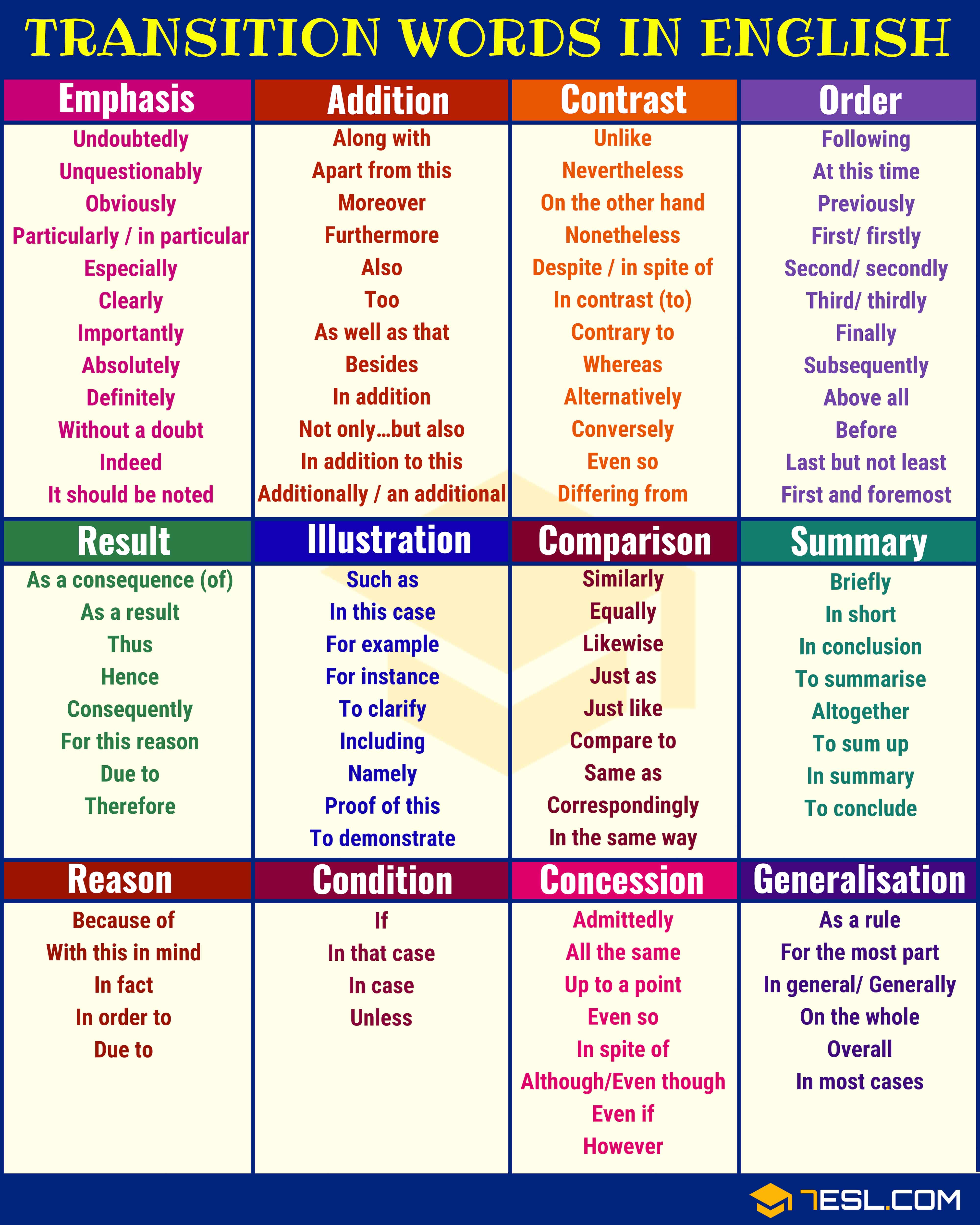
For your future reference, this chart provides a fantastic visual summary of these categories and more.
Test your understanding!
For each pair of sentences, identify the logical relationship (e.g., Contrast, Cause and Effect) and choose the best transition word from the options.
- The project timeline is very aggressive. ______, we have a highly skilled team.
(however, therefore, for example) - The client approved the new designs. ______, we can begin development next week.
(in addition, as a result, for instance) - Our application needs better monitoring. ______, we should implement a tool like Datadog or New Relic.
(specifically, however, finally)
Show answer
- however (The relationship is Contrast. The aggressive timeline is a negative, but the skilled team is a positive that counters it.)
- as a result (The relationship is Cause and Effect. The client's approval directly enables development to begin.)
- specifically (The relationship is Example/Illustration. You are moving from a general statement to a specific example of a solution.)
How to Choose the Right Transition: A Practical Method
Knowing the categories is one thing; applying them in the moment is another. A common pitfall is to sprinkle words like "however" or "therefore" into your writing without being certain they represent the true logical connection.
The Harvard Writing Center offers a brilliant technique for ensuring your choice is accurate.
Transitions | Harvard College Writing Center
The resource 'Transitions' from the Harvard College Writing Center explains a simple but powerful method for choosing the right transition.
Please read the final section of this article, which begins with 'If you’re not sure which transitional words to use...'. The core idea is to articulate the connection between your ideas in your own words first.
Let's formalize this into a two-step process:
- State the Connection: Look at the two sentences or ideas you want to link. In your own words (either spoken aloud or written in a note), describe their relationship. Ask yourself: "How does idea B relate to idea A?"
- Select the Word: Based on your description, find the transition word or phrase that best matches that relationship.
Let's try it with a work-related example:
- Idea A: "We could migrate our services to a serverless architecture."
- Idea B: "This would significantly reduce our infrastructure costs."
- State the Connection: "Idea B is a positive result or effect of Idea A."
- Select the Word: The relationship is Cause and Effect. Good choices would be
consequently,as a result, ortherefore.
Translated Sentence: "We could migrate our services to a serverless architecture. Consequently, this would significantly reduce our infrastructure costs."
This method forces you to clarify the logic for yourself before you communicate it to others, which is a core exercise in structured thinking.
Conclusion
In this lesson, we've unpacked the crucial role of transitional words and phrases. They are the logical connectors that make your communication clear, structured, and easy to follow.
Key Takeaways:
- Transitions are not just decoration; they are functional words that signal the logical relationship between ideas.
- The most common relationships include Addition, Contrast, Cause and Effect, Example, and Sequence.
- To choose the right transition, first articulate the connection between your ideas in your own words, then select the word that best fits that connection.
By mastering this skill, you are making the logical structure of your thoughts visible and understandable to your audience, which is a giant leap towards your goal of clear and sequential communication.
Preview of the next lesson:
Now that you have a toolkit of transitions and a method for choosing the right one, our next lesson will focus on application. We will learn how to use transitions to ensure smooth flow not just between two ideas, but between full sentences and across entire paragraphs.