Hello! Welcome to your next lesson.
In our last session, you mastered the Plan, Draft, Review process for composing structured professional emails. We saw how adapting the "Hourglass Structure" creates messages that are clear, direct, and efficient.
Today, we'll apply that same powerful process to a different, but equally important, area: composing clear and engaging personal messages. Your goal is to use the planning and writing skills you've developed to communicate more effectively in your personal life, whether you're writing a long-overdue catch-up message, sharing a story, or just texting a friend.
The core process remains the same, but our focus will shift. While professional emails prioritize efficiency, personal messages thrive on connection and engagement. This means we'll adapt our approach to structure, tone, and content to not only convey information but also to share experiences and build relationships.
The Core of Personal Communication: Audience and Tone
The biggest shift from professional to personal writing is your relationship with the audience. In a professional context, you might be formal and direct. In a personal context, you can be more relaxed, use humor, and show more of your personality.
However, "personal" doesn't mean "unstructured." Thinking about your audience is still the crucial first step.
Mastering the Art of Text Writing: A Step-by-Step Guide to ...
The article 'Mastering the Art of Text Writing' by Gabriel Okonkwo provides an excellent framework for thinking about your audience in any context. Let's start by reviewing these fundamentals.
Please read the first two sections: 'Understanding Your Audience' and 'The Power of Tone and Voice in Digital Communication'. Pay close attention to the table of 'Audience Factors' and the examples showing how word choice changes the tone.
As the article highlights, knowing your audience allows you to tailor your language, tone, and the level of detail you provide. For personal messages, this means asking yourself:
- Relationship: How well do I know this person? (e.g., a close friend vs. a new acquaintance)
- Context: What was our last conversation about? What do they already know about this topic?
- Expectation: Is this a quick check-in or a longer story? What kind of response am I hoping for?
Answering these questions first helps you find the right tone and avoid misunderstandings, which is a key part of clear communication.
Structuring Personal Messages: The Art of the Anecdote
While a professional email often opens with the main point, a personal message might build up to it, especially if you're telling a story. Learning to structure a simple story, or an anecdote, is an excellent way to practice the sequential thinking you want to improve.
A good anecdote has a clear beginning, middle, and end, just like the Hourglass Structure we discussed.
How to tell an anecdote in English
Let's watch a short clip from the British Council's video, 'How to tell an anecdote in English', which breaks down this simple and effective structure.
Watch the section 'Basic Structure of an Anecdote' from 00:18 to 01:08. Notice how this structure maps to the familiar Introduction-Body-Conclusion model.
As the video explains, the structure is straightforward:
- Introduction (The Hook): Grab their attention. Phrases like "You won't believe what happened to me..." or "I have to tell you about the funniest thing..." work well.
- Main Events (The Body): Tell the story step-by-step. This is where you practice sequencing. Use words like first, then, next, and so to guide your reader through the events logically.
- Conclusion (The Punchline or Reflection): End with the most exciting part, the lesson you learned, or a final thought. This gives the story a purpose.
This simple structure turns a messy collection of thoughts into a coherent narrative.
Making Your Message Engaging: Three Key Ingredients
A clear structure is the skeleton of your message. To make it truly engaging, you need to add substance. This is where you move from just reporting an event to helping the reader experience it with you.
This is less about being a "natural" storyteller and more about applying specific techniques. Your analytical background might be an advantage here; think of it as providing the brain with high-quality, specific data to construct a vivid mental image.
The ONLY 3 Ingredients You Need To Be A Better Storyteller!
The speaker Vinh Giang, in his video 'The ONLY 3 Ingredients You Need To Be A Better Storyteller!', explains three powerful techniques for making any story compelling. These are directly applicable to your writing.
Please watch the three sections covering the core ingredients: 'Be Specific (Using the Five Senses)' (06:39 - 09:38) 'Reporting versus reliving a story' (09:26 - 12:08) 'Share the meaning of the story' (12:08 - 14:59) As you watch, think about how you can apply these techniques to even simple, everyday stories.
Let's summarize these crucial ingredients:
- Ingredient 1: Be Specific. Don't just say "It was a nice day." Describe what you saw, heard, or felt. "The sun was bright, the air was crisp, and the only sound was the jingling of my keys." Specific, sensory details make your story feel real.
- Ingredient 2: Relive, Don't Report. Write in the present tense as if the event is happening now. Instead of "I walked into the room and was nervous," try "I'm walking into the room, and my palms are sweating." This pulls the reader into the moment with you.
- Ingredient 3: Share the Meaning. This is your "So What?". Why are you telling this story? The meaning transforms your story from a simple sequence of events into a gift for the reader. It’s the lesson, the insight, or the feeling you want to share. It often starts with "The reason I'm telling you this is because..."
Test your understanding!
Imagine you are describing a frustrating experience at a train station.
General/Reported version: "I missed my train because I went to the wrong platform. It was very annoying."
Engaging/Relived version: "So I'm standing there, pressing the button to open the train door, and nothing happens. I press it again. Still nothing. My heart starts pounding. A woman inside points, and I realize—I’m on the wrong side of the train! I grab my suitcase and just start running..."
Which version makes you feel more connected to the experience? The second one uses specificity ("pressing the button," "heart starts pounding") and a "relived" tense to create a much more engaging message.
The Full Process for Personal Messages
Now, let's combine everything into the Plan, Draft, Review process for a personal message.
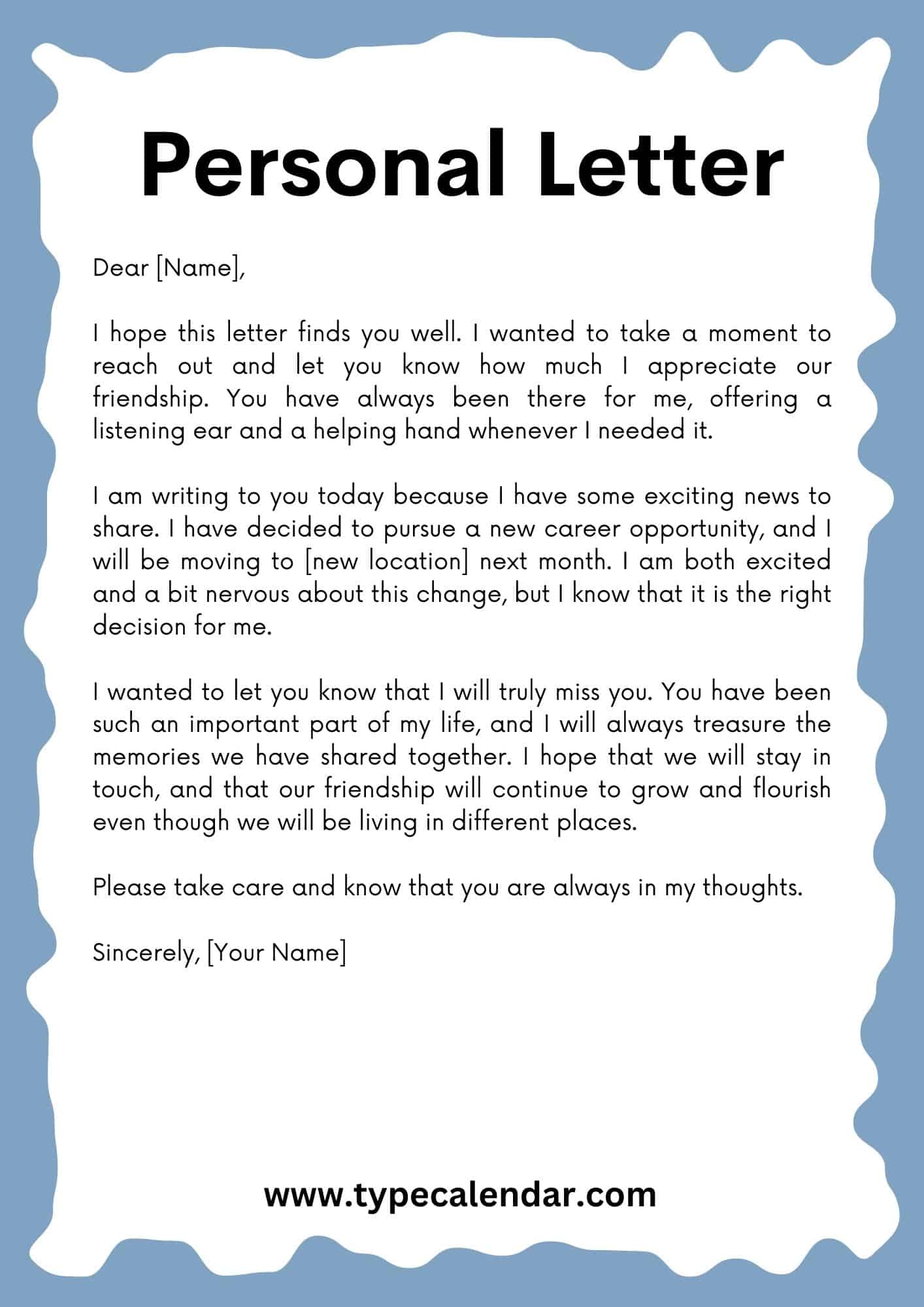
The structure in this letter is a great example of how to organize a personal message clearly.
Step 1: Plan (Think Before You Write)
- Purpose & Audience: What is the main story or feeling I want to share? Who am I writing to, and what's our relationship?
- Outline the Anecdote:
- Hook: How will I start?
- Key Events: What are the 2-4 most important steps in the story? List them in order.
- Meaning/Punchline: What is the takeaway?
Step 2: Draft (Write with Engagement in Mind)
- Follow your outline to build the message.
- Use storytelling techniques: specific sensory details, "reliving" the story in the present tense.
- Inject your personality. Use words and phrases that sound like you.
- Keep your paragraphs short and focused, with one main idea per paragraph.
Step 3: Review (Check for Clarity and Tone)
- Read your message aloud. Does it flow well? Does it sound authentic to you?
- Is the sequence of events easy to follow?
- Is the tone right for the person you're writing to?
- Do a quick check for typos or confusing sentences that might disrupt the flow.
Practice Exercise
Let's apply this process.
Scenario:
You want to send a message to a good friend you haven't spoken to in a few weeks. You recently tried a new activity for the first time (e.g., a cooking class, a hiking trail, attending a concert of an artist you didn't know) and had a surprisingly funny or insightful experience.
Your Task:
Write a message to your friend telling them about this experience. Apply the full Plan, Draft, Review process.
- Plan: Briefly outline the hook, key events, and the meaning/punchline.
- Draft: Write the full message (it can be an email or a message for an app like Telegram or WhatsApp).
Show your plan and draft
(Take your time to plan and write your message before revealing the example below.)
Show example answer
Here’s one possible way to approach this, following the process.
1. Plan:
- Purpose: Share a funny story about my first pottery class and reconnect with my friend.
- Audience: Close friend (Sasha), so the tone can be very casual and humorous.
- Outline:
- Hook: "You will not believe the disaster I created in a pottery class last weekend."
- Key Events:
- Signed up for the class feeling confident.
- The instructor makes it look easy.
- I get a lump of clay and it immediately goes everywhere but the center.
- My "bowl" ends up looking like a melted ashtray.
- Meaning/Punchline: "It was a total mess, but so much fun. Made me realize I should stick to coding! We should try something new and ridiculous like that together soon."
2. Draft (Example Message):
Hey Sasha,
Hope you're doing well! It's been a minute.
You will not believe the disaster I created last weekend. I decided on a whim to take a pottery class. I walk in, feeling all artistic and confident, you know? The instructor sits down and in like, 30 seconds, whips up this perfect, beautiful bowl. "Easy," I think.
So they give me this giant lump of wet clay. The moment I touch it, it’s like it has a mind of its own. There's clay on my face, on the wall, everywhere except the center of the wheel where it's supposed to be. I'm fighting this thing for an hour, and what I end up with is... well, let's call it an "abstract sculpture." It looks more like a melted ashtray from a 70s sci-fi movie.
The reason I'm telling you this is because it was a complete, hilarious failure, and I haven't laughed that hard in ages. It made me think we absolutely need to try something new and be terrible at it together soon.
How have you been? Let's catch up properly next week!
Best,
[Your Name]
Why this message works:
- It follows the Hook -> Events -> Meaning structure.
- It uses specific details ("giant lump of wet clay," "melted ashtray").
- It "relives" the story ("I walk in," "I'm fighting this thing").
- The tone is personal and authentic.
- The conclusion shares the meaning and proposes a clear next step ("Let's catch up").
Conclusion
You now have a complete framework for structuring your thoughts in both professional and personal writing. The core process of Plan, Draft, and Review is universal. The key is adapting your approach to fit the context.
Key Takeaways:
- The principles of structured thinking apply to personal messages just as they do to professional ones.
- For personal messages, adapt the structure to tell a story or an anecdote: Hook -> Main Events -> Meaning/Conclusion.
- Make your messages engaging by being specific, "reliving" the experience, and sharing the meaning behind the story.
- Always consider your audience and tone to ensure your message builds connection.
Preview of the next lesson:
We have now covered how to structure entire messages for both professional and personal contexts. In our next lesson, we will zoom in on the connections between your ideas. We will learn how to select and use appropriate transitional words and phrases to ensure your writing flows smoothly from one sentence and one paragraph to the next, making your logic even clearer to your reader.