Hello. The previous lesson separated SNAP eligibility from the date a state applies an eligibility rule to a particular case. This lesson starts after that decision: for an eligible household, how is the monthly benefit calculated, and who pays for it?
P.L. 119-21 changes both sides of that picture. Rules about the food plan and deductible expenses can change a household’s benefit even if everyone remains eligible. Separate funding rules increase what states may have to pay to administer SNAP and, later, to finance benefits. Keeping household calculations distinct from state financing is the central task here.
The household calculation has two moving parts
An eligible household’s monthly SNAP benefit, or allotment, depends chiefly on a maximum amount for its size and its net monthly income. Net income is counted income after allowable SNAP deductions. In simplified form:
The maximum is tied to USDA’s Thrifty Food Plan (TFP). Deductions work on the other side of the calculation: a larger allowable deduction lowers net income and generally raises the benefit. For example, if a three-person household’s maximum is $808 and its net income is $400, its calculated allotment is $688. If a rule removes $100 of deductions while everything else stays fixed, net income becomes $500 and the calculated allotment becomes $658—a $30 reduction. This is an illustration of the formula, not a prediction for a particular household. Minimum-benefit and other case-specific rules can also matter.
The Congressional Research Service (CRS) primer provides the underlying calculation. Read its “Income and SNAP Deductions” subsection for the meaning of net income, then “Maximum Monthly Allotments” and “Calculation of a Household’s Monthly Benefit” for the two parts of the formula.
Supplemental Nutrition Assistance Program (SNAP): A Primer on Eligibility and Benefits
This CRS primer establishes the existing benefit calculation before examining what P.L. 119-21 changed.
In “The Traditional Path to Eligibility,” find the subsection “Income and SNAP Deductions.” Read the deductions discussion, from its explanation of net income through the paragraph following the rules for households with elderly or disabled members. Focus on the standard, earned-income, dependent-care, and excess-shelter deductions; note that some shelter and medical-expense rules differ for households with elderly or disabled members. Later, under “Benefits” and “Benefit Amounts (Allotments),” read “Maximum Monthly Allotments” for the TFP’s role, then “Calculation of a Household’s Monthly Benefit” through its three-person example. The primer’s FY2027 dollar figures are year-specific reference amounts, not amounts permanently fixed by the 2025 law.
One distinction will prevent several mistakes below: an expense deduction is not a payment that reimburses a household for that expense. It reduces the income SNAP treats as available for food. Removing an expense from the deduction calculation may lower benefits, but not necessarily by the full expense amount.
What the enacted law changes in that calculation
CRS compares prior law, the House-passed bill, and P.L. 119-21 as enacted on July 4, 2025. Use the enacted column: an earlier proposal is not authority for what a household or state must do.
Read CRS’s side-by-side comparison to identify the enacted benefit and funding rules without importing requirements from the earlier House bill.
In Table 1, pp. 4–6, compare the “Prior Law” and “H.R. 1 (P.L. 119-21) as Enacted” columns. On p. 4, start with the “Thrifty food plan” row; the enacted entry begins with USDA’s reevaluation authority. On pp. 4–5, read the “Availability of standard utility allowances based on receipt of energy assistance” row, including its enacted exception for households with elderly or disabled members. On p. 5, read “Restrictions on internet expenses,” including the enacted restriction. Finally, on pp. 5–6, read “Matching funds requirements for benefit costs,” from the rate bands through the possible delays. Finish with “Administrative cost sharing” on p. 6, where the enacted entry states the new federal reimbursement rate. Watch which column supplies each number.
The TFP change concerns reevaluating the plan’s contents, not ending annual adjustments for food prices. Under prior law, USDA was to reevaluate the basket every five years. Under the enacted law, USDA has discretion to reevaluate it no earlier than October 1, 2027, subject to constraints that prevent a reevaluation from raising its cost faster than inflation. Annual inflation adjustment continues. Thus, “SNAP maximum benefits are frozen” is not an accurate description; neither does the law prescribe one immediate dollar reduction for every household.
Two other changes affect net income rather than the TFP maximum:
- Energy-assistance evidence and utility allowances. Previously, receipt of a qualifying payment from the Low Income Home Energy Assistance Program (LIHEAP), or similar assistance, could establish heating or cooling costs for a standard utility allowance (SUA). That allowance can increase an excess-shelter deduction. For a household without an elderly or disabled member, the enacted law removes receipt of such a payment, by itself, as a basis for that allowance. It does not make the same change for a household with an elderly or disabled member. Nor does it mean a household without one can never establish qualifying heating or cooling expenses by other means.
- Internet costs. The law prohibits counting household internet costs in calculating the excess-shelter deduction. A household whose allowed shelter costs fall may have higher net income and therefore a lower benefit. The outcome depends on how its costs enter the calculation, including any applicable utility allowance; it is not a ban on buying internet service or on receiving SNAP.
These benefit-calculation amendments are among the provisions CRS describes as effective upon enactment. An effective date establishes the legal rule; it does not identify the month every individual case is updated. USDA guidance, state systems, and case processing determine how a change reaches an allotment.
A reference table for tracing the effects
Use the table to locate the first place a change acts. A possible consequence in the last column is not an automatic outcome for every household or state.
| Provision | First place it acts | Statutory timing | Effect to trace |
|---|---|---|---|
| TFP reevaluation | Maximum allotment | USDA may reevaluate no earlier than Oct. 1, 2027; annual inflation adjustment continues | Constrains future maximum-benefit growth relative to what a different reevaluation might have produced; not an immediate uniform cut. |
| Energy assistance and SUA | Allowed utility/shelter expense, then net income | Amendment effective upon enactment | Some households without an elderly or disabled member may lose an allowance obtained solely through receipt of energy assistance; other ways to establish costs may still apply. |
| Internet expense | Allowed shelter expense, then net income | Amendment effective upon enactment | Excluding a previously counted cost can raise net income and lower an affected household’s calculated benefit. |
| Administrative funding | Federal reimbursement of state administrative costs | FY2027, beginning Oct. 1, 2026 | Federal share falls from 50% to 25%; state share rises from 50% to 75%. This is not itself a change to the household allotment formula. |
| Benefit cost sharing | Who finances issued SNAP benefits | Starts FY2028, beginning Oct. 1, 2027, unless a statutory delay applies | Depending on its payment error rate, a state may owe 0%, 5%, 10%, or 15% of benefit costs. A state budget obligation is not, by itself, a household benefit cut. |
The first three rows operate through the benefit calculation. The last two concern federal–state financing. A state confronted with higher costs might make further budget or program decisions, but those decisions must not be presented as reductions automatically written into the household formula.
What an error-rate-based state share means
Before the new benefit match takes effect, SNAP benefits are federally financed. Under the enacted law, a state’s possible share is based on its SNAP payment error rate—a quality-control measure of erroneous benefit payments, including overpayments and underpayments. An error rate is not a fraud rate. The enacted law also did not adopt the House bill’s proposal to replace the existing dollar tolerance for counting payment errors with zero.
For a fiscal year in which the benefit match applies, the enacted bands are:
| State payment error rate | State share of SNAP benefit costs |
|---|---|
| Below 6% | 0% |
| At least 6% but below 8% | 5% |
| At least 8% but below 10% | 10% |
| At least 10% | 15% |
For FY2028, a state may elect to use its FY2025 or FY2026 error rate. From FY2029 onward, the law uses the rate from the third preceding fiscal year: for example, FY2026’s rate determines the FY2029 band. That lag matters when interpreting a claim that a state’s current error rate immediately changes its funding.
The statute also allows a delayed start for certain states with comparatively high rates. If the specified threshold is met using FY2025 data, benefit cost sharing can be delayed until FY2029; if met using FY2026 data, it can be delayed until FY2030. The threshold is defined by the error rate multiplied by 1.5 reaching at least 20%—about 13⅓% before rounding. A delayed start does not permanently fix the state’s eventual percentage: the rate applicable to the later fiscal year must still be used.
The supplied Brookings/Hamilton Project table makes the rate bands easy to see:
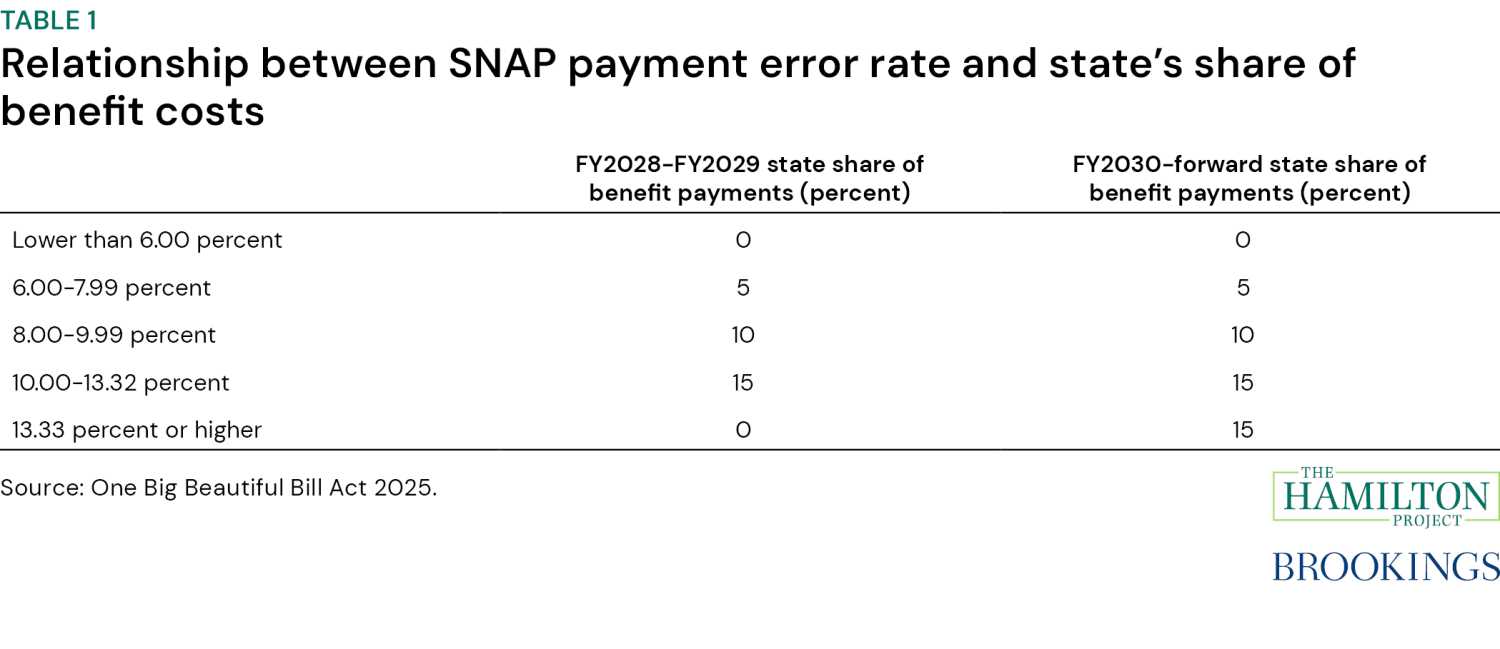
Read that highest row with care. A state qualifying for a delay only through FY2028 may begin paying in FY2029; one qualifying for a delay through FY2029 may begin in FY2030. The displayed “13.33%” is also a rounded presentation of a threshold defined by the statute’s multiplication test. The statutory timing and the relevant prior-year rates take precedence over a compact graphic.
Following dollars through a state budget
Suppose a state has $1 billion in annual SNAP benefit costs and $100 million in allowable administrative costs. Hold both amounts constant solely to isolate the financing rules.
At the old 50% administrative reimbursement rate, the state pays $50 million of the $100 million administrative bill. From FY2027, with federal reimbursement at 25%, it pays $75 million: an additional $25 million in this illustration.
Now suppose its applicable, non-delayed payment error rate puts it in the 8%–under-10% band for FY2028. Its 10% benefit share would be $100 million on $1 billion of benefits. Together, the illustrated administrative and benefit shares would put $175 million on the state budget, compared with $50 million under the former financing arrangement—a $125 million difference, assuming unchanged costs and no other adjustments. The households’ statutory allotments do not fall by $125 million as a mathematical consequence of this funding transfer.
This example also shows why two superficially similar percentages must not be combined carelessly. The 75% applies to administrative costs; the 10% applies to benefit costs. They have different bases, start dates, and reasons for changing. Actual fiscal effects depend on benefit spending, administrative spending, the applicable error-rate data, any delay, and subsequent state choices.
CRS reports Congressional Budget Office (CBO) projections of household and state effects, including the possibility of varied state responses to the benefit match. These are estimates, not additional statutory commands. Read the short “Potential State and Household Effects of the Enacted Law” section for how CBO describes them.
Return to the CRS overview for estimates of who may experience lower benefits and why a state financing change does not dictate a single state response.
On p. 13, under “Potential State and Household Effects of the Enacted Law,” read from the TFP estimate through the benefit-match discussion. Focus on the distinction between estimated reductions in household benefits from calculation rules and possible state responses to paying a benefit share. Then read the paragraph beginning “CBO specified that the effects in this estimate” immediately below the bullets: its warning about overlap among provisions explains why separate estimated effects should not simply be added.
For scale, CRS reports CBO estimates that the internet-expense rule lowers monthly benefits by about $10 for roughly 65% of SNAP households, on average in each year from 2026 through 2034; the energy-assistance rule affects a smaller share, with a larger estimated monthly reduction among those affected. CBO estimates that the TFP rule lowers the average monthly benefit by $14 by 2034 relative to its comparison baseline. Those figures describe modeled effects over specified periods, not amounts that the statute deducts from an individual’s EBT card. CBO also models differing state responses to the benefit match; Congress did not require every state to choose the same response.
Key takeaways
To trace an SNAP claim, first identify whether it changes the maximum allotment, an allowable deduction, administrative funding, or benefit funding. The TFP provision constrains future reevaluations while annual inflation adjustments continue. The utility and internet provisions can alter net income and thus benefits for affected households. Separately, states take on a larger administrative share beginning FY2027 and a possible error-rate-based benefit share beginning FY2028, subject to the law’s delays and prior-year-rate rules. Neither a state payment error nor a projected budget response should be mistaken for a finding of fraud or an automatic household cut.
The next lesson broadens the spending map beyond health care and SNAP. Later, the course will bring these start dates and projected effects together in a cross-program timeline and examine how to compare budget estimates with public claims.