This module brings together the tax, health coverage, and nutrition assistance changes studied so far. Its first task is chronological: to build a timeline that says not just when a change happens, but what kind of date it is. That distinction matters because P.L. 119-21 was enacted on July 4, 2025, while some provisions apply to the 2025 tax year, some begin in later fiscal years, and others depend on agency or state implementation.
You will build a selective cross-program timeline, not an inventory of every provision. The aim is to make it precise enough to test a statement such as “the changes start in 2027” without treating an approximate chart label as a statutory effective date.
Four clocks, not one
A useful timeline gives each entry both a date and a date type:
- Enactment: July 4, 2025, when P.L. 119-21 became law. Enactment does not mean every provision began operating that day.
- Statutory application or effective date: the event specified by law—for example, a tax year beginning in 2025, a vehicle acquired after September 30, 2025, or a federal fiscal year.
- Phase-in or expiration: a change that begins gradually, or a temporary provision’s final eligible period.
- Implementation: an agency’s instructions or a state’s decision about how and when it will carry out a federal requirement. Implementation cannot be assumed from the enactment date alone.
The units matter. Tax year 2025 usually means the period whose income is reported on a return filed in 2026; it does not mean a deduction first becomes available on July 4. Federal fiscal year 2027 begins on October 1, 2026. A health coverage rule that starts on December 31, 2026, will often appear on a simplified graphic under “2027,” but the two descriptions are not equally precise.
Use this graphic as an orientation map. Its bars help reveal which changes are temporary and which unfold later, but its year markers and selected-policy labels cannot establish exact legal dates.
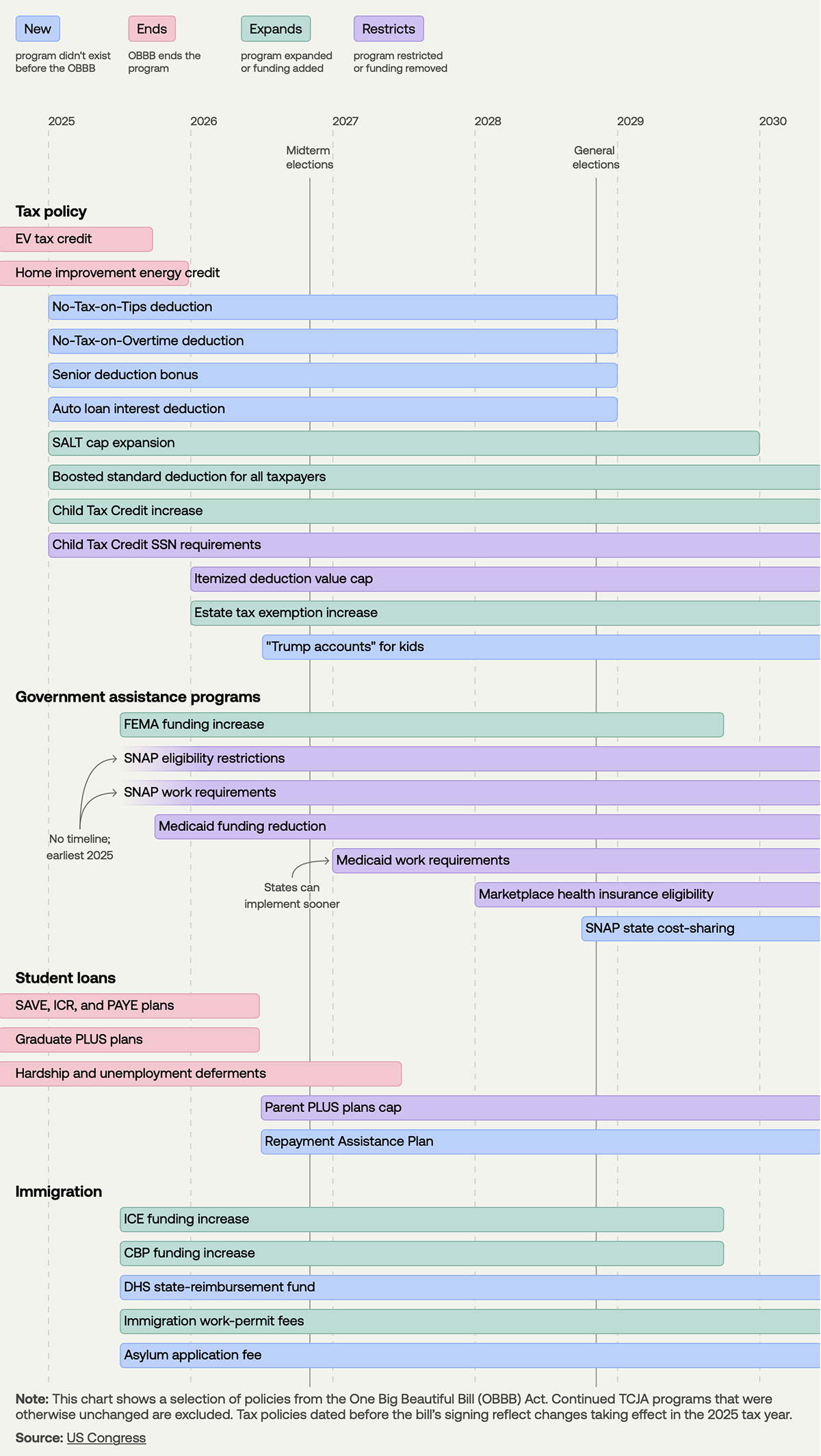
A second precaution comes from the bill’s legislative history. A document about H.R. 1 as passed by the House in May 2025 is not automatically a description of P.L. 119-21 as enacted in July. The tax reading below explicitly analyzes the enacted law. The health reading later in the lesson serves a different purpose: it shows how to spot a version label before relying on a date.
Tax: distinguish a tax year from a cutoff date
For a short orientation, watch the tax portion of Trump’s Big Beautiful Bill: The Tax and Spending Updates, Explained from The Wall Street Journal. Listen for the difference between the temporary new deductions and the extensions of earlier tax rules. Treat the video as an overview; the enacted-law CRS report that follows supplies the more exact dates.
Trump’s Big Beautiful Bill: The Tax and Spending Updates, Explained | WSJ
Watch the tax portion of Trump’s Big Beautiful Bill: The Tax and Spending Updates, Explained from The Wall Street Journal to get the broad shape of the timeline.
Watch the tax overview. Focus on the temporary tips, overtime, and senior deductions, and on the September 30 clean-vehicle cutoff. The video groups several rules under “2025”; the next reading separates their legal triggers.
The Congressional Research Service (CRS) report Tax Provisions in P.L. 119-21, the FY2025 Reconciliation Law is the principal tax reference here. In its Table 1, follow the standard deduction, senior deduction, and child tax credit rows together; then move to the state and local tax (SALT) deduction row. Notice how “permanent” describes the absence of a scheduled sunset, while “applies from 2025 onward” identifies the first tax year covered.
Tax Provisions in P.L. 119-21, the FY2025 Reconciliation Law | Congress.gov | Library of Congress
Read the selected household rows in the Congressional Research Service report to anchor the timeline in an analysis of the enacted law.
In Table 1, “Providing Permanent Tax Relief for Middle-Class Families and Workers,” read from “Extension and Enhancement of Increased Standard Deduction,” through “Termination of Deduction for Personal Exemptions Other than Temporary Senior Deduction,” and “Extension and Enhancement of Increased Child Tax Credit.” Begin with these household rows. Then find “Limitation on Individual Deductions for Certain State and Local Taxes, Etc.” near the end of Table 1; read the SALT schedule. Focus on its 2025–2029 period and its change in 2030.
The resulting dates do not all work alike. The larger standard deduction and the modified child tax credit generally apply beginning with tax year 2025 and are not given a 2028 expiration in these provisions. The additional deduction for eligible taxpayers aged 65 or older, by contrast, is available for tax years 2025 through 2028. The higher SALT deduction cap begins in 2025, rises under the law’s schedule through 2029, and returns to in 2030 for most filers. A 2030 entry belongs on the timeline even though it is not a new bill being enacted that year: it is a change already scheduled by the 2025 law.
Now read the three temporary deduction rows in CRS Table 2. The key chronological point is that they cover tax years 2025–2028, rather than beginning on the day the bill was signed.
Tax Provisions in P.L. 119-21, the FY2025 Reconciliation Law | Congress.gov | Library of Congress
Read the three temporary deduction rows in the CRS enacted-law report to see how their shared tax-year window is stated.
In Table 2, “Delivering on Presidential Priorities to Provide New Middle-Class Tax Relief,” read “No Tax on Tips,” “No Tax on Overtime,” and “No Tax on Car Loan Interest.” Start at the deduction rows and stop before “Trump Accounts and Contribution Pilot Program.” Focus on each row’s final applicability sentence, not on the slogan “no tax”: qualified tips and overtime remain subject to payroll taxes.
An expiration can instead hinge on a transaction date. Read the clean-vehicle row in CRS Table 5 with that contrast in mind.
Tax Provisions in P.L. 119-21, the FY2025 Reconciliation Law | Congress.gov | Library of Congress
Use the CRS clean-vehicle row to contrast a purchase cutoff with a tax-year window.
In Table 5, “Ending Green New Deal Spending, Promoting America-First Energy, and Other Reforms,” find “Termination of Clean Vehicle Credit,” concerning new qualifying vehicles. Read that complete row. Pay particular attention to “acquired”: the row does not define the cutoff as the date a buyer files a tax return.
Thus, a timeline entry saying only “EV credit ends in 2025” loses the operative condition. For the new clean-vehicle credit discussed in that row, the law terminates the credit for vehicles acquired after September 30, 2025. The acquisition date, not merely the calendar year, is what makes the entry useful.
Health: a federal start date is not every enrollee’s experience
For selected Medicaid expansion adults, the enacted law calls for six-month eligibility redeterminations beginning December 31, 2026, rather than the usual twelve-month interval. Its community engagement requirement is also scheduled to begin December 31, 2026, with an option for a state to start sooner. These are dates for federal requirements; they do not establish that every affected person is reviewed or loses coverage on that date. Eligibility, exemptions, verification, notice, and the timing of an individual review still matter.
The curated health CRS report is useful for practicing source control, but its principal tables describe a House-passed version. Read the two rows and, crucially, their source note. Do not cite those rows alone as proof of the enacted health provisions.
Use this Congressional Research Service report to practice checking which version of a bill a health-policy table describes, rather than treating its rows as enacted-law authority.
In Table 1, “Provisions Related to Medicaid in the One Big Beautiful Bill Act,” find “Section 44108. Increasing frequency of eligibility redeterminations for certain individuals” and read the renewal row. Then find “Section 44141. Requirement for states to establish Medicaid community engagement requirements for certain individuals” and read the start-date row. Finally, go to the “Source” note below Table 1 and locate the version label. Notice the word “would” in the rows and the May 22 version identified in the note.
This reading illustrates why a matching date is not enough to validate a source. The House-passed rows help you recognize the provisions, but a claim about what was enacted must be checked against the enacted text or an enacted-law analysis.
Implementation adds another layer. Suppose, hypothetically, that a state announced on September 1, 2026, that it would use the law’s option to begin its Medicaid community engagement requirement before December 31. The announcement date would be a dated state decision; the date the state chose would be an implementation start; and the December 31 date would remain the law’s general scheduled federal start. This is an illustration, not a claim that a particular state made such an announcement. A real timeline should name and date an actual state document before adding an early-start entry.
The graphic’s “Medicaid work requirements” bar sits around 2027. That is a reasonable visual shorthand for a requirement scheduled at the very end of 2026, but it should not replace December 31, 2026 in a precise timeline.
SNAP: eligibility changes and state funding use different clocks
SNAP—the Supplemental Nutrition Assistance Program—shows why a single bar labelled “SNAP changes” is especially unhelpful. The law revises work-related time-limit rules and eligibility categories, while other provisions change who pays program costs. A household-facing eligibility change and a state-budget change need separate timeline entries.
The supplied graphic places SNAP eligibility and work restrictions near the beginning of its range, but explicitly gives them “No timeline; earliest 2025.” Do not convert that label into “every affected household’s benefits changed on July 4, 2025.” A sound entry identifies the federal provision and its effective-date rule, then records separately the dated federal guidance and state implementation materials used to determine when a particular case is handled. Notices and recertification schedules may affect when a household encounters a rule.
Two funding entries can be dated by federal fiscal year, rather than by a household’s benefit month:
- Beginning FY2027—October 1, 2026—the federal share of SNAP administrative costs falls from 50% to 25%. The corresponding state share rises from 50% to 75%. This concerns the cost of administering SNAP, not a 25% cut to each household’s benefit.
- The law also establishes a later, error-rate-based state share of SNAP benefit costs. Its operation depends on the relevant fiscal-year rules and includes possible delays for qualifying states. Do not read an exact start for every state from the graphic’s “SNAP state cost-sharing” bar; a state-specific entry needs the applicable statutory trigger, error-rate information, and dated implementation guidance.
This is the same analytical discipline used for Medicaid. A federal obligation, a state’s preparations, and an individual household’s outcome are related events, not interchangeable dates.
Assemble the cross-program timeline
The table below is a compact model. “Type” is as important as “When”: it prevents an application date from being mistaken for an agency rollout or an expiration from being mistaken for enactment.
| When | Program and selected change | Date type and what to record |
|---|---|---|
| July 4, 2025 | P.L. 119-21 becomes law | Enactment. Starting point for checking each provision; not a universal operational start. |
| Tax year 2025 | Larger standard deduction and modified child tax credit begin to apply; eligible tips, overtime, and senior deductions enter their 2025–2028 window | Tax-year application. Tax year is not the date the return is filed. |
| September 30, 2025 | Last acquisition date before the new clean-vehicle credit’s termination rule applies to later acquisitions | Transaction cutoff. Check when a qualifying vehicle was acquired. |
| October 1, 2026 | Reduced federal share of SNAP administrative costs begins in FY2027 | Fiscal-year start. State administrative funding is distinct from household benefits. |
| December 31, 2026 | Six-month Medicaid expansion redeterminations and the scheduled community engagement requirement begin | Statutory schedule. A state may choose an earlier community engagement start under the law; individual review dates vary. |
| Tax year 2028 | Final tax year in the temporary tips, overtime, and senior deduction window | Expiration boundary. Under the enacted schedule, those deductions do not continue into tax year 2029. |
| Tax year 2030 | SALT deduction cap returns to its lower scheduled level | Scheduled change. The 2025 law itself specifies the later change. |
This table deliberately does not assign an exact day to the graphic’s broad SNAP eligibility bars or a single nationwide day to every state’s benefit-cost sharing. Leaving a date qualified is more accurate than inventing precision. To extend the table for a particular state, add a separate row bearing the date and title of that state’s actual implementation notice, and label it state decision, not statutory amendment.
Takeaways
A defensible timeline records the legal trigger, its date unit, and the source version. P.L. 119-21’s enactment date is only the starting reference point: tax-year deductions, a vehicle-acquisition cutoff, fiscal-year SNAP funding changes, and scheduled Medicaid requirements run on different clocks. Broad graphics can show their relationship, but exact claims need the provision’s wording; implementation claims additionally need dated agency or state evidence.
The next lesson turns from when provisions operate to how their costs are estimated, including why deficit estimates can differ when analysts use different baselines, budget windows, or treatments of interest and economic feedback.