Hello! Welcome to the next lesson in our Embedded Interview Preparation Bootcamp.
In our previous session, we did a deep dive into intrusive linked lists, implementing the powerful list_head and container_of pattern used in the Linux kernel. You learned how this approach minimizes memory overhead and improves cache performance, making it ideal for systems programming.
Today, we'll tackle a classic algorithmic problem related to linked lists, one that frequently appears in interviews for senior embedded roles. Our learning outcome is to detect cycles in a linked list using Floyd's tortoise-and-hare algorithm. A cycle can cause catastrophic failures like infinite loops during list traversal, so detecting them is a critical safety and correctness check. This lesson will not only equip you with an efficient algorithm but also sharpen your problem-solving skills with pointers.
1. The Problem: What is a Cycle and Why is it Dangerous?
A linked list is supposed to terminate with a NULL pointer. A cycle occurs when a node's next pointer refers to a previous node in the list, creating a loop.
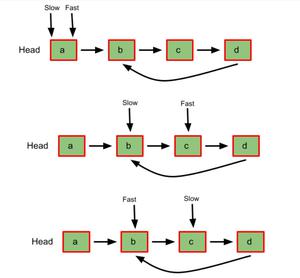
If you try to traverse a list with a cycle using a standard loop like while (current != NULL), your program will never terminate. In an embedded system, this can lead to a device hanging, a watchdog timer reset, or worse.
One way to detect a cycle is to store every visited node's address in a hash table and check for duplicates. While this works, it requires O(n) extra space, which is often unacceptable in memory-constrained embedded systems. We need a more efficient solution.
The video below introduces this problem and sets the stage for a clever, space-efficient algorithm.
Data Structures: Cycles in a Linked List
Gayle Laakmann McDowell, author of 'Cracking the Coding Interview', introduces the cycle detection problem and provides a great analogy to help build intuition for the solution.
Watch from the beginning to 01:40. Pay attention to the race track analogy—it's the key to understanding the two-pointer technique we're about to explore.
2. Floyd's Cycle-Finding Algorithm: The Tortoise and the Hare
As the video hinted, the most elegant solution is Floyd's Cycle-Finding Algorithm, also known as the "tortoise and hare" algorithm. It uses two pointers that traverse the list at different speeds:
- A slow pointer (the tortoise) moves one node at a time.
- A fast pointer (the hare) moves two nodes at a time.
The logic is as follows:
- If the list has no cycle, the
fastpointer will reach the end (NULL) before theslowpointer. - If the list has a cycle, the
fastpointer will eventually enter the loop and start circling. Theslowpointer will follow it into the loop. Since thefastpointer is moving faster, it is guaranteed to eventually "lap" theslowpointer, meeting it at the same node.
This next video provides an excellent visual demonstration of the algorithm in action.
Finding loops/cycles in a linked list
The CodeVault channel provides a clear, step-by-step visualization of how the slow and fast pointers move through a list and eventually collide if a cycle exists.
Watch from the beginning to 03:55. This will give you a concrete visual understanding of how the pointers interact, which will make the code implementation much easier to grasp.
3. Implementation in C
Now, let's translate this logic into C code. The implementation is surprisingly concise. The most critical part is handling the loop condition correctly to avoid dereferencing a NULL pointer.
DSA: Linked Lists - Jyotiprakash's Blog
This blog post provides a clean, standard C implementation of Floyd's algorithm. We will use this as our reference for the detectLoop function.
Focus on the code under the heading "6. Detect Loop in a Linked List". Analyze the while loop condition and the placement of the pointer increments relative to the collision check.
Here is a complete C implementation based on the one you just reviewed.
#include <stdio.h>
#include <stdlib.h>

// Standard node structure
typedef struct Node {
    int data;
    struct Node* next;
} Node;

/*
 * Detects if a cycle exists in a linked list using Floyd's algorithm.
 * Returns: 1 if a loop is found, 0 otherwise.
 */
int detectLoop(Node* head) {
    // Edge case: an empty list or a single-node list can't have a cycle.
    if (head == NULL || head->next == NULL) {
        return 0;
    }

    Node* slow_p = head;
    Node* fast_p = head;

    // The fast pointer moves two steps, so we must ensure both fast_p
    // and fast_p->next are valid before moving.
    while (fast_p != NULL && fast_p->next != NULL) {
        slow_p = slow_p->next;          // Move slow pointer by one
        fast_p = fast_p->next->next;    // Move fast pointer by two

        // If the pointers meet, a cycle is present.
        if (slow_p == fast_p) {
            printf("Loop detected! Meeting at node with data (for example): %d\n", slow_p->data);
            return 1;
        }
    }

    // If the loop terminates, fast_p has reached the end of the list.
    return 0;
}

// Helper function to create a node
Node* createNode(int data) {
    Node* newNode = (Node*)malloc(sizeof(Node));
    if (!newNode) return NULL;
    newNode->data = data;
    newNode->next = NULL;
    return newNode;
}

int main() {
    // Create a list: 1 -> 2 -> 3 -> 4 -> 5
    Node* head = createNode(1);
    head->next = createNode(2);
    Node* cycle_start = createNode(3);
    head->next->next = cycle_start;
    head->next->next->next = createNode(4);
    head->next->next->next->next = createNode(5);

    // Create a cycle: 5 -> 3
    head->next->next->next->next->next = cycle_start;

    if (detectLoop(head)) {
        printf("The linked list has a cycle.\n");
    } else {
        printf("The linked list does not have a cycle.\n");
    }

    // Remember to free memory in a real application! This is omitted for brevity.
    return 0;
}
Complexity Analysis
- Time Complexity: O(n), where n is the number of nodes. In the worst case (a long list with a small cycle at the end), the slow pointer traverses the list approximately once before meeting the fast pointer.
- Space Complexity: O(1). This is the key advantage. We only use two extra pointers, regardless of the list size. This makes the algorithm perfectly suited for embedded systems.
4. Interview Deep Dive: Finding the Start of the Loop
In an interview, a common follow-up question is: "Great, you've detected a cycle. Now, can you find the node where the cycle begins?"
Fortunately, Floyd's algorithm can be extended to do just this. There's a mathematical property at play:
When the slow and fast pointers meet, the distance from the head of the list to the start of the cycle is equal to the distance from the meeting point to the start of the cycle.
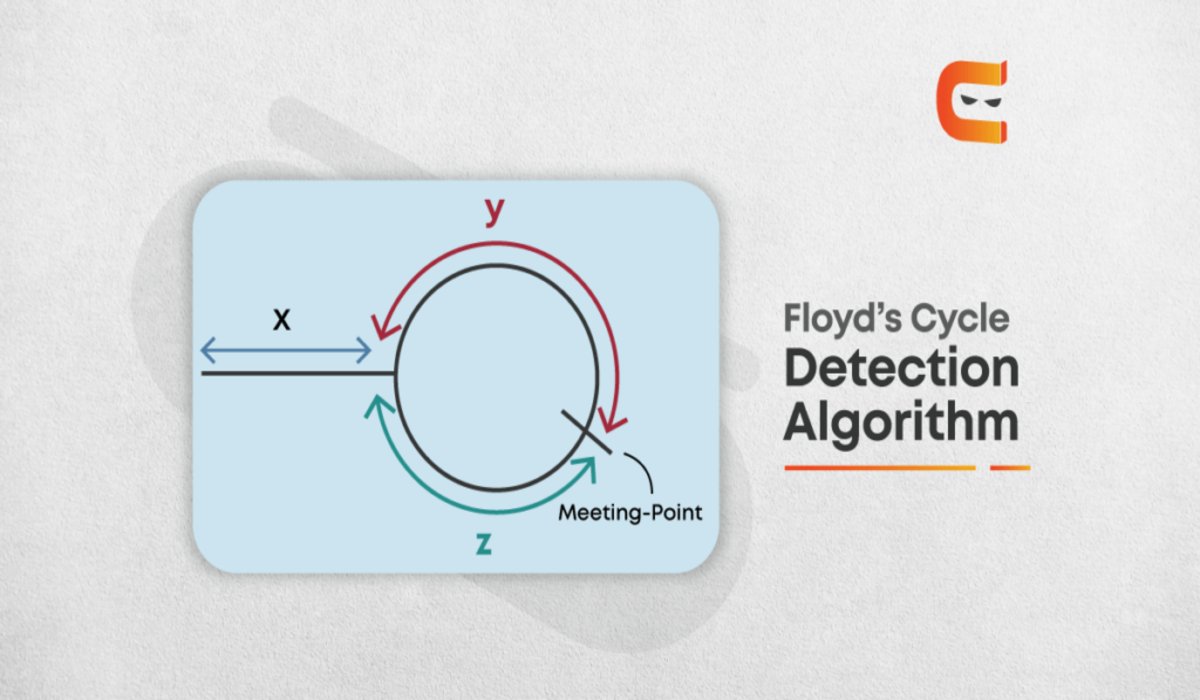
This leads to a simple, two-phase algorithm:
- Phase 1: Detect the cycle. Run the tortoise and hare algorithm as before. If they meet, a cycle exists.
- Phase 2: Find the start node. After they meet, leave the
fastpointer at the meeting point. Reset theslowpointer back to theheadof the list. Now, advance both pointers one step at a time. The node where they meet again is the start of the cycle.
Solutions - NeetCode (Linked List Cycle II)
The NeetCode solutions page provides a fantastic, concise explanation of this two-phase algorithm and highlights common pitfalls interview candidates fall into.
Read the sections "2. Fast & Slow Pointers" and "Common Pitfalls". The intuition and algorithm steps clearly explain the second phase of finding the loop's start. The pitfalls section is excellent preparation for an interview.
Here's a C function that implements both phases:
/*
 * Detects a cycle and returns the starting node of the cycle.
 * Returns: A pointer to the starting node of the cycle, or NULL if no cycle exists.
 */
Node* detectAndGetCycleStart(Node* head) {
    if (head == NULL || head->next == NULL) {
        return NULL;
    }

    Node* slow_p = head;
    Node* fast_p = head;
    Node* meeting_point = NULL;

    // Phase 1: Detect the cycle
    while (fast_p != NULL && fast_p->next != NULL) {
        slow_p = slow_p->next;
        fast_p = fast_p->next->next;
        if (slow_p == fast_p) {
            meeting_point = slow_p;
            break;
        }
    }

    // If no meeting point, there is no cycle
    if (meeting_point == NULL) {
        return NULL;
    }

    // Phase 2: Find the start of the cycle
    slow_p = head; // Reset slow pointer to the head
    while (slow_p != fast_p) {
        slow_p = slow_p->next;
        fast_p = fast_p->next; // Fast pointer is now also moving one step at a time
    }

    // Both pointers now meet at the start of the cycle
    return slow_p;
}
If you were to run this function with the main from our previous example, it would correctly return a pointer to cycle_start (the node with data 3).
Conclusion
You've now mastered a classic, highly efficient algorithm that is a staple of technical interviews. Being able to explain and implement it flawlessly, including the extension to find the cycle's start, demonstrates a strong command of pointers and algorithmic problem-solving.
Key Takeaways:
- Cycles in linked lists are a serious bug that can cause infinite loops.
- Floyd's "tortoise and hare" algorithm detects cycles in O(n) time and with O(1) space complexity.
- The algorithm relies on two pointers moving at different speeds: a
slowpointer (1 step) and afastpointer (2 steps). A collision indicates a cycle. - By resetting one pointer to the head after collision and moving both at the same speed, you can precisely locate the starting node of the cycle.
Preview of the Next Lesson:
We have covered array-based and pointer-based linear data structures. In our next lesson, we will move to a non-linear structure that is fundamental to real-time and embedded systems: the heap. We will learn how to implement a min-heap-based priority queue suitable for managing timers or events in an embedded system. This is a crucial component in RTOS schedulers and event-driven firmware.