Hello! Welcome to the next lesson in your Embedded Interview Preparation Bootcamp.
In our last session, we designed a callback-driven event handler and saw how a linked-list implementation offered flexibility at the cost of requiring dynamic memory management. That malloc call we used for the linked list opens up a critical area of system programming that is a frequent focus in interviews for senior roles at companies like Qualcomm, NVIDIA, and AMD. Today, we're going to pull back the curtain on malloc.
This lesson addresses the learning outcome: Explain heap allocator internals, including the roles of sbrk/brk, free lists, coalescing, and fragmentation. We will explore how a C program requests memory from the operating system and, more importantly, how the C standard library manages that memory to serve your application's requests efficiently.
1. The Allocator's Interface with the OS: brk and mmap
The first thing to understand is that malloc is a library function, not a system call. It acts as a middleman, requesting large blocks of memory from the operating system (OS) and then carving out smaller pieces for your application. This avoids the overhead of making a system call for every single small allocation.
The two primary system calls malloc uses on Linux-like systems to get memory are brk (or its wrapper sbrk) and mmap.
How processes get more memory. (mmap, brk)
To see how this works in practice, let's watch this excellent video from Jacob Sorber. He uses the strace tool to reveal the system calls made by a simple program that uses malloc, providing a very practical look at the allocator's behavior.
Please watch the following segments: Observing brk vs. mmap (0:51 - 1:38): Notice how small allocations result in brk calls, while larger allocations switch to using mmap. The Program Break (1:38 - 2:44): This is a key concept. Understand what the program break is and how it defines the end of the heap segment. Using brk and sbrk (2:44 - 3:45): See how sbrk is used to incrementally move the program break, effectively growing or shrinking the heap. Important Usage Note (5:45 - 6:23): Pay attention to the advice against mixing your own brk calls with malloc's usage.
To summarize the key points from the video:
- The Heap and the Program Break: The heap is a region of a process's virtual memory that grows "upwards" from the end of the data/BSS segments. The program break is a pointer maintained by the kernel that marks the top of the heap. Any memory address below the break is valid; anything above it is not.
brk()andsbrk(): These system calls manipulate the program break.brk(addr)sets the break to a specificaddr.sbrk(increment)moves the break byincrementbytes. Critically, it returns the previous location of the break, giving you a pointer to the start of the newly allocated memory block.
mmap(): This system call creates a new, independent memory mapping in the process's virtual address space. Unlikesbrk, it is not tied to the contiguous heap region.
Most modern malloc implementations use a hybrid strategy:
- For small-to-medium allocations: They use
sbrkto grow a single, contiguous heap. This is efficient for frequent, small requests. - For large allocations: They switch to
mmap. This is advantageous because a largemmap-ed region can be returned to the OS immediately withmunmapwhen freed, preventing the heap from staying permanently bloated (a problem withsbrk). It also avoids fragmenting the main heap with a single huge allocation.
This hybrid approach is visualized well in the following diagram:

2. Managing the Heap: Metadata, Free Lists, and Fragmentation
Now that the allocator has a large region of memory, its main job begins: managing this space. It must keep track of which parts are allocated and which are free, so it can reuse the free parts for future requests.
This is done by dividing the heap into chunks. Each chunk contains the user's requested memory plus some metadata that the allocator uses for bookkeeping.
What does it take to design a memory allocator? Dynamic Memory Allocation System Design
This video by Chris Kanich provides an excellent conceptual overview of how to design a memory allocator. It breaks down the core components of heap management.
Watch these three sections to understand the fundamental mechanics: Headers, Footers, and the Implicit Free List (1:40 - 7:49): Pay close attention to how metadata (size and allocation status) is stored in a header before the user's data. This forms an "implicit" linked list of all chunks on the heap. Allocation Strategies and Fragmentation (7:49 - 14:04): This part addresses a crucial interview topic. Understand the difference between First Fit and Best Fit, and how they relate to the problem of external fragmentation (having enough total free memory, but no single contiguous block that is large enough). Coalescing Free Blocks (14:04 - 19:17): This explains the primary technique for combating external fragmentation: merging adjacent free blocks into a single, larger free block. Understand the different cases for coalescing (with the next block, previous block, or both).
Let's consolidate those concepts, as they are central to any discussion about allocators.
The Chunk and its Metadata
The most basic allocator design embeds a header at the beginning of every memory chunk. This header typically stores:
- Size of the chunk: Needed so
free()knows how much memory to release. - Allocated/Free status: A flag (often packed into the low-order bits of the size field) indicating if the chunk is in use.
The user gets a pointer to the memory after this header. When free() is called with this pointer, the allocator simply subtracts the header size to get back to the metadata.
Free Lists: Tracking Available Memory
A free list is the data structure the allocator uses to keep track of all the free chunks.
-
Implicit Free List: As shown in the video, this is the simplest form. The "list" is simply implied by the contiguous layout of chunks on the heap. To find a free block, the allocator must iterate through every chunk from the beginning of the heap, checking its status bit. This is simple but slow, with a search time of O(N) where N is the total number of chunks.
-
Explicit Free List: A much more efficient approach. Here, the payload area of a free chunk is repurposed to store pointers to the next and previous free chunks, forming a doubly-linked list.
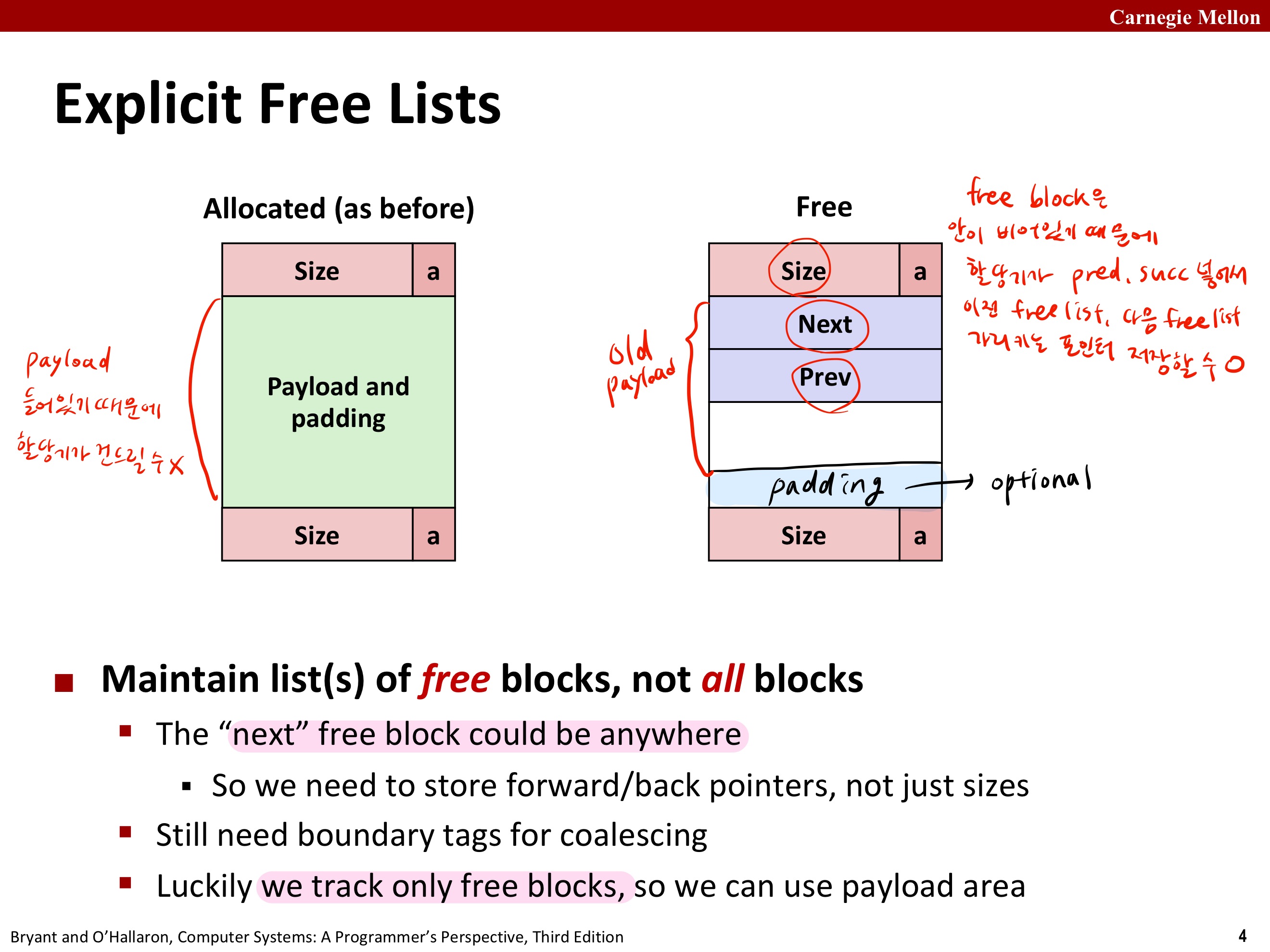
With an explicit free list, the search time is proportional to the number of free blocks, which is typically much smaller than the total number of blocks.
Fragmentation and Coalescing
- Internal Fragmentation: Wasted space inside an allocated chunk. This happens when the allocator gives you a block larger than you requested (e.g., due to alignment requirements or to meet a minimum block size).
- External Fragmentation: Wasted space between allocated chunks. This is the more serious problem, where you have many small free blocks, but none are large enough to satisfy a new request.
- Coalescing: The solution to external fragmentation. When a block is freed, the allocator inspects its adjacent neighbors (using the metadata headers/footers). If a neighbor is also free, they are merged into one larger free block. Performing this check on every
freeoperation is called immediate coalescing and prevents the heap from becoming riddled with tiny, unusable free chunks.
3. A Look at a Real-World Allocator: glibc's ptmalloc2
The concepts of free lists and coalescing are the foundation. However, production-grade allocators like ptmalloc2 (used in glibc on Linux) are far more complex to deliver high performance, especially in multi-threaded applications.
Instead of a single free list, ptmalloc2 uses a sophisticated system of bins. A bin is a free list for chunks of a specific size or size range.
Beyond `malloc(size)`: A Deep Dive into glibc's Heap Internals
To appreciate the complexity and performance optimizations in a real allocator, let's look at this deep dive into glibc's heap internals. You don't need to memorize every detail, but understanding the overall strategy is a major differentiator in an interview.
Please read the section titled "The Filing System: How free Organizes Chunks into Bins". Focus on understanding the purpose of each type of bin: Tcache Bins: Why are they per-thread and what's the performance benefit? Fast Bins: What is the trade-off being made by not coalescing chunks in these bins? Unsorted Bin: What is the role of this temporary holding area? Small and Large Bins: How do these act as the main, sorted repository for free chunks? The Top Chunk: What happens when none of the bins can satisfy a request?
The binning strategy of ptmalloc2 is a masterclass in performance engineering:
- Tcache (Thread Cache): The fastest layer. Each thread gets its own cache of recently freed small chunks. Since it's thread-local, no locking is required, which is a massive performance win for multi-threaded applications.
- Fast Bins: For small chunks that miss the tcache. They are singly-linked and don't coalesce, trading a bit of fragmentation for the speed of not having to merge blocks. The assumption is that small blocks of the same size will be requested again soon.
- Unsorted Bin: A single "purgatory" bin where larger freed chunks land first. When the next
mallocruns, it scans this bin, giving these recently freed chunks a chance to be re-used immediately (great for temporal locality) before incurring the cost of sorting them into the correct bin. - Small/Large Bins: The main, sorted, coalesced free lists. Small bins are for exact sizes, while large bins are for size ranges. These are the general-purpose workhorses of the allocator.
- Top Chunk: The final frontier. If all bins fail,
malloccarves memory from the chunk at the very top of the heap, extending the heap withsbrkif necessary.
Conclusion
You now have a multi-layered understanding of heap allocation, from the OS interface to the internal data structures and real-world optimizations. This knowledge is not just academic; it's essential for debugging complex memory corruption, tuning performance, and demonstrating system-level expertise in an interview.
Key Takeaways:
mallocis a library function that gets memory from the OS viasbrk(for the main heap) andmmap(for large allocations or thread heaps).- The allocator manages memory by dividing it into chunks, each with a metadata header storing its size and status.
- Free lists (implicit or explicit) are used to track available chunks for reuse. Explicit lists are much faster for finding free blocks.
- Fragmentation (internal and external) is the primary challenge. Coalescing—merging adjacent free blocks—is the key technique to combat external fragmentation.
- Production allocators like
glibc'sptmalloc2use a sophisticated hierarchy of bins (tcache, fast, unsorted, small, large) to optimize for speed, multi-threading, and memory usage.
In our next lesson, we will put this theory into practice. You will implement a fixed-block memory pool allocator, a common technique in embedded systems to achieve deterministic, real-time memory management by pre-allocating a fixed number of fixed-size blocks.