Hello! Welcome to the next lesson in your Embedded Interview Preparation Bootcamp.
In our last session, we drew a detailed comparison between C and C++, concluding that modern C++ can offer "negative-cost" abstractions, providing safety and structure while sometimes generating even more efficient code than C. This understanding of compile-time versus runtime trade-offs is a perfect foundation for today's topic.
We are now moving into Module 7: RTOS (Real-Time Operating Systems). An RTOS provides a powerful layer of abstraction for managing complexity and concurrency. The most fundamental service it offers is task scheduling. Your ability to articulate the differences between scheduling models is a core competency tested in senior embedded interviews.
Your learning outcome for this lesson is to: Compare preemptive, cooperative, and round-robin scheduling models and their suitability for different embedded applications.
We will break down each model, analyze its strengths and weaknesses, and connect them to real-world scenarios you've likely encountered in your automotive work.
1. The Language of Real-Time Scheduling
Before comparing schedulers, we need a common vocabulary. In real-time systems analysis, specific terms are used to define a task's timing constraints and a scheduler's performance. Misunderstanding these can lead to flawed system design.
The following article provides an excellent primer on this essential terminology.
You Don't Need an RTOS (Part 1) - Nathan Jones
This article, 'You Don't Need an RTOS (Part 1)' by Nathan Jones, clearly defines the core concepts needed to analyze any scheduling system. Understanding these terms is non-negotiable for a professional discussion on RTOS behavior.
Please read the section titled 'Definition Time'. As you read, focus on internalizing the definitions for these key terms: Task: A unit of work. Period: The rate at which a task is expected to run. Deadline: The time by which a task must complete to avoid system failure (hard deadline) or degraded performance (soft deadline). Cooperative vs. Preemptive: The fundamental difference in how a scheduler transfers control. Worst-Case Execution Time (WCET): The longest time a task could possibly take to execute. Worst-Case Response Time (WCRT): The longest possible time from a task's release until it completes its execution, including any blocking or preemption delays. Schedulable: A state where all tasks in a system are guaranteed to meet their deadlines.
These terms allow us to move from vague descriptions to a quantitative analysis of whether a system will work reliably under all conditions.
2. The Cooperative Model: Predictable Simplicity
The simplest scheduling model is one where tasks "cooperate" to share the CPU. This model is often implemented without a formal RTOS, using a simple while(1) loop, commonly called a superloop.
Definition: In a cooperative model, a task runs until it voluntarily relinquishes control of the CPU, either by finishing its work or by explicitly calling a yield() function. A running task cannot be interrupted by another task, regardless of its urgency.
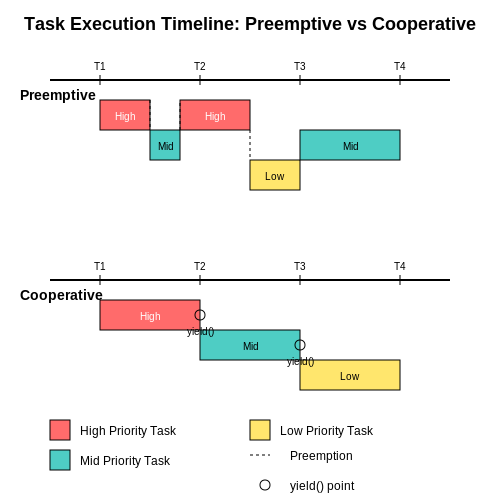
How it Works & Suitability:
A cooperative scheduler sequentially checks if each task has work to do. If it does, it executes that task's logic. This approach is highly predictable.
You Don't Need an RTOS (Part 1) - Nathan Jones
The article 'You Don't Need an RTOS' provides a clear code example of a superloop and discusses its operational mechanics.
Please review the section '"In the red corner...!"'. Focus on the 'Superloop' code column. Notice how each task is a non-blocking code block within a single while(1) loop. The PD task's delay is managed with a timer check, not a blocking call.
Trade-offs:
-
Pros:
- Simple & Low Overhead: Minimal code, no complex context switching mechanism.
- Immune to Race Conditions: Since tasks cannot preempt each other, data shared between them doesn't require mutexes or other synchronization primitives, drastically simplifying the design.
- Highly Predictable: The execution order is fixed.
-
Cons:
- Unresponsive: A long-running task blocks all other tasks. If a high-priority event (like a CAN message arrival) occurs while a low-priority task (like updating a display) is running, the event won't be processed until the current task yields. This makes cooperative systems unsuitable for meeting hard real-time deadlines in complex systems.
- Fragile: The system's responsiveness depends on every task being a "good citizen" and yielding quickly. A single poorly written task can bring down the entire system's performance.
Interview Application: Cooperative scheduling is best suited for simple, single-purpose embedded systems where tasks are very short and the timing requirements are not strict. Think of a basic sensor node that reads a value, performs a quick calculation, and goes to sleep.
3. The Preemptive Model: Responding to Urgency
Most real-time systems, especially in automotive, have tasks of mixed criticality. A task handling airbag deployment is infinitely more important than one updating the infotainment screen. This is where preemption is essential.
Definition: In a preemptive model, the scheduler ensures that the highest-priority task that is ready to run is always the task that has control of the CPU. It can (and will) forcibly interrupt a lower-priority task to do so. This is the model used by most commercial and open-source RTOSs like FreeRTOS, Zephyr, and QNX.
The following video powerfully demonstrates the difference this makes.
#26 RTOS Part-5: What is "real-time"? Preemptive, priority-based scheduling
The 'Quantum Leaps' YouTube channel provides an excellent experimental comparison. This segment shows a scenario where a simple round-robin scheduler fails to meet a deadline, which a priority-based preemptive scheduler handles with ease.
Please watch from the beginning to 10:39. 00:00 - 08:47: The presenter sets up an experiment with two periodic tasks. Observe how the simple 'fair' scheduler (round-robin) causes the high-frequency task to miss its deadline. 08:47 - 10:39: The presenter then diagrams how a priority-based preemptive scheduler would solve this problem by ensuring the high-priority task always runs first, even if it means delaying the low-priority task.
Trade-offs:
-
Pros:
- Highly Responsive: High-priority tasks are serviced immediately, making this model ideal for systems with hard real-time constraints.
- Decouples Tasks: The behavior of low-priority tasks generally does not affect the timing of high-priority tasks.
-
Cons:
- Complexity: Introduces the need for synchronization mechanisms (mutexes, semaphores) to protect shared resources, leading to potential issues like race conditions, deadlock, and priority inversion.
- Higher Overhead: Each context switch consumes CPU cycles and memory.
- Less Deterministic Execution Order: The exact sequence of task execution can vary depending on external events, making debugging more difficult.
Interview Application: Preemptive scheduling is the standard for any complex embedded system with mixed-criticality tasks. In an automotive context, this is a given. An ECU must process high-priority CAN frames and control actuators with deterministic timing, while simultaneously handling lower-priority diagnostics and communication.
4. The Round-Robin Model: A Policy of Fairness
Round-robin is another type of preemptive scheduling, but its goal is fairness, not urgency.
Definition: In a round-robin model, all ready tasks are placed in a queue. Each task is given a fixed time slice (or "quantum") to execute. If the task is still running when its time slice expires, it is preempted and placed at the end of the queue, and the next task runs.

How it Works & Suitability:
As demonstrated in the Quantum Leaps video you just watched, a pure round-robin approach is ill-suited for real-time control because it doesn't prioritize urgent tasks. However, it serves an important role within a priority-based system. Most preemptive RTOSs, including FreeRTOS, use round-robin scheduling for all tasks that share the same priority level.
Trade-offs:
-
Pros:
- Ensures Fairness: Prevents any single task from monopolizing the CPU (among tasks of equal priority).
- Simple to Implement: A straightforward queuing mechanism.
-
Cons:
- Ignores Urgency: Treats a critical task and a background task as equally important. Not suitable for systems with hard real-time constraints.
- Context Switch Overhead: Can lead to high overhead if the time slice is small and there are many tasks.
Interview Application: You would mention round-robin scheduling not as a primary strategy for a real-time system, but as a mechanism to ensure fairness among a group of equal-priority, non-critical tasks. For example, if you have several background tasks for logging telemetry data to different outputs (serial, flash, network), running them in a round-robin fashion at a low priority level ensures they all make progress without interfering with critical system functions.
5. Synthesis: Comparing the Models
For an interview, you need to be able to summarize these trade-offs concisely.
| Model | Primary Goal | How it Works | Pros | Cons | Best For... |
|---|---|---|---|---|---|
| Cooperative | Simplicity | Tasks run to completion or yield voluntarily. | Simple, low overhead, no race conditions from preemption. | Unresponsive to urgent events. | Simple, low-power devices with short, non-critical tasks. (e.g., a wireless temperature sensor). |
| Preemptive | Urgency / Response | The highest-priority ready task always runs. | Meets hard real-time deadlines, highly responsive. | Complex (requires sync), overhead from context switching. | Most complex embedded systems with mixed-criticality tasks. (e.g., Automotive ECUs, flight controllers, medical devices). |
| Round-Robin | Fairness | Tasks run in a circular queue, each for a fixed time slice. | Prevents task starvation, ensures all tasks progress. | Ignores task priority/urgency. | Groups of equal-priority, non-critical tasks within a preemptive system. (e.g., multiple logging or communication tasks). |
Conclusion
You now have a structured understanding of the three fundamental scheduling models in embedded systems. You can define each one, explain its mechanics, and—most importantly for your interviews—articulate the specific trade-offs that make each model suitable for different applications.
Key Takeaways:
- Cooperative scheduling prioritizes simplicity and predictability over responsiveness.
- Priority-based preemptive scheduling prioritizes responsiveness to urgent events over simplicity, and is the standard for real-time systems.
- Round-robin scheduling prioritizes fairness and is typically used as a secondary policy for tasks of equal importance within a preemptive system.
Preview of the Next Lesson:
We've established that priority-based preemption is essential for meeting real-time deadlines. This raises the most critical question: How do we assign task priorities? A wrong assignment can lead to system failure even if the CPU is not fully loaded. In our next lesson, we will answer this by diving into Rate Monotonic Scheduling (RMS), a cornerstone of real-time systems theory that provides a mathematical basis for assigning priorities and proving that a system is schedulable.