Welcome to the prevention module. Acute treatment aims to relieve an attack that has begun; preventive treatment aims to reduce future attacks and their impact. The two can belong in the same care plan. In this lesson, you will use a sample three-month history to see how clinicians weigh monthly headache days, migraine days, disruption to daily life, and the results of acute treatment when deciding whether prevention merits discussion.
Why count more than attacks?
Two people can each report “two migraines a month” yet have very different needs. One may recover with acute medicine and carry on with usual activities. The other may lose two days of work or ordinary responsibilities each time, despite taking treatment. Counting attacks alone misses both how long symptoms last and what they prevent someone from doing.
Migraine: A Neurological Condition That's Not Just in Your Head - Yale Medicine Explains
Watch Yale Medicine’s Migraine: A Neurological Condition That’s Not Just in Your Head for its description of migraine’s effects beyond head pain and its explanation of why frequent reliance on pain relievers deserves attention.
Watch daily impact, focusing on symptoms and the time before and after head pain that can disrupt activities. Continue through frequent medicine use, where the clinician explains why repeated use of nonprescription pain relievers can signal a need to revisit the treatment plan. The video does not establish medication-overuse headache from any particular diary; that requires a more detailed assessment.
A useful history therefore keeps several counts distinct. A headache day is a calendar day on which headache occurs. A migraine day is a day with migraine symptoms; in the example below, every migraine day is also counted among the headache days. An attack can last across more than one day, so “number of attacks” and “number of migraine days” need not be the same.
Disability adds another dimension. Rather than relying only on a pain score, a history can record days when symptoms caused missed work or other responsibilities, substantially reduced activity, or made ordinary tasks difficult. It should also record what happened after acute treatment: whether relief was adequate and usual functioning returned, not merely whether medicine was taken.
When prevention becomes worth discussing
The American Migraine Foundation describes preventive treatment as a way to reduce how often attacks occur and how much they affect life. It also sets out several reasons to consider it; no single count is a command to start a medicine.
Preventive Migraine Treatment: An Introduction | AMF
Read the American Migraine Foundation’s introduction to connect the purpose of prevention with the clinical reasons for offering it.
Under “Are You a Candidate for Preventive Migraine Treatment?”, read the opening contrast. Under “The Goals of Migraine Prevention”, read the goals paragraph through its final sentence. Then find “Who is a Candidate for Preventive Migraine Treatments?” and read the candidate list. Notice that frequency, disability, acute-treatment response, tolerability, medicine use, and preference are separate reasons for a discussion.
A practical frequency marker is four or more migraine days per month, or four or more moderate-to-severe headache days per month. Migraine that interferes with daily activities also warrants consideration. These are prompts for a conversation, not diagnostic criteria and not a rule that someone with fewer days must wait. Disabling attacks despite appropriate acute treatment, inadequate acute relief, inability to use an acute medicine, or concern about frequent acute-medicine use can matter even when the monthly migraine-day count is lower.
The purpose of the discussion is to weigh likely benefit against burdens and risks in the person’s circumstances. Prevention may reduce attack frequency, severity, disability, and the need for acute medicine; it need not eliminate every migraine to be worthwhile. A clinician may also review whether the current acute treatment is suitable and working as intended. Considering prevention does not mean giving up acute treatment for attacks that still occur.
A worked three-month history
Consider this fictional diary summary. “Disability days” are days when symptoms caused missed duties or substantially curtailed normal activities. “Good relief” means that, after acute treatment, symptoms eased enough for usual functioning to resume.
| Month | All headache days | Migraine days | Disability days | Migraine days treated acutely | Treated days with good relief |
|---|---|---|---|---|---|
| January | 7 | 5 | 3 | 5 | 2 |
| February | 8 | 6 | 4 | 6 | 2 |
| March | 6 | 4 | 2 | 4 | 2 |
First, keep the denominators straight. January’s five migraine days are part of its seven headache days, not five additional days. Across the three months, the person recorded 4–6 migraine days per month, meeting the frequency marker for a prevention discussion in every month shown. The 6–8 total headache days each month give further context, but they should not be mistaken for 6–8 migraine days.
Next, consider what those days cost. The diary records 2–4 disability days per month. That is not just a description of pain intensity: it shows a recurring loss of ordinary function. Finally, acute treatment restored functioning on only 2 of 5, 2 of 6, and 2 of 4 treated migraine days, respectively. The diary supports the statement “acute treatment often leaves substantial symptoms or disruption,” without yet explaining why it falls short.
A concise interpretation would be: Preventive treatment merits discussion because migraine occurred on at least four days each month for three months, regularly disrupted activities, and was often not adequately controlled by acute treatment. A clinician would still need to review the diagnosis, the acute-treatment plan, other health considerations, and the person’s preferences before choosing a course of action. The record does not, by itself, prove medication-overuse headache or show which preventive option would suit them.
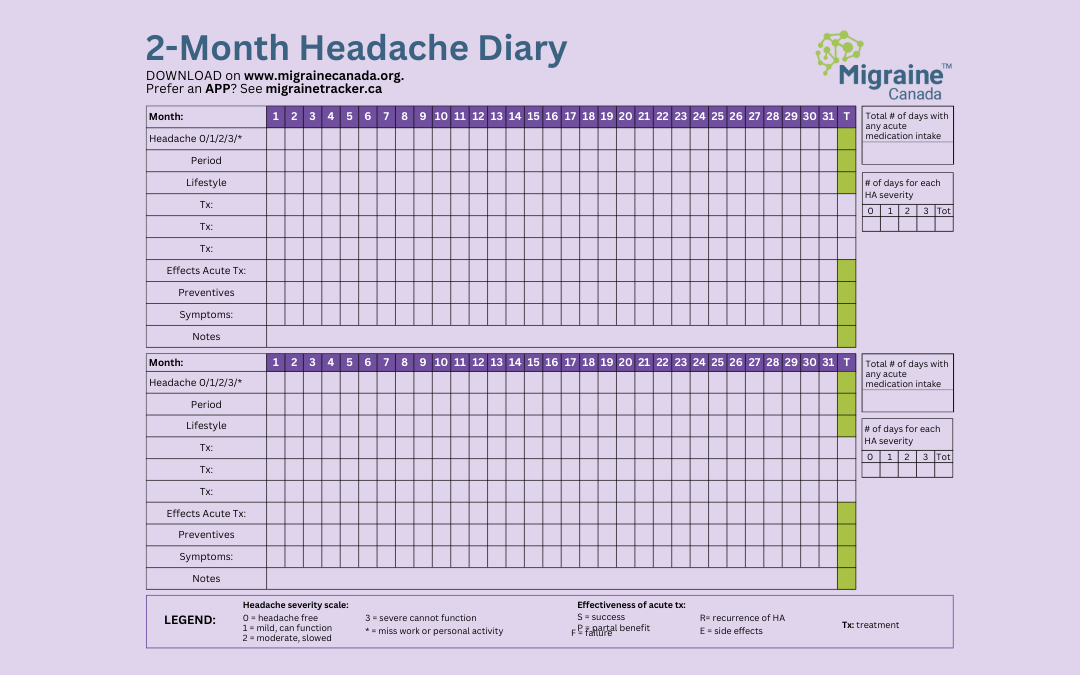
The illustrated diary has a place for treatment effects, but it has no dedicated “disability days” row. That detail could be added in the notes or brought into a monthly summary. A diary is most useful when the counts preserve what mattered in daily life, not just how many boxes contain a headache score.
Why the same threshold does not produce the same decision
Imagine a second history with two migraine days per month, both causing a full day of lost activity despite an appropriate acute treatment. It falls below the four-day frequency marker, yet the disability and poor relief make prevention a reasonable topic to raise. The marker is not a minimum amount of suffering required before a conversation.
Now imagine four migraine days per month, each relieved well by acute treatment with little interruption to activities. Frequency still makes prevention worth considering, but it does not make a preventive medicine automatic. The person and clinician might weigh the current burden, the effort and possible adverse effects of prevention, and the person’s preference for changing the plan.
These contrasts reveal the central decision: frequency describes how often migraine creates an opportunity for harm; disability and acute-treatment response show how much harm remains under the current plan. Frequent use of acute medicine is another reason to review that plan, but assessing medication-overuse headache calls for a medication-specific record over time, not an assumption based on one busy month.
Key takeaways
A prevention discussion is especially well supported by recurring months with four or more migraine days, four or more moderate-to-severe headache days, substantial interference with daily life, or inadequate or unsuitable acute treatment. Count headache and migraine days separately, then add disability and the result of acute treatment. Together, those details explain far more than an attack count alone. The outcome of the discussion is individualized; it is not an automatic prescription.
The next lesson examines several oral preventive options and the suitability and adverse-effect considerations that help distinguish them.