Welcome. This first module begins with recognizing what a migraine attack can look like before moving on to aura and the warning signs that require medical attention. Your longer-term goal is to understand how treatment decisions are made; that starts with being able to describe the whole attack, not just the headache.
In this lesson, you will learn to pick out a typical migraine pattern from a short symptom history: the character of the head pain, nausea or vomiting, sensitivity to light or sound, and changes that may appear before or after the pain. Recognition is useful for a clinician conversation, but it is not the same as diagnosing a headache yourself.
Look for a pattern, not one defining symptom
Imagine someone who becomes unusually tired and keeps yawning on Friday. On Saturday, a gradually developing headache makes walking around uncomfortable. The pain pulses on one side, ordinary light feels harsh, and they feel nauseated. The head pain eases that evening, but they remain drained and find it hard to concentrate on Sunday. That history suggests more than an isolated episode of head pain: its accompanying symptoms and its course over time form a recognizable migraine pattern.
Migraine is a neurological condition that produces attacks. During the headache portion, pain is often moderate to severe, throbbing or pulsing, and worse with ordinary movement. It frequently affects one side of the head, but it can affect both. Nausea, sometimes with vomiting, and sensitivity to light and sound are especially useful clues. The symptoms may interrupt work, meals, conversation, or other ordinary activities. Not every person has every feature, and attacks can vary even within the same person.
Read the NHS overview to establish the core symptoms and the usual timescale of an attack. It provides a concise foundation for interpreting the histories in this lesson.
In “Symptoms of migraine,” begin with the main-symptoms list and read the symptom account through the final paragraph on how often attacks occur. Notice which features describe the headache itself and which occur earlier or alongside it. You can note the brief mention of aura; the next lesson will examine it in detail.
The NHS describes attacks commonly lasting 4 hours to 3 days, while early symptoms may begin hours or up to two days before the head pain. These are useful guides, not a stopwatch for deciding whether an individual headache “counts.” The combination of features matters more than any single detail. A one-sided throbbing headache may suggest migraine, for example, but nausea and pronounced light or sound sensitivity make the pattern more informative.
The headache is only part of the attack
Symptoms before the head pain are often called the prodrome, or premonitory phase. Someone may yawn repeatedly, feel unusually tired or thirsty, crave a particular food, notice a mood change, or develop neck stiffness. These signs are easy to miss because each can happen for many other reasons. Their significance becomes clearer when they repeatedly occur in the hours or days before a person’s familiar headache.
After the head pain subsides, a postdrome may follow. Fatigue, difficulty concentrating, mood changes, or lingering sensitivity can leave someone unable to resume their usual routine immediately. In the opening history, Sunday’s exhaustion is therefore part of the account of the attack, even though the severe pain ended on Saturday.
Watch this short explanation of the phases with one caution in mind: they are a way to describe an attack, not a set of stages that everyone must experience.
Phases of a Migraine Attack - Chapter 3: Episode 2 - Migraine Explainer Video Series
Watch “Phases of a Migraine Attack” from Migraine Disorders for a compact account of symptoms before, during, and after head pain.
Watch the opening for the variation between attacks and examples of early symptoms. Continue through the aura overview as a preview only. Focus on pain and recovery: the speaker describes the headache’s accompanying symptoms and what can linger after it fades.
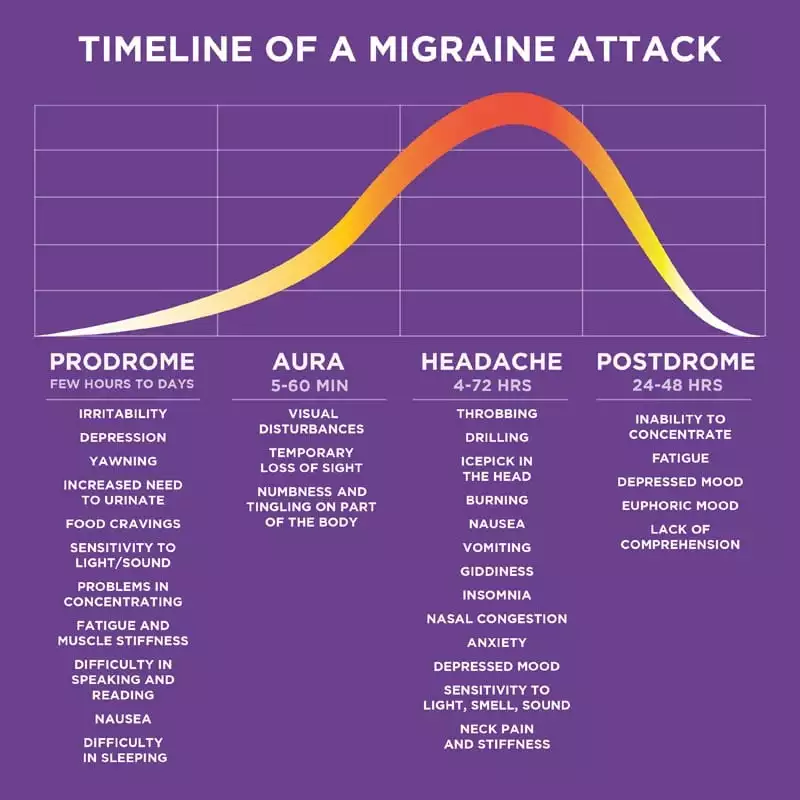
The timeline helps explain why a history limited to “Where did it hurt?” misses useful information. It also needs a qualification: aura is not required for migraine. Aura refers to temporary neurological symptoms, such as visual changes or tingling; the next lesson will cover how those symptoms typically develop. The phases can overlap, and a person may have no noticeable prodrome or postdrome at all.
A food craving in the prodrome deserves particular care in interpretation. If someone craves a food shortly before pain begins, eating that food may appear to have caused the attack when the craving was actually an early symptom. Later in the course, you will learn how a headache diary can help distinguish recurring patterns from assumptions about triggers.
Turning a short history into a useful description
A practical way to recognize a possible migraine is to reconstruct the account in three parts. First, establish the head pain: how it developed, how long it lasted, whether it pulsed, whether it was one-sided or bilateral, and whether movement made it worse. Second, identify symptoms during the pain, especially nausea or vomiting and light or sound sensitivity. Third, note what happened on either side of the pain, such as yawning beforehand or exhaustion afterward.
Consider a second history: a person has six hours of disabling, pulsing pain across both sides of the head, feels sick, and cannot tolerate normal room lighting or conversation. They recall no warning symptoms and feel well once the pain resolves. The bilateral location and absence of a noticeable prodrome do not rule out migraine. The duration, character of the pain, nausea, sensory sensitivity, and effect on daily functioning still form a typical pattern.
The reverse is equally important. Fatigue before a headache, or nausea with a headache, does not establish migraine on its own. A clinician considers the full history, whether attacks recur in a similar way, relevant health circumstances, and whether anything points to another cause. Describing what happened and when is more useful than trying to make every symptom fit a phase.
Some presentations should not be treated as a routine familiar migraine. A headache that is suddenly at maximum intensity, or new neurological symptoms such as weakness or trouble speaking, needs urgent medical assessment rather than an assumption that it is “just migraine.” A later lesson will distinguish emergency warning signs from changes that call for prompt clinical review.
Key takeaways
A typical migraine history often combines moderate or severe head pain with nausea or vomiting and sensitivity to light or sound. Pain is often pulsing, may worsen with movement, and can be on one side or both. Early signs such as yawning and fatigue, and later effects such as exhaustion or difficulty concentrating, help reveal the full attack—but neither these phases nor aura must be present.
Being able to describe this pattern gives you a sound basis for discussing symptoms with a clinician. Next, you will look more closely at aura, including how its temporary visual, sensory, or speech symptoms develop.