Welcome back. Last lesson distinguished acute treatment, which addresses an attack under way, from preventive treatment, which aims to reduce attacks over time. This lesson stays with acute treatment. You’ll compare paracetamol (called acetaminophen in some countries), nonsteroidal anti-inflammatory drugs (NSAIDs) and triptans—not just by what they are, but by when they may help, when they may be unsafe, and whether a medicine can be taken during an attack with nausea or vomiting.
Choose for the attack that is happening
An acute medicine generally has a better chance of helping when taken early in a recognizable attack, rather than after pain and other symptoms have become established. “Early” is not a reason to medicate every uncertain sensation: the timing should fit the person’s attack pattern and the medicine in their agreed plan. If an aura is followed by headache, for example, guidance for triptans generally places the dose at the start of the headache pain, not simply at the first aura symptom.
Severity also matters. A mild-to-moderate attack might respond to an ordinary pain reliever, while a moderate-to-severe attack may call for a migraine-specific medicine such as a triptan. A clinician can use either a stepped plan—trying one suitable treatment before changing course for later attacks—or a stratified plan that specifies different treatments for different kinds of attack. Neither means someone must endure a severe attack while waiting for a weaker option to fail.
2. Acute treatment of migraine in primary care | Right Decisions
Read this Right Decisions clinical guide for its practical distinction between early treatment, mild-to-moderate attacks and moderate-to-severe attacks. Treat the listed doses as examples from a clinical guideline, not as a personal dosing plan.
In “Background,” read timing and strategies. Then, under “Mild to moderate attacks,” continue through “Moderate to severe attacks”: read the treatment choices. Focus on how the choice changes with attack severity and what the guide suggests when an NSAID is unsuitable or nausea complicates treatment.
Paracetamol/acetaminophen is a general pain reliever. It may be enough for some mild-to-moderate attacks, especially when an NSAID is unsuitable. It is not an NSAID: it does not share the same anti-inflammatory action or the same stomach-bleeding risks. That does not make it risk-free. Too much can cause serious liver injury, and it can be easy to take more than intended when cold remedies or combination pain medicines also contain it. Liver disease is a reason to check suitability with a clinician.
NSAIDs, such as ibuprofen and naproxen, relieve pain and reduce inflammation-related signaling. They are common options for mild-to-moderate migraine, provided the person can take them safely. Aspirin is another NSAID used for acute migraine in some treatment plans. These medicines are not interchangeable with paracetamol merely because both can be bought without a prescription.
Triptans, such as sumatriptan, are migraine-specific acute medicines. They are often considered for moderate-to-severe attacks or when an ordinary pain reliever has not provided adequate relief. Different triptans and delivery forms can work differently for an individual, so an unsuccessful trial of one does not necessarily mean the entire class will be ineffective.
Safety changes the comparison
The most useful question is not “Which class is strongest?” but “Which option is both likely to help and suitable for this person?” An over-the-counter label does not answer the second half.
NSAIDs can irritate the stomach and increase the risk of ulcers or gastrointestinal bleeding. Kidney disease, cardiovascular disease, high blood pressure, a history of ulcers or bleeding, and medicines that increase bleeding risk can all change the decision. Pregnancy also requires specific advice; NSAIDs are particularly problematic later in pregnancy. Taking two NSAIDs together is not a way to make treatment more effective and can increase harm.
Triptans have a different major limitation. Their effects include narrowing certain blood vessels, so they are generally unsuitable for people with conditions such as coronary heart disease, peripheral vascular disease, a history of stroke or uncontrolled high blood pressure. They can cause sensations including flushing, tingling or tightness. New or concerning chest pain should not be assumed to be a harmless medicine effect; it needs urgent medical assessment. A clinician should also check other medicines and relevant health circumstances, including pregnancy or breastfeeding, before recommending a triptan.
2. Acute treatment of migraine in primary care | Right Decisions
Return to the Right Decisions guide to see why “triptan” is a class rather than a single, identical option, and how its safety checks differ from those for ordinary pain relievers.
Under “Types of triptan,” read response and forms. Under “Adverse effects” and “Cautions and contraindications,” read effects and cautions. Finally, under “How to Take Triptans,” read triptan timing. Notice that advice about a second dose depends on what happened after the first; follow the instructions for the specific prescribed medicine.
The same history can point away from one class without establishing that another is safe. Someone with a past stomach ulcer might need to avoid an NSAID, but whether a triptan is appropriate still depends on their cardiovascular history and other medicines. Likewise, pregnancy is not a situation in which one rule about all pain relievers or all triptans can replace individualized advice.
Nausea can make the route as important as the medicine
Migraine-associated nausea is more than an additional symptom to relieve. If someone vomits soon after swallowing a tablet, the dose may not stay down. An attack can also slow stomach emptying, making an oral medicine less predictable. Thus, a treatment that works well on a day without nausea may be impractical during a different attack.
A clinician may suggest an antiemetic (medicine for nausea), sometimes alongside the acute pain treatment. If swallowing or keeping down tablets is the main obstacle, a nasal spray or injection may be more useful; some triptans are available in these forms. An orally disintegrating or “melt” tablet is easier to take without water, but it is generally swallowed with saliva and should not be mistaken for an injection or nasal treatment that bypasses the problem of vomiting.
[PDF] FAQ: Understanding Acute Treatment for Migraine
Read the American Migraine Foundation’s FAQ for a patient-facing explanation of why both timing and delivery method belong in an acute treatment plan.
In the opening FAQ text, read early treatment, which ends just before “How do I decide which acute treatment is right for me?” In the answer to that question, read delivery choices. Focus on the example of severe nausea rather than treating any one form as best for every attack.
The distinction between drug and delivery is worth keeping clear. Switching from an oral triptan to a non-oral triptan addresses a delivery problem; switching from an NSAID to a triptan may address inadequate relief, a safety concern or both. The reason for changing treatment helps a clinician choose what to try next.
Put the factors together
This table groups the considerations a clinician may use. Its “migraine features” include intensity, speed and nausea; its “therapeutic trials” include whether a medicine was taken at the intended dose and time; and its “patient characteristics” include health conditions and possible interactions. A medicine that seemed ineffective may deserve a different interpretation if it was taken very late or vomited soon afterward—but that does not mean repeating doses without advice.
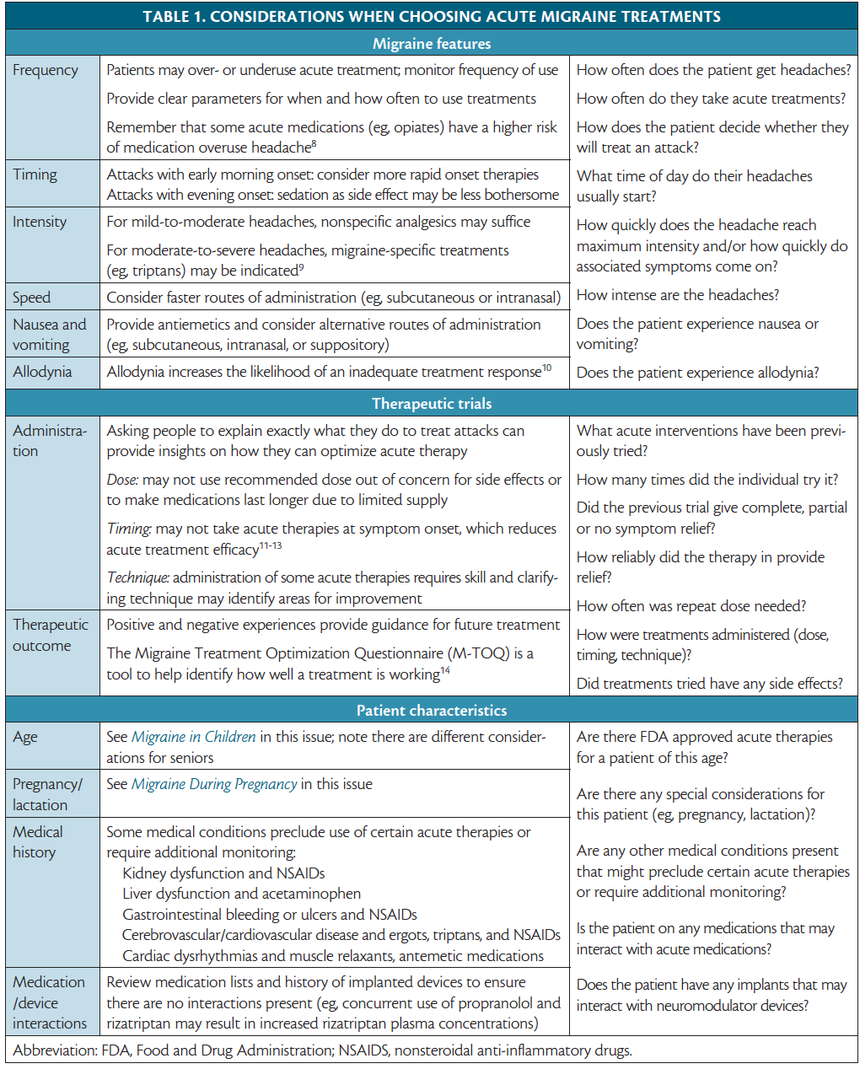
Consider two contrasting patterns. For an occasional mild attack without vomiting, a suitable oral pain reliever taken early might be practical. For an attack that becomes severe quickly and brings early vomiting, a plan relying only on an oral tablet may fail even if the drug itself can treat migraine; a clinician may consider a migraine-specific or non-oral option after checking safety. Neither pattern identifies a universally “best” medicine. The person’s conditions, other medicines, previous responses and ability to take the treatment all matter.
Finally, how often acute medicine is needed is part of its safety and usefulness. Frequent use of ordinary pain relievers or triptans calls for a review of the plan rather than simply escalating treatment on one’s own. The later lesson on medication-overuse headache will examine use-day patterns more precisely.
Takeaway
Paracetamol/acetaminophen, NSAIDs and triptans can all serve acute relief, but they differ in their usual place in a plan and their principal safety concerns. Early treatment helps; attack severity and prior response guide the choice; and nausea or vomiting may make a non-oral route or antiemetic important. The right comparison therefore includes timing, suitability and delivery, not just the name of a drug.
The next lesson looks at gepants and ditans—other migraine-specific acute options that may be discussed when treatments covered here are ineffective or unsuitable.