Hello! In our previous lessons, we've built a solid foundation, understanding what foundation models are, how LLMs work, and the critical role of training data in teaching them. We established that these models are powerful but general-purpose, trained on vast, broad datasets.
This brings us to a crucial question from a product development standpoint: How do you transform a generalist model into a specialist that understands your unique business needs? This lesson will answer that by defining model 'fine-tuning' and explaining why it's the key to adapting pre-trained models for specific, high-value tasks. This concept is the bridge between the general AI models we've discussed and the customized solutions you aim to understand in Amazon Bedrock.
From Generalist to Specialist: The Core Idea of Fine-Tuning
Imagine hiring a brilliant, highly-educated recent graduate. They have a massive base of general knowledge but no experience in your specific industry—be it fintech, ERP implementation, or agile project management. You wouldn't ask them to re-learn how to read and write; instead, you would train them on your company's processes, terminology, and culture.
Fine-tuning in machine learning works on a similar principle. It's a technique within a broader field called transfer learning, where knowledge gained from one task is applied to a different but related task.
Fine Tuning LLM Explained Simply
This video from the codebasics channel provides an excellent, simple analogy to introduce the concept of transfer learning, which is the foundation of fine-tuning.
Watch the first 44 seconds of the video, from the beginning. The speaker uses the analogy of transferring skills from cricket to baseball to explain the core idea.
As the video suggests, fine-tuning is the process of taking a powerful, pre-trained model and retraining it on a new, smaller, and highly specific dataset. This allows the model to adapt its existing knowledge to a new domain or task without the need to start from zero.
This two-stage process is fundamental to modern AI applications:
- Pre-training: A massive foundation model is created by training it on enormous, general datasets (like a large portion of the internet). This is incredibly expensive and time-consuming, but results in a model with a broad understanding of language, grammar, and facts.
- Fine-tuning: This pre-trained model is then taken and its training continues, but with a smaller, curated dataset of labeled examples that are directly relevant to the desired task.
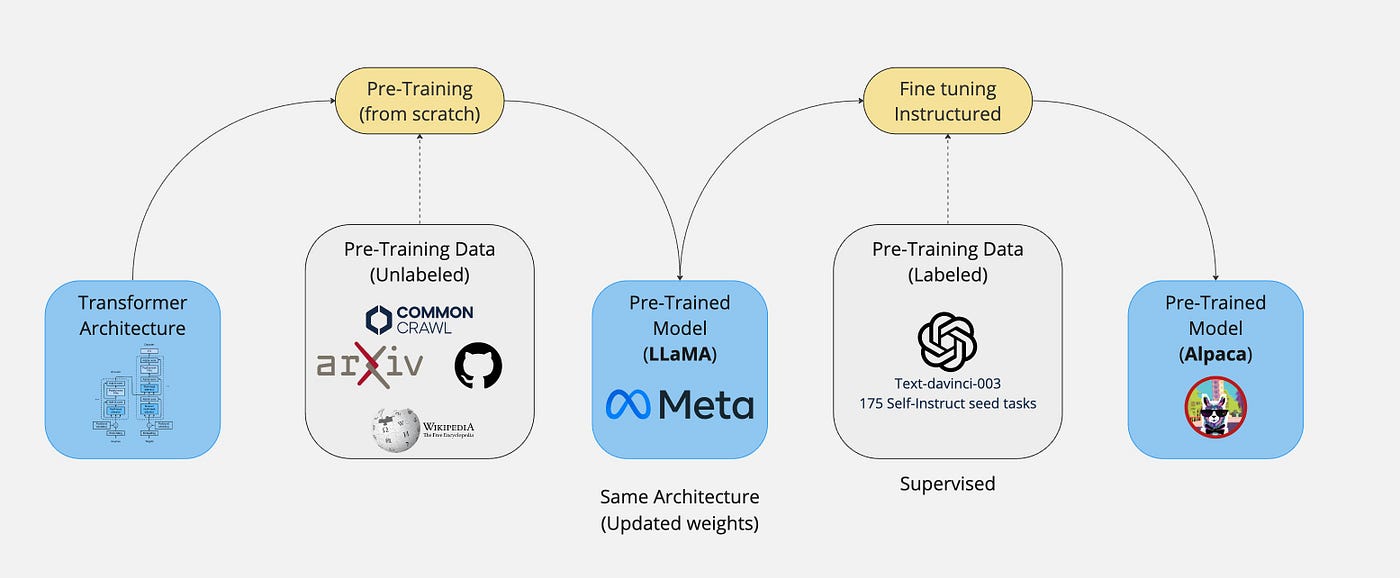
The diagram below illustrates this process perfectly. A base model (like Meta's LLaMA) is pre-trained on vast, unlabeled public data. It is then fine-tuned on a smaller, labeled, instruction-based dataset to create a specialized model (like Alpaca) that is better at following commands.
Why is Fine-Tuning Necessary?
You might wonder why a model trained on the entire internet isn't good enough. The core issue is that pre-trained models are masters of pattern completion, not necessarily user intent. They are trained to predict the next word in a sequence, which can lead to responses that are grammatically correct but not practically useful.
The following article from IBM explains this distinction clearly.
This article provides a formal definition of fine-tuning and explains its critical role in making LLMs useful for practical applications.
First, read the initial section titled "What is fine-tuning?" to solidify the definition. Then, skip down to the section "Fine-tuning large language models" and read the first three paragraphs, from the introduction. Pay close attention to the resumé example, which perfectly illustrates the gap between text completion and fulfilling user intent.
As the article highlights, fine-tuning bridges the gap between the model's general knowledge and your specific requirements. In your role as a product manager, identifying the need for customization is key. Fine-tuning is the mechanism to achieve it.
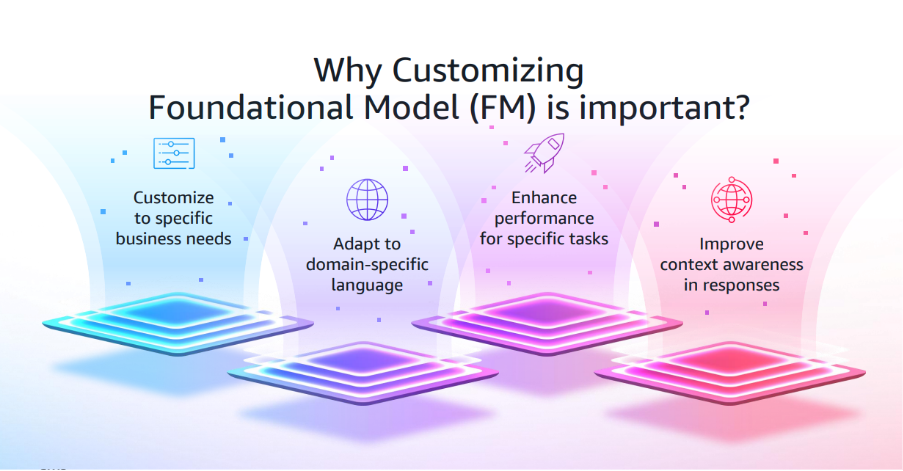
The primary reasons for customizing a model align directly with creating business value:
When to Use Fine-Tuning: A Product Manager's Framework
From a strategic perspective, you need to know when to employ this technique. Fine-tuning is not always the answer, but it's the right choice in specific scenarios. You would choose to fine-tune a model when your application requires a deep understanding of a specific style, terminology, or reasoning process.
Pre-Training vs Fine-Tuning vs RAG: A Simple Enterprise AI Guide
This business-focused guide provides clear criteria for when to use fine-tuning and offers a practical example.
Read the section "Fine-Tuning — Teaching the Model Your Language" for a definition framed around business domains. Then, read the decision framework criteria under the heading "Use Fine-Tuning when". Finally, read "Scenario 2: Automating Customer Support Conversations" to see a concrete use case.
Here are some prime examples where fine-tuning creates a more effective product:
- Adapting Tone and Style: A customer service chatbot can be fine-tuned on exemplary conversation logs to adopt an empathetic and brand-aligned tone.
- Mastering Domain-Specific Jargon: An AI assistant for financial analysts can be fine-tuned on market reports to understand specific terminology and generate relevant summaries.
- Following a Specific Format: A model can be fine-tuned to always generate code, API calls, or SQL queries in a precise, structured format required by your systems.
- Incorporating Proprietary Knowledge: While fine-tuning is more about teaching behavior than new facts, it can help a model reason about concepts unique to your business that are present in your proprietary training data.
This process essentially "bakes in" the context and specialized intuition directly into the model's parameters, making it faster and more reliable for its specific job.
This video from IBM Technology further explains the benefits of fine-tuning, emphasizing how it embeds specialized knowledge into the model.
Watch the segment from the introduction to fine-tuning, which describes it as "baking in this context and intuition into the model." Then, skip to the example provided at the end, which discusses using fine-tuning for a legal document summarizer that needs to understand nuanced terminology.
Conclusion
In this lesson, we've defined fine-tuning and explored its critical role in adapting powerful, general-purpose foundation models into specialized tools that can drive real business value.
Here are the key takeaways:
- Fine-tuning adapts, it doesn't create from scratch: It's a form of transfer learning where a pre-trained model is further trained on a small, task-specific dataset.
- It's about behavior, not just knowledge: The main goal is to teach a model how to respond—with the right tone, in the right format, and using the right terminology for your specific domain.
- It's efficient and accessible: Compared to the monumental cost of pre-training, fine-tuning allows organizations to leverage existing foundation models and customize them for their own needs.
- It solves a key business problem: Fine-tuning transforms a generalist AI into a specialist that understands your business context and user intent, leading to a much more effective and valuable product.
With this, we have concluded our module on core AI and machine learning concepts. You now have the conceptual building blocks—understanding foundation models, LLMs, training data, and fine-tuning—to begin exploring how these ideas are implemented in a real-world service.
In our next lesson, we will transition to the practical environment by introducing the AWS Management Console, the web interface you will use to access and manage all AWS services, including Amazon Bedrock.