In our last session, you successfully wrote a full IELTS Task 2 essay under timed conditions, focusing on the essential macro-structure: planning, introduction, body paragraphs, and conclusion. This was a crucial step in building your capacity to deliver a complete piece of writing within the exam's tight constraints.
Today, we transition from the architectural blueprint of the essay to the fine-grained connections that make it strong and coherent. This lesson centers on the learning outcome: to use a range of linking words and discourse markers to connect ideas within and between paragraphs. Mastering this skill is not just about adding a few fancy words; it's about making your arguments flow logically and persuasively, which directly impacts 25% of your Writing score under "Coherence and Cohesion."
From your experience in systems architecture, you know that a collection of high-quality components is not enough; they must be connected by well-defined interfaces and logical pathways to function as a cohesive system. Similarly, in writing, linking words act as these logical connectors, guiding the reader through your argument and showing the relationship between your ideas.
1. Understanding Coherence, Cohesion, and Linking Words
First, let's clarify two key terms that are central to a high-scoring essay: coherence and cohesion.
- Coherence is the logical organization of your essay. It's about having a clear overall structure and ensuring each paragraph has one central idea that is easy for the reader to follow.
- Cohesion refers to the linguistic "glue" that holds your sentences and paragraphs together. This is achieved using specific words and phrases, often called cohesive devices or linking words.
The following resource provides a clear definition of these concepts.
20+ Coherence & Cohesion Templates for Band 9 Essays - IELTS GPT
This article from IELTS GPT explains the fundamental difference between coherence and cohesion, two of the four criteria on which your writing is assessed.
Please read the first part of the article, from the beginning down to the table. Focus on the sections defining coherence and defining cohesion. Pay special attention to the table that lists different cohesive elements and their functions.
Now that you understand the concepts, let's dive into the practical tools for creating cohesion. The video below provides an excellent overview of the most important linking words for IELTS Writing Task 2, categorized by their function. It also highlights the correct grammar and punctuation, which is critical for avoiding errors.
BAND 9 IELTS Writing Task 2 LINKING WORDS
This comprehensive video from Fastrack IELTS breaks down the essential linking words you'll need, with clear examples and grammatical rules.
Watch the video from the beginning until the summary. The presenter systematically covers words for: Strong Contrast: although, however, despite (00:48-06:11) Simple Contrast: while, whereas, on the other hand (06:11-08:19) Addition: as well as, moreover, furthermore (08:19-11:59) Sequence: subsequently, thereafter (11:59-12:43) Result/Consequence: as a result, consequently, therefore (12:43-14:50) Cause: because, as, since (14:50-16:42) As you watch, pay close attention to the punctuation (commas, semicolons) and the grammatical structures that follow each linking word (e.g., noun vs. clause).
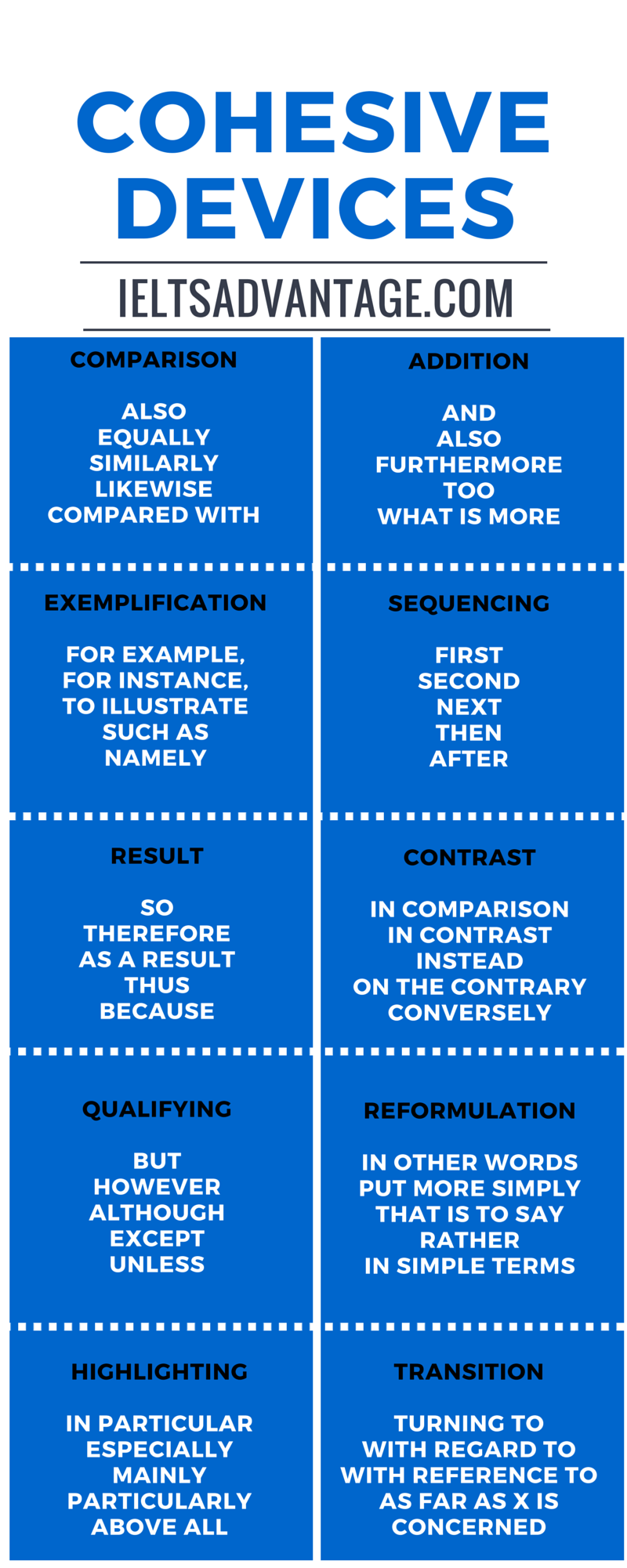
To help you remember these categories, here is a useful visual summary. You might want to save this image for quick reference when you practice.
2. Practice: Building Your Skills
In line with your preference for a practice-first approach, we'll now move directly to hands-on exercises. Knowing the words is one thing; using them correctly under pressure is another. The following resource offers a series of targeted exercises to build your muscle memory.
Linking Words Exercises - 165 Free Practice Questions | B1-B2
This page from English-Exercises.org provides a large set of free interactive exercises focused on linking words. The exercises are designed to target common errors made by English learners.
First, briefly review the list of common mistakes at the bottom of the page. This will reinforce what you learned in the video, especially the difference between using despite and although. Next, complete the following exercises from the list near the top of the page. They offer instant feedback, which is perfect for self-correction. Contrast: Although vs Despite vs However - This is labelled as the "KEY" exercise as it tests the most common point of confusion. Result: So vs Therefore vs Consequently - This focuses on choosing the right connector for the register (formal vs. informal). Mixed: However vs Because vs Therefore - This will test your ability to identify the correct logical relationship (contrast, cause, or result). Feel free to do more exercises if you have time, but these three cover the most critical areas.
Now, let's try a different kind of practice that involves constructing sentences and paragraphs.
20+ Coherence & Cohesion Templates for Band 9 Essays - IELTS GPT
This section of the IELTS GPT article provides practical, non-interactive exercises to test your understanding of paragraph structure and linking word usage.
Navigate to the section titled "Practical Exercises to Improve Coherence and Cohesion." Please complete: Exercise 1: This tests your ability to see the logical flow of ideas. Exercise 2: This is a fill-in-the-blanks task to check your word choice. Exercise 3: This challenges you to write a sentence that bridges the gap between two paragraphs, a key skill for overall essay flow.
3. Application and Self-Correction
The final step is to apply this knowledge to your own writing. A common mistake is to "sprinkle" linking words into an essay without ensuring the underlying logic is sound. A linking word can only make an existing logical connection clear; it cannot create one.
To see how linking words are integrated naturally, watch this short clip from the video we used in the previous module. The presenter explicitly points out where and why linking words are used in a high-scoring paragraph.
How to Get a Band 9 in IELTS Writing Task 2 (Proven System)
This video on writing a Band 9 essay demonstrates how cohesive devices are used in context.
Watch the segment from 05:52 to 06:15. The presenter explains the use of "furthermore" to add a related point. Then, watch from 09:51 to 10:25, where he compares "moreover" and "furthermore" in two different versions of a paragraph. This shows that these words are often interchangeable for adding a point of similar importance.
Your Turn: A Self-Editing Task
Take out the essay you wrote in the previous lesson ("Do the disadvantages of international tourism outweigh the advantages?"). Read through it with one specific goal: to improve its cohesion.
- Identify at least 2-3 places where you can add a linking word to make the connection between sentences or ideas clearer.
- Check if you have used any linking words incorrectly (e.g., a comma mistake with
however, or usingdespitewith a full clause). - See if you have repeated a simple linker like
andorbuttoo often. Could you replace one with a more sophisticated alternative likein additionornevertheless?
This act of reviewing and editing your own work is one of the most powerful ways to improve.
Conclusion
In this lesson, we have focused on the devices that create cohesion, making your writing flow logically and smoothly. A good use of linking words is a clear signal to the examiner that you can structure your arguments effectively, which is essential for a Band 7.
Key Takeaways:
- Cohesion is the "glue": It connects your ideas linguistically, while coherence is the overall logical structure.
- Function dictates form: Choose linking words based on the logical relationship you want to express (e.g., contrast, result, addition).
- Grammar and punctuation are critical: Incorrect usage of linking words can create errors and lower your score. Pay special attention to what follows the linker (a noun or a clause) and the punctuation around it.
- Variety is key: Avoid overusing simple connectors like
and,but, andso. A range of appropriate cohesive devices demonstrates grammatical sophistication.
In our next lesson, we will continue to build on this foundation by exploring other methods for creating flow. We will cover how to improve clarity and flow by using referencing (e.g., 'this trend', 'these effects') and substitution. These techniques, combined with linking words, will give you a full toolkit for writing a highly cohesive and fluent essay.