Welcome to the final lesson of your IELTS preparation course. Over the past month, you have moved from deconstructing the exam to mastering core skills and, most recently, completing full mock tests under exam conditions. Your detailed self-assessments of the Listening, Reading, Writing, and Speaking modules have generated the critical data we need for this final stage.
This lesson is where your background in project management becomes a powerful asset. We will treat the final days before your exam as the last, crucial sprint of "Project IELTS Band 7." Your goal is to move from broad practice to precise, targeted execution. We will synthesize your performance data from the mock tests to build a final revision plan that focuses your energy on the areas that will yield the greatest return on investment for your score.
1. From Data to Strategy: The Final Sprint
In systems development, you wouldn't deploy code without a final round of bug fixing and optimization. Similarly, the goal now isn't to run more full-length simulations but to fix the specific "bugs" or error patterns your mock tests have revealed. Merely repeating practice tests can reinforce mistakes; strategic, targeted practice is what elevates a score.
The article below highlights some common pitfalls that test-takers encounter, particularly the mistake of over-relying on practice tests without a clear strategy for improvement.
Improve Your IELTS Band Score in 2026: A Practical Guide | IDP IELTS
This article from IDP IELTS outlines several common reasons why test-takers struggle to improve their scores.
Please read the section titled "Common mistakes". Pay special attention to point #2, "Relying too heavily on practice tests," and point #3, "Not getting expert feedback." Your self-assessment work has served as a form of expert feedback, and now we will use it to avoid simply repeating the same test cycle.
2. Synthesizing Your Mock Test Performance
Before you can create a plan, you need a clear, consolidated view of your performance data. Your task now is to conduct a final "performance audit," collating your notes and scores from the previous lessons' mock tests.
The guide below provides an excellent framework for systematically analyzing mock test results for each section. We will use it to structure your audit.
How to Analyse Your IELTS Mock Test Results? - IMS India
This guide from IMS India offers a structured approach to breaking down your performance in each section of the IELTS test.
Use this article as a checklist to consolidate your findings. For each of the four skills, review the relevant section in the article and answer the questions for yourself based on your mock test results: Listening: Refer to Section 3. What question types caused errors (e.g., map labeling, multiple choice)? Were the errors due to spelling, misunderstanding synonyms, or losing concentration? Reading: Refer to Section 4. Which question types were most difficult (e.g., True/False/Not Given, Matching Headings)? Did you run out of time? Writing: Refer to Section 5. Based on your self-assessment against the band descriptors, what were your 1-2 weakest areas across Task 1 and Task 2 (e.g., Task Achievement, Grammatical Range, Cohesion)? Speaking: Refer to Section 6. From your recording and self-assessment, what are the most critical issues? Is it hesitation ("thinking delay"), overuse of fillers, repeated grammatical errors (e.g., subject-verb agreement, tenses), or a lack of topic-specific vocabulary?
At the end of this audit, you should have a "High-Priority List" of 3-5 specific, actionable weaknesses. For example:
- Reading: Difficulty with 'Not Given' answers.
- Writing: Lack of a clear overview in Task 1.
- Speaking: Frequent use of "uhm" and "like" when discussing abstract topics.
- Grammar: Inconsistent use of articles (
a,an,the).
3. Creating Your Final 7-Day Revision Plan
With your high-priority list defined, you can now build a targeted plan. The following five-step process, adapted from a strategy for using practice tests effectively, is perfect for structuring your final week.
Improve Your IELTS Band Score in 2026: A Practical Guide | IDP IELTS
This section of the IDP IELTS article provides a clear, step-by-step method for turning test analysis into focused practice.
Read the section "How to use practice tests and feedback to improve IELTS score." We will adapt this cycle for your final week's plan.
Here is a template for your 7-day plan, incorporating this five-step cycle. Your task is to fill this in with your own priorities.
Your 7-Day Pre-Test Sprint Plan
Days 1-3: Targeted Skill-Building (Fixing the Bugs)
- Focus: Your 3-5 highest-priority weaknesses.
- Method: Instead of full tests, do "mini-exercises" (Step 4 from the article).
- Example for "Not Given" questions: Take 3 Reading passages you've already done. For each one, only do the T/F/NG questions. For every "Not Given" answer, force yourself to explain why it's not given (i.e., the information is not in the text). Timebox: 15 minutes per passage.
- Example for Speaking fillers: Record yourself answering 3-4 Part 3 questions. Listen back only for fillers. Re-record the same answers, consciously replacing fillers with strategic pauses or phrases like "That's an interesting point..."
- Your Plan for Days 1-3:
- Priority 1: ____________ -> Mini-Exercise: ____________ (30 mins/day)
- Priority 2: ____________ -> Mini-Exercise: ____________ (30 mins/day)
- Priority 3: ____________ -> Mini-Exercise: ____________ (20 mins/day)
Days 4-5: Consolidation & Timed Practice
- Focus: Integrating your improved skills under time pressure.
- Method: Take one timed section of the test each day, focusing on the area you practiced.
- Day 4: Complete a full, timed Writing section (Tasks 1 & 2 in 60 mins). Review your work specifically for the weaknesses you practiced.
- Day 5: Complete a full, timed Reading section (60 mins). Analyze your performance on your problem question types.
Day 6: Light Review & Mental Preparation
- Focus: Reinforce knowledge without causing burnout. No heavy practice.
- Method:
- Review your vocabulary lists and mind maps.
- Quickly review key grammar rules (e.g., tenses, articles).
- Do a quick 15-minute self-check using the chart below as a warm-up, not a serious diagnostic.
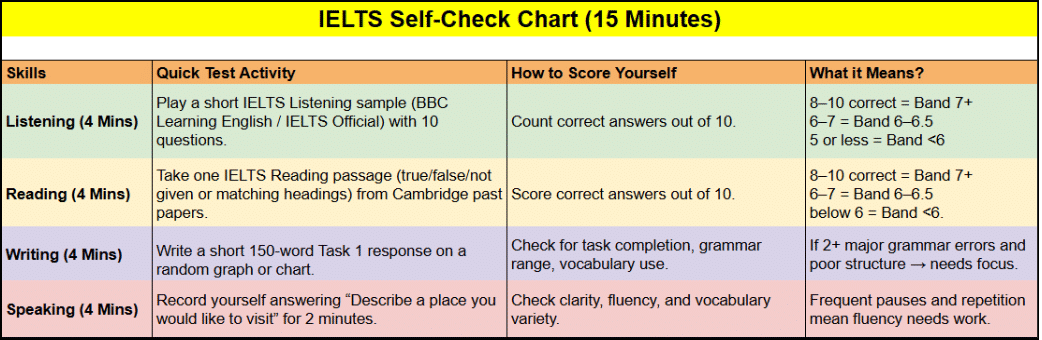
Day 7: Test Day Logistics and Mindset
- Focus: Arriving at the test calm, confident, and ready. Absolutely no last-minute cramming.
- Method: This day is about execution, not preparation. Watch the video below for expert advice on practical and mental readiness.
This video from Adam's English Lessons provides invaluable advice on the mental and logistical preparations for test day.
Watch the final section of the video on mental preparation. The presenter treats the test like a project management exercise, which should align well with your approach. Pay close attention to the tips regarding: What to do the night before (and what not to do). Sleep, nutrition, and managing focus on test day. Logistics: knowing the test center location in advance. Mindset: staying calm and confident.
Conclusion
This brings us to the end of our intensive 30-day course. You have systematically built your skills, practiced diligently, and performed a rigorous analysis of your capabilities. By creating and following this final, targeted revision plan, you are ensuring that your preparation is both efficient and effective, giving you the best possible chance of achieving your Band 7 goal.
Key Takeaways:
- A successful final week is about strategic, targeted practice, not just more volume.
- Your mock test results are data points that must be analyzed to identify high-impact areas for improvement.
- Structure your final days with a mix of intensive skill-building, timed consolidation, and mental preparation.
- Test day success is as much about logistics and mindset as it is about English skills.
You have completed the preparation phase of "Project IELTS Band 7." You have the skills, the strategy, and the analytical mindset to succeed. Go into the test with confidence, execute your plan, and achieve the score you've worked for. Best of luck