Welcome to the final lesson in our module on foundational proof techniques. In our last session, you mastered proof by contradiction, a powerful tool for demonstrating that certain combinatorial arrangements are impossible. We saw how assuming the opposite of a claim can lead to a logical absurdity, providing definitive proof.
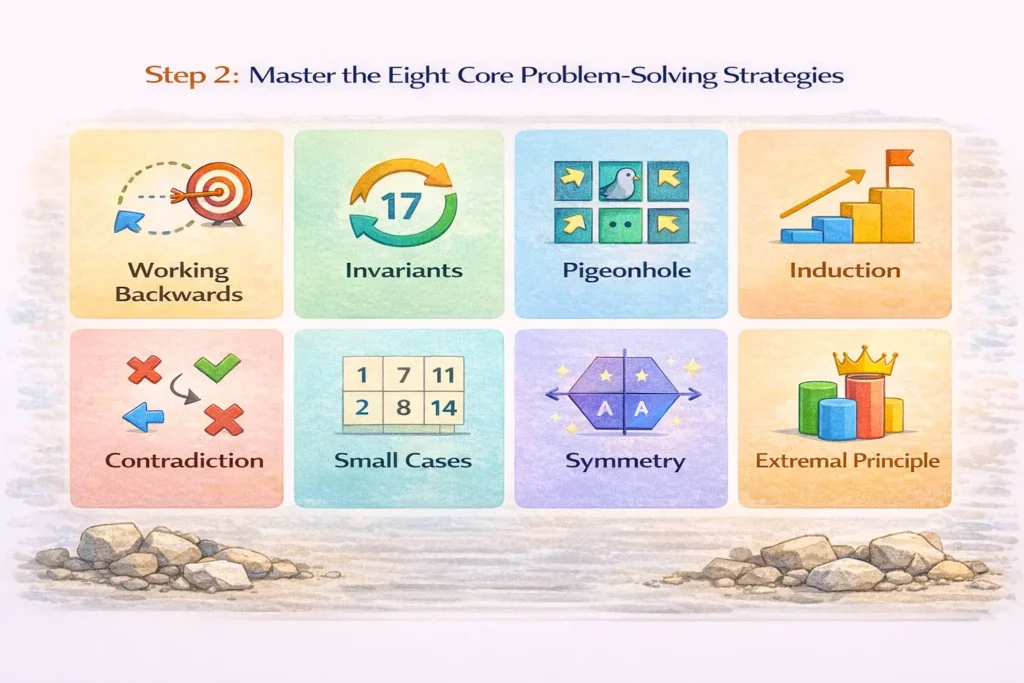
Today, we shift from proving impossibility to actively discovering properties of configurations. We will explore the Extremal Principle, a surprisingly simple yet profound idea that forms the basis of many elegant proofs in combinatorics and geometry. The core concept is to analyze a finite collection of objects by focusing on an object that is "extreme" in some way—the smallest, largest, closest, or simplest. By understanding the properties this special object must have, we can often deduce properties of the entire system. This lesson will equip you to formulate such arguments, a crucial skill for your goal of tackling Olympiad-level problems, especially in combinatorial geometry.
The Heart of the Principle: Look to the Edges
The Extremal Principle leverages a fundamental truth: every non-empty, finite collection of objects that can be ordered has a smallest and a largest element. This might sound obvious, but its application is what makes it powerful. When faced with a complex configuration, instead of getting lost in the multitude of possibilities, we single out an element with an extreme property and see what that implies.
Extremal Principle | Brilliant Math & Science Wiki
This article from Brilliant.org provides a clear definition of the Extremal Principle and highlights some clues for when it might be useful.
Please read the introductory section, starting from the definition up to the start of the examples. Pay close attention to the clues that suggest using this principle, such as distinct values or bounded sets.
The general strategy often combines with proof by contradiction, following a pattern like this:
- To prove a property, assume it's false.
- This assumption implies the existence of a set of "bad" configurations or objects.
- From this set, choose an object that is "extreme" in some sense (e.g., the smallest triangle, the shortest path).
- Show that the properties of this extreme object lead to a contradiction, often by constructing an even "more extreme" object, which is impossible by definition.
Let's see this in action.
A First, Simple Example
Consider this classic introductory problem:
N students are standing in a field such that the distance between each pair is distinct. When a whistle blows, each student throws a ball to the nearest student. Prove that there is at least one pair of students who throw their balls to each other.
The extremal argument is beautifully simple. Consider the pair of students, A and B, who are closest to each other. Since all distances are distinct, this distance is unique and is the minimum of all possible pairwise distances.
- The nearest student to A must be B.
- The nearest student to B must be A.
Therefore, A and B throw their balls to each other. We didn't need to analyze any other students; focusing on the extreme case (the minimum distance) was enough.
A Masterclass in Extremal Arguments: The Sylvester-Gallai Theorem
Now for a deeper, more significant result from combinatorial geometry. The Sylvester-Gallai Theorem states:
For any finite set of points in the plane, not all on a single line, there exists a line that passes through exactly two of the points.
This problem resisted proof for decades, yet the eventual solution is a stunning application of the extremal principle. The following video walks through this elegant proof.
Is there (always) a line that passes through exactly 2 points?
This video by Zach Star provides an exceptionally clear, visual explanation of a proof for the Sylvester-Gallai Theorem.
Please watch the entire video. The key steps are: The problem statement: What are we trying to prove? Setting up the extreme case: The video explains how to order all possible lines by considering the perpendicular distance from each line to the closest point not on that line. This is the crucial extremal property. The contradiction: It is shown that if the line with the minimum such distance contains three or more points, we can always construct a new line with an even smaller distance, a contradiction. The conclusion: Therefore, the line with the minimum distance must contain exactly two points.
This proof is a perfect marriage of the extremal principle and proof by contradiction. The "extreme object" is the pair , where is a line passing through at least two of our points and is a point not on , such that the distance from to is minimized over all such possible pairs. Assuming contains three or more points allows us to construct a new pair with an even smaller distance, which contradicts our initial choice of as the minimum.
Further Applications
The principle's power is its versatility. Let's look at a couple more examples to see its application in different contexts.
Extremal Principle | Brilliant Math & Science Wiki
The same article from Brilliant.org provides several excellent worked examples.
Please read the following two examples from the "Examples" section: Start with the problem titled "2n points are chosen". Here, the extreme object is the configuration of line segments with the minimal total length. The argument shows that this minimal configuration cannot have any crossings. Next, read the problem about the infinite chessboard. This is interesting because the set of squares is infinite. However, since the numbers are positive integers, the Well-Ordering Principle guarantees a smallest integer exists. The argument then shows that its neighbors must all be equal to it, and by extension, all integers on the board are equal.
These examples showcase different ways to define "extreme": minimal total length and a minimal value in an infinite set of integers.
Practice Problems
Now it's your turn to formulate arguments using the extremal principle. For each problem, the first and most important step is to identify what property you want to minimize or maximize.
- Geometric Confinement: Finitely many points are given in the plane. It is known that the distance between any two of them is at most 1, and any triangle formed by three of these points has an obtuse angle. Prove that all the points are contained in some disc of diameter at most 1.
Hint: This is Problem 1 from the resourceA sample class — the Extreme principle. Consider the two points with the largest distance between them. Let this distance be . What can you say about all other points in relation to the circle with diameter connecting these two points?

-
A Curious Set: Let be a finite set of distinct positive real numbers. For every pair of elements (where can be equal to ), the number is also in . Prove that contains at most two elements.
Hint: Let be the largest element in . Consider and for some other element . What does this tell you? -
Rooks on a Chessboard: Rooks are placed on an chessboard. We are told that for any empty square, the total number of rooks in its row and column is at least . Prove that there are at least rooks on the board.
Hint: Consider the row or column with the fewest rooks. Let this minimum number be . What can you deduce about the squares in this row/column? -
The Gas Station Problem: There are identical cars on a circular track, positioned at various gas stations. The total amount of gas in all the stations is just enough for one car to complete a single lap. Show that there is a car which can start with the gas at its station and complete a full lap by picking up gas from the other stations it passes.
Hint: This is a classic, but the extremal argument is tricky. Imagine a "super car" with a huge tank of gas that starts at some station and drives one lap, collecting gas from each station it passes. Consider the point on the track where the amount of gas in its tank was at its minimum. What happens if a regular car starts at that station?
Conclusion
You have now completed our foundational module on proof techniques, adding the powerful Extremal Principle to your toolkit alongside induction and proof by contradiction. This principle encourages a strategic, focused approach to complex problems: instead of trying to understand everything at once, you find an edge, a boundary, an extreme—and use that as your anchor to unravel the entire problem.
Key Takeaways:
- The Core Idea: In any finite, ordered set, there is a minimal and a maximal element. Analyzing these can reveal properties of the whole set.
- Finding the Extreme: The "extreme" property can be distance (closest/furthest), value (smallest/largest), size (area/length), or a more abstract quantity. Choosing the right property is the key.
- Common Proof Structure: The principle often works hand-in-hand with proof by contradiction. Assume a desired property doesn't hold, pick an extreme counterexample, and show that it leads to a contradiction, often by constructing an even more extreme case.
We are now ready to move from the logic of proofs to the art of counting. In the next module, "Core Counting Principles and Bijections," we will begin our deep dive into enumerative combinatorics. You'll learn how to formally apply the sum and product rules and begin solving problems that ask "How many...?" instead of "Is it possible...?"