Hello! Welcome back.
In our last lesson, you created a pleated sample panel, successfully prototyping the "skin" of your bodice. You confirmed how your fashion fabric and underlining work together to create the structured, architectural pleats that are central to your design vision.
Today, we move from the surface to the core structure. A strapless gown relies on an internal framework to support its shape and defy gravity. This framework is called boning. Think of it as the load-bearing skeleton that will support the beautiful pleated facade you've designed. Without it, a strapless bodice would simply collapse.
Your learning outcome for this lesson is to select the appropriate boning type (spiral steel, flat steel) for strapless support. We'll investigate the properties of the two most important types of boning for your project, understand where to use each, and make a clear plan for your dress. Your background in product and industrial design will be very useful here, as we're essentially specifying materials based on their mechanical properties—flexibility versus rigidity—to achieve a functional and elegant result.
1. The "Skeleton": Understanding the Role of Boning
Before we compare types, let's clarify what boning actually does. Boning consists of narrow strips of a rigid or semi-rigid material that are inserted into channels, or "casings," sewn onto the garment's lining or underlining.
Its primary functions are to:
- Provide vertical support: It prevents the bodice from wrinkling, collapsing, or sagging under its own weight.
- Define the shape: It helps the fabric conform to the contours of the body, creating the smooth, sculpted silhouette you want.
- Distribute stress: It transfers the tension of a snug-fitting garment evenly, particularly around the waist and bust.
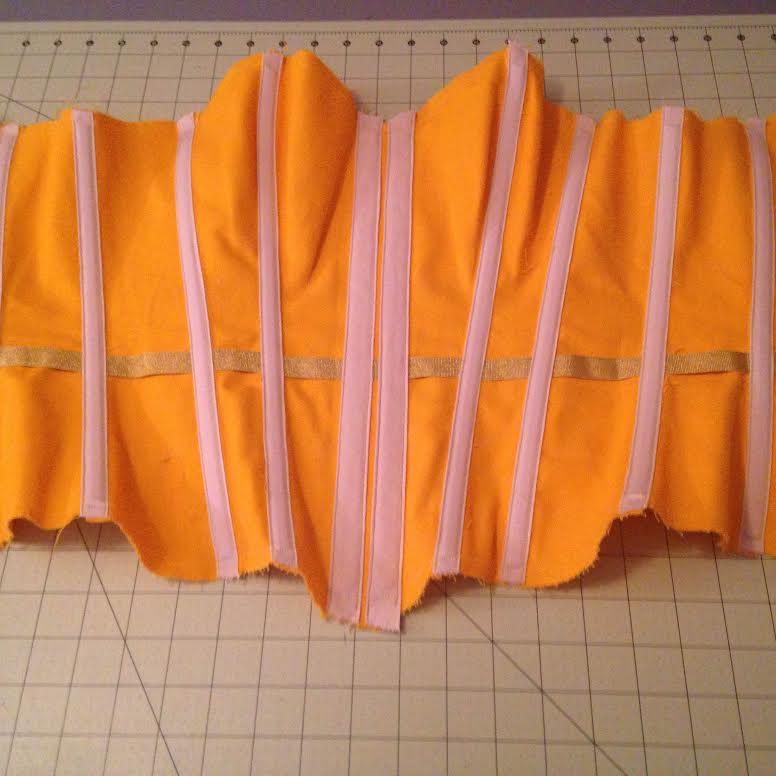
The image below shows the inside of a work-in-progress bodice. You can clearly see the white fabric casings sewn vertically to house the bones, and a horizontal waist stay (the gold ribbon) which works with the boning to anchor the garment. This is the hidden structure you will be creating.
2. The Main Contenders: Flat Steel vs. Spiral Steel
For a high-quality, structured garment like a wedding dress, steel boning is the professional standard. Plastic boning, while common in fast fashion, can warp with body heat and doesn't provide the robust support required. Within steel, there are two key players for your project: Flat Steel and Spiral Steel.
To understand the crucial differences in how they move and function, let's watch a few short, focused video clips.
Intro to Spiral Steel Boning | Lucy's Corsetry
First, watch this segment from Lucy's Corsetry. It provides a very clear, side-by-side visual comparison of how flat steel and spiral steel boning flex.
Watch from 00:51 to 01:21 to see the properties of flat steel boning. Notice it only bends in one direction. Then, watch from 03:20 to 04:05 to see how spiral steel boning moves. Observe its 'four-way' flexibility.
Now, let's deepen that understanding with another perspective that discusses where and why you'd use each one.
WHAT BONES SHOULD YOU USE FOR YOUR CORSET? // Corset Making
This video from Stephanie Rubletz, 'WHAT BONES SHOULD YOU USE FOR YOUR CORSET?', explains the practical applications. Pay close attention to her discussion of rigidity vs. flexibility.
First, watch the section on spiral steel boning from 00:53 to 01:48. Note her comments on using it for movement and over curves. Then, watch the section on flat (sprung) steel boning from 02:29 to 04:27. She gives excellent advice on where to place these for maximum stability, particularly at the back.
From these videos, we can summarize the key differences:
| Feature | Flat Steel Boning (or Sprung Steel) | Spiral Steel Boning |
|---|---|---|
| Material | A single, solid strip of spring steel, usually coated in white nylon to prevent rust. | A flattened coil of steel wires, resembling a tiny, flattened Slinky. |
| Flexibility | One-directional flex. Bends forward and back, but is rigid side-to-side. | Multi-directional flex. Bends forward, back, AND side-to-side. |
| Analogy | Like a ruler. | Like a firm, flat spring. |
| Best For | Areas needing absolute rigidity and straightness, like next to a zipper or lacing. | Areas that need to curve around the body, like side seams or seams over the bust. |
Here is a close-up look at spiral steel boning, showing its coiled construction.

3. A Comprehensive Comparison
You now have a good sense of the two main types. The following chart from CorsetMaking.com is an excellent technical resource that summarizes the properties of these and other boning types. It's a great reference to have.
Boning Information from CorsetMakingSupplies.com
Please read the 'Boning Comparison Chart' from CorsetMaking.com. This will solidify your understanding and serve as a valuable future reference.
Focus on the first two columns in the chart: 'White Steel Boning' (which is flat steel) and 'Spiral Steel Boning'. Compare their listed properties, advantages, disadvantages, and ideal uses. You can skim the other types for context.
As the resources suggest, for a high-quality garment requiring both structure and comfort, you rarely use just one type of boning. You use each type where its specific properties serve the design best.
4. Your Gown's Blueprint: Selecting the Boning
Based on your design—a modern, architectural, strapless bodice with a back zipper—the ideal solution is a hybrid approach.
-
Flat Steel Boning for the Center Back:
- Where: You will place one flat steel bone on each side of your center back zipper.
- Why: The zipper is a point of high tension. The rigidity of flat steel will act like two pillars, keeping the back edge of the bodice perfectly straight and preventing the fabric from buckling or the zipper from warping. This is non-negotiable for a clean, professional finish.
-
Spiral Steel Boning for All Other Seams:
- Where: You will use spiral steel boning in the channels along the front and side seams of the bodice.
- Why: These seams curve around your torso. The flexibility of spiral steel will provide strong support while also bending with your body as you move and breathe. It creates a defined shape without feeling like a rigid cage, offering the perfect blend of structure and comfort for a wedding dress.
This combination leverages the best of both materials, giving you the robust support of a corset with a degree of flexibility and comfort appropriate for an all-day event.
Conclusion
In this lesson, you've moved from the aesthetics of your bodice to its structural engineering. You've learned that selecting the right boning is a process of matching a material's physical properties to a specific function within the garment.
Key Takeaways:
- Steel is the standard for high-quality structured garments like your wedding dress.
- Flat steel boning is rigid and provides stability. Its primary use in your gown will be to support the center back closure.
- Spiral steel boning is flexible and provides support over curves. It is the ideal choice for the front and side seams of your bodice to allow for movement and comfort.
- A hybrid approach, using both types of boning in strategic locations, will yield the most professional and comfortable result.
You now have a clear material specification for your bodice's internal framework. In our next lesson, we will shift our focus to the skirt. As per the syllabus, we will cover how to prepare and cut the delicate silk organza and chiffon for your multi-layered sheer skirt. Later, in Modules 8 and 10, we will return to the bodice to create the boning channels and install the boning you've selected today.