Welcome back! In our previous lesson, we established a high-level map of consistency models, from the strict guarantees of linearizability to the high availability of eventual consistency. We identified causal consistency as a practical middle ground that prevents logical anomalies (like seeing a reply before its original message) without incurring the high costs of total ordering.
Today, we'll move from the what to the how. This lesson fulfills our promise to explore the core mechanisms that make causal consistency possible. We will examine Lamport timestamps and vector clocks, the foundational algorithms for ordering events in a distributed system. A solid grasp of these concepts is essential for discussing system design trade-offs at a senior level, as they represent the fundamental tools for reasoning about causality without a centralized clock.
1. The Trouble with Time
In a single-machine environment, ordering events is trivial; you can rely on the system's high-precision monotonic clock. However, in a distributed system, relying on physical, wall-clock time is fraught with peril. Each machine has its own clock, and even with synchronization protocols like NTP (Network Time Protocol), tiny drifts and unpredictable network latencies make it impossible to know for sure if an event on node A happened "before" an event on node B in real-time.
This is precisely the problem that logical clocks were invented to solve. Instead of measuring physical time, they track the logical progression of events based on cause and effect.
Distributed Systems 4.1: Logical time
To begin, let's watch a brief segment from Martin Kleppmann that clearly articulates this problem and introduces the concept of logical time as the solution.
Watch the first part of the video, from the beginning up to the introduction to logical clocks. Focus on the example of the inconsistent timestamps and why physical clocks fail to capture causality.
The key idea is that we care less about when an event happened in nanoseconds and more about what happened before it. This is the "happens-before" relationship, the cornerstone of causality.
2. Lamport Timestamps: The First Step to Causal Ordering
Leslie Lamport’s seminal 1978 paper introduced the concept of a logical clock, now known as a Lamport timestamp. It's a simple yet powerful way to create a partial ordering of events that is consistent with causality. The mechanism is just a simple counter that each node maintains.
Let's look at the algorithm and its properties.
Distributed Systems 4.1: Logical time
This next segment from the same video explains the Lamport clock algorithm and its properties with a clear example.
Please watch from the section on Lamport clocks. Pay close attention to: The three simple rules for updating the counter. The key guarantee: if event A happens-before B, then its timestamp will be smaller. The example execution trace, which makes the rules concrete. The technique for creating a total order by combining the timestamp with a node ID.
To summarize the algorithm:
- Initialization: Each node initializes a counter to 0.
- Internal Event: Before an event occurs on a node, it increments its counter.
- Send Event: When a node sends a message, it first increments its counter and then includes the new value in the message.
- Receive Event: When a node receives a message, it updates its counter to
max(local_counter, received_counter), and then increments it by one.
The crucial property of Lamport clocks is: If A → B (A happens-before B), then Timestamp(A) < Timestamp(B). This ensures that the causal chain is never broken. If you see a reply to a message, the reply's timestamp will always be greater than the original message's timestamp.
However, Lamport clocks have a significant limitation. If Timestamp(A) < Timestamp(B), it does not necessarily mean A → B. The events could be concurrent. The timestamps alone don't provide enough information to distinguish between a causal relationship and concurrency.
Let's get another perspective from a textual resource that provides a very structured overview.
Clocks and Causality - Ordering Events in Distributed Systems
This article provides a concise breakdown of the Lamport clock mechanism and its deficiencies.
Please read the section titled Lamport Clock. This reinforces the algorithm and explicitly lists the deficiencies, particularly the inability to determine concurrency.
As both resources point out, this ambiguity is a problem. For many applications, especially those needing to detect concurrent updates to data, we need a more powerful tool. This leads us to vector clocks.
3. Vector Clocks: Precisely Capturing Causality
Vector clocks solve the main deficiency of Lamport clocks. They can definitively tell you whether one event happened before another, or if they were concurrent.
Instead of a single counter, each node maintains a vector (an array) of counters, with one entry for every node in the system. The i-th element of the vector at node j represents the latest event counter that node j has seen from node i.
The algorithm is a bit more involved, but it builds on the same principles.
Distributed Systems 4.1: Logical time
Let's return to Martin Kleppmann's lecture, where he introduces vector clocks as the solution to the shortcomings of Lamport clocks.
Watch from the section on vector clocks. Focus on: The structure of the vector timestamp. The rules for updating the vector during local, send, and receive events. The example showing how vectors evolve, and what a vector like [2, 2, 0] actually represents. The rules for comparing two vector timestamps. The "if and only if" property that makes vector clocks so powerful.
The key rules for updating and comparing vector clocks are:
- Initialization: Each node
iinitializes a vector of zeros, e.g.,[0, 0, ..., 0]. - Internal Event: On an event at node
i, it increments its own counter in the vector:VC_i[i]++. - Send Event: Node
ifirst incrementsVC_i[i]and then sends its entire vectorVC_iwith the message. - Receive Event: When node
jreceives a message fromiwith vectorVC_i, it first updates its local vector by taking the element-wise maximum:VC_j[k] = max(VC_j[k], VC_i[k])for allk. Then, it increments its own counter,VC_j[j]++.
The image below shows this process in action.

With vector clocks, we get a much stronger guarantee:
V(A) < V(B)if and only ifA → B.- Events A and B are concurrent if and only if their vectors are incomparable (i.e.,
not(V(A) <= V(B))andnot(V(B) <= V(A))).
This "if and only if" property is what allows a system to algorithmically determine the causal relationship between any two events just by looking at their timestamps.
4. Practical Application: Conflict Detection
This ability to detect concurrency is not just a theoretical curiosity; it's fundamental to how many modern NoSQL databases, like DynamoDB and Riak, handle updates in a highly available, multi-leader, or leaderless environment. You've worked with DynamoDB, so this should connect directly to your experience.
When a client reads a piece of data from such a database, the data comes with a vector clock. When the client later wants to write an update, it sends the new data along with the vector clock it previously read. The database can then use this to see if another concurrent write has happened in the meantime.
Design Key-Value Store - (PART-VI) : Inconsistency Resolution and Vector Clocks😱🤯⚙️
This video provides a practical walkthrough of how vector clocks are used for inconsistency resolution in a key-value store, a scenario directly relevant to your backend experience.
Watch from the main explanation. The audio is in Hindi, but the on-screen diagrams and English text clearly illustrate the sequence of reads, writes, and how the vector clocks evolve to detect a conflict. Focus on how two different clients update the same data, leading to two different vector clocks that are deemed concurrent.
If the database receives a write with a vector clock that is causally "behind" the one it currently has for that data, it's a simple update. But if the received vector clock is concurrent with the stored one, a conflict is detected.
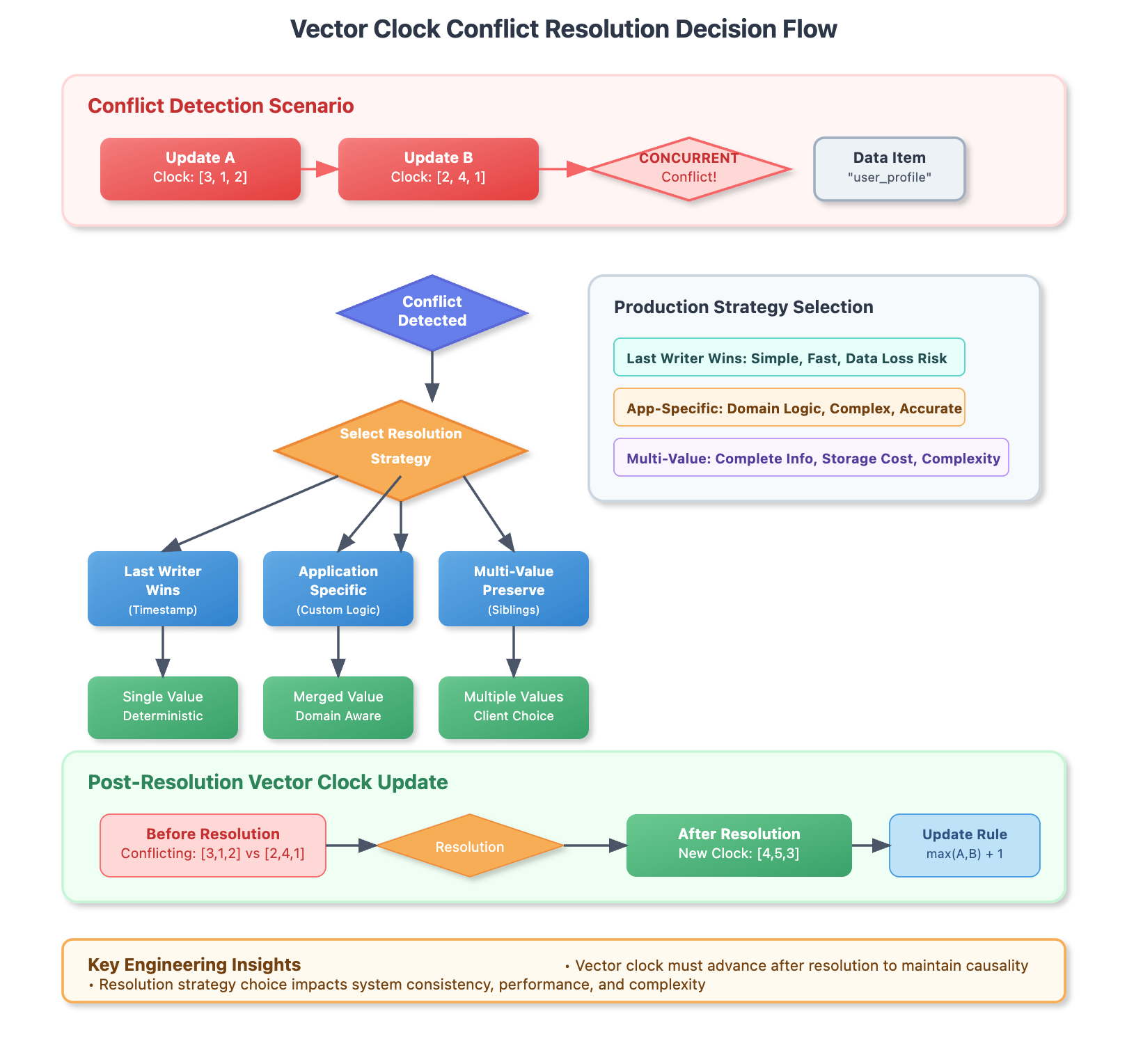
The main trade-off of vector clocks is that the size of the clock grows linearly with the number of nodes (O(N)), which can be an issue in very large or dynamic systems. This is a classic system design trade-off: precision and correctness vs. space and performance overhead.
Conclusion
In this lesson, we demystified the logical clocks that underpin causal consistency. You can now articulate how both Lamport timestamps and vector clocks work, and more importantly, explain their trade-offs for an interview setting.
Key Takeaways:
- Lamport Timestamps are simple counters that provide a partial causal order. If
A → B, thenTimestamp(A) < Timestamp(B). However, they cannot distinguish concurrent events from causally ordered ones based on the timestamps alone. They are space-efficient (O(1)). - Vector Clocks are vectors of counters that provide a complete causal history. They can definitively determine if events are causally related or concurrent.
A → Bif and only ifVectorClock(A) < VectorClock(B). - This precision comes at the cost of space complexity (
O(N)), as the vector size depends on the number of nodes in the system. - In practice, vector clocks are a crucial mechanism for detecting and handling data conflicts in highly available distributed databases.
In our next lesson, we will see how these concepts fit into the broader context of data replication. We will compare single-leader, multi-leader, and leaderless replication architectures, and analyze how each approach uses (or doesn't use) mechanisms like these to manage consistency and availability.